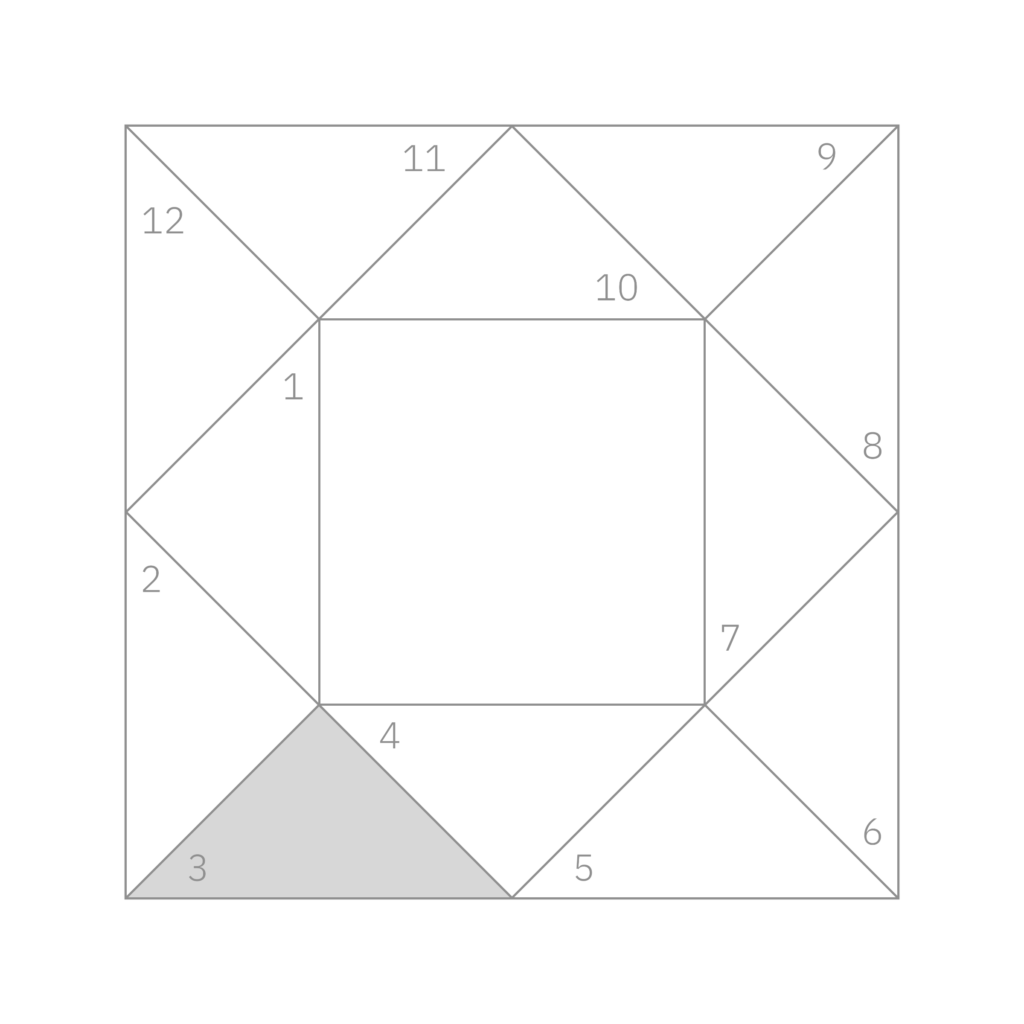
Latin name: Brothers (Fratres).
Greek name: Goddess (θεα — Thea).
Arabic name: House of Brothers (بيت الإخوة — Bayt al-Ikhwah).
House type: cadent (decline).
House of ‘Joy’: for the figures of E Moon (Populus, Via).
House of ‘Sorrow’: for the figures of A Sun (Fortuna Major, Fortuna Minor).
Mundane Planetary Ruler: F Mars.
Direction: north-north-east.
When a child masters basic concepts such as “I am distinct from others” and “mine versus not mine,” he begins taking his first steps toward exploring the surrounding world. The child ventures out of the parental home independently for the first time, discovering new territory—the yard and nearby neighbours—learns to interact with peers, and later enters school to continue this exploration.
The concept of independent movement and exploration of familiar territory has specific meanings:
- the third house indicates short trips, such as to work, for groceries, or along known, psychologically comfortable routes, as well as the road itself;
- the third house reflects neighbors or areas adjacent to one’s home.
The concept of initial communications and learning the laws of this world manifests in:
- the third house governs basic or “lower” communication: phone calls, computer interactions, short messages, regular and electronic letters, driving skills, the internet, advertising, communication hubs, postal offices, and disseminated rumors, gossip, and folk tales (as “lower knowledge” from the people), including PR and political technologies;
- the third house shows basic knowledge (preschool and school curricula) and the places where it is acquired: kindergarten, school, lower grades;
- the third house denotes the querent’s students and classmates.
The first children a child interacts with before venturing into the yard are their siblings, so the third house indicates brothers and sisters (direct, cousins, second cousins).
Key Notes on the Third House
- The third house rules cousins. There is no need to view a cousin as the child of a parent’s sibling; it suffices to take the radical third house, which signifies siblings in general.
- The third house governs the querent’s commutes to work. Even a long commute does not shift to the ninth house. Similarly, visiting a nearby religious shrine remains under the ninth house as a form of pilgrimage, since all religious matters pertain to the ninth house.
- A letter the querent awaits from another person belongs to the ninth house (as the third house from the seventh house).
Common Errors
Third House as the “House of Messengers”
Some ancient astrologers erroneously associated the third house with messengers. In reality, the third house signifies only letters and messages themselves, but not those who deliver them. The delivery of information constitutes a form of service; therefore, all manner of envoys, couriers, and postmen pertain to the house of servants—that is, the sixth house.
However, there is an important nuance here. If the querent asks, “Will the postman come to me today?”, what interests him is, in most cases, not the postman as such, but whether he will receive a letter. In such a case, the question concerns the turned third house. An exception arises if the querent is awaiting a letter from his father (fourth house). In that instance, the father’s letter would be signified by the turned third house from the fourth—that is, the radical sixth house.
Few people know this, but in olden times messengers were assigned to the fifth house, as may be read on the relevant page.
Third House as the “House of Faith and Religion”
When studying the works of medieval astrologers and geomancers, one may notice that they associated faith and religion not only with the ninth house, but also with the third. It is important to consider the historical context: in the Middle Ages, religion permeated every aspect of daily life and was an integral part of society, even for the common people. Consequently, the third house could indeed signify basic, widespread religious knowledge and practices accessible to everyone. In the modern era, circumstances have changed, and all matters pertaining to faith, religion, and spirituality should be interpreted primarily through the ninth house.
Examples of Third House Questions
- Will I get stuck in traffic on my way to work today?
- Will my neighbors stop making noise at night if I ask them?
- Is the rumor true?
- Did N receive my letter?
- Is this school good for my children?
- Will my cousin get married this year?
Quotes on the Third House
As with the ninth house, so it is said of the third that it signifies proximate wisdom, because it is in sextile with the ascending degree. It also signifies brothers, kinsmen, and the like.
A planet in the third house is like a person who comes to visit his brother.
The third house shows all things touching brothers, sisters, cousins, changes, small journeys, kindred, faith, and religion; therefore it is called the Goddess… It rules the shoulders, arms, and hands.
From the third house is judgment given of the querent’s brothers, sisters, kindred, and neighbours; of short or inland journeys; and of removing from one place to another. It also signifies messengers, epistles, and letters, etc. In the parts of man’s body it governs the arms and shoulders.
It signifies brothers, sisters, cousins or kindred, neighbours, small journeys or inland journeys, removing from one place to another, epistles, letters, rumours, and messengers. It rules the shoulders, arms, hands, and fingers.