

Latin Name: Sol.
Greek Name: Helios (Ηλιος — Hēlios).
Arabic Name: ash-Shams (الشمس).
Hebrew Name: Shemesh (שמש).
Alternative Name: the Greater Luminary.
Mundane Houses Ruled: Genitor, Benefacta.
Domicile: e Leo.
Figures: Fortuna Major, Fortuna Minor.
Gender: masculine.
Sect: diurnal.
Qualities: moderately hot and dry.
Element: 🜂 fire.
Powers: vitalizing, energizing, vivifying, illuminating, maturing, and favoring.
Colors: golden, radiant, royal, luminous, and solar colors; pure gold, imperial yellow, golden yellow, deep gold, saffron-gold, amber-gold, scarlet, and imperial purple.
Smells: warm, noble, pleasant, aromatic, resinous, and well-tempered fragrances; strong but not harsh odors, especially saffron-like and balsamic aromas.
Tastes: rich, bittersweet, mildly sweet-spicy, aromatic, warming, and well-tempered tastes; strong but not burning or harsh flavors.
Things: unique, central, royal, golden, luminous, life-giving, vital, noble, honorable, splendid, precious, mature, ripe, nourishing, staple, and solar things; gold, crowns, royal insignia, objects of authority and honor, citrus fruits, ripe fruits, basic daily foods, and all things that either stand above others in dignity or sustain life at its most essential level.
Places: royal courts, seats and residences of supreme authority, throne rooms, audience and reception halls, grand ceremonial halls, award halls, halls of fame, red-carpet venues, public stages of honor and renown, central public squares used for ceremony and proclamation, prominent viewpoints, magnificent clear and well-kept buildings, iconic landmark structures, record-setting towers, and places of authority, recognition, fame, public appearance, ceremony, splendor, and visible excellence.
Weather: clear, bright, warm, dry, seasonable, and sunlit weather; fair skies, healthy daylight, moderate solar heat, dry clear air, and weather proper to the season.
Metals and Materials: gold, fine gold, gilded materials, gold-bearing substances, and all royal, precious, pure, noble, incorruptible, and high-quality materials of supreme value.
Stones: amber, citrine, chrysoberyl, diamond, heliolite, imperial topaz, ruby, rutilated quartz, and golden spinel.
Character: noble, dignified, confident, fearless, cheerful, optimistic, generous, honorable, loyal, truthful, clear-minded, strong-willed, self-possessed, purposeful, direct, steadfast, ambitious, authoritative, and naturally inclined toward leadership, recognition, excellence, public honor, and high position; seeking to stand at the center of affairs, to be seen, respected, acknowledged, and obeyed, and to move forward with clarity, certainty, courage, and command; capable of inspiring confidence, giving strength to others, dispelling gloom, revealing what is hidden, standing for truth, and pursuing a clear and honorable goal; in its harsher expression—proud, arrogant, domineering, self-important, vain, attention-seeking, intolerant of rivals, harsh toward opponents, contemptuous of inferiors, hungry for power, status, wealth, and worldly supremacy, imposing its will on others, judging from above, demanding admiration, overshadowing those nearby, and burning others through excessive force of personality.
Physical Appearance: a large, strong, healthy, and well-composed body; a broad and prominent forehead; a ruddy, golden, saffron, yellowish, or sun-warmed complexion; large, round, bright, clear, sharp, and commanding eyes; fair, yellowish, golden, or light-brown hair with a tendency toward thinning, a receding hairline, or baldness; and a dignified, noble, confident, radiant, and authoritative expression.
People and Professions: sovereigns, monarchs, heads of state, presidents, rulers, princes, high nobility, aristocrats, high magistrates, governors, ministers, ambassadors, courtiers, royal and state officials, chiefs of protocol, ceremonial officers, patrons, heads of families, leaders, founders, chief executives, public representatives, celebrities, stars, award-winners, honored persons, national heroes, and all who stand at the center of authority, dignity, honor, fame, recognition, public visibility, or supreme rank.
Anatomy: the right eye in men and the left eye in women, the heart, vital force, and the head.
Endocrine Gland: the thymus gland.
Diseases: fever, frequent heartbeat, redness of the eye, diseases of the brain, and the diseases of F Mars in a milder form.
Planetary Years: 19 traditional years.
Stage of Life: youth and early adulthood (ages 22–41).
Day of the Week: Sunday.
Night of the Week: the night from Wednesday to Thursday.
Astrological Characteristics of the Sun
Light, Life, and Sovereign Centrality
The Sun is regarded as a diurnal and masculine luminary. Its temperament is moderately hot and dry, and its nature is associated with the element of fire. Among the seven traditional planets, the Sun occupies a unique and sovereign place. It is not merely one wandering body among others, but the visible source of day, light, warmth, vitality, clarity, and manifestation.
For this reason, the Sun naturally signifies kingship, dignity, honor, glory, nobility, supreme rulers, authoritative figures, and everything that stands at the center of visible order. The Sun does not unite separate parts through agreement, as Jupiter does, nor does it subdue resistance by force, as Mars does. It establishes the center by which things become visible and receive position, rank, and direction.
The Sun is also connected with the principle of uniqueness. Yet this uniqueness does not mean strangeness, eccentricity, or mere difference for its own sake. It is the uniqueness of the center. In a well-ordered world there may be many nobles, counselors, warriors, teachers, and servants, but only one supreme light, one king, one throne, and one visible source of daylight order. Thus the Sun signifies what is singular, outstanding, superior, and without equal within its own sphere.
The Solar Symbol: Point and Circle
The symbol of the Sun expresses this nature with unusual clarity: a point at the center of a circle. The central point signifies source, origin, inward power, and the fixed principle from which everything proceeds. The circle signifies the manifestation of that center outwardly: fullness, wholeness, radiance, and the field embraced by its action.
This is essential to the solar principle. The Sun is not a scattered force. Its action begins from the center. It does not spread as chaotic movement, but proceeds from a single point that maintains its place and, by doing so, creates order around itself.
In this sense, the solar circle may be understood as an image of the manifested world, while the central point is the source by which that world receives light, measure, and life. A circle without a point would be an empty form; a point without a circle would remain a hidden origin not yet manifested outwardly. In the Sun, both principles are joined: the inward center and its visible radiance.
The solar principle makes things manifest. What was hidden in darkness becomes visible beneath the light of the Sun. What was immature is brought toward ripeness. What was weak or unformed receives strength, direction, and clarity. For this reason, the Sun is associated not only with authority, but also with truth, sight, honor, clear judgment, and the power to see things as they are.
Moderate Fire and Vital Heat
The fire of the Sun must be distinguished from the fire of Mars. Mars is excessively hot and dry; its heat cuts, burns, inflames, divides, and damages the integrity of form. Solar heat is different: moderate, royal, life-giving, and maturing.
The Sun illuminates and warms, but in its proper measure it does not destroy. It is the fire of the household hearth on which bread and food are prepared; the campfire around which travelers gather for warmth; the lamp that gives light to a house; the solar heat that ripens fruit and dries excessive dampness; the warmth that strengthens the body, raises the spirit, and makes life possible. It is not the fire of conflagration, battle, forge, wound, or fever, but the fire of measure, nourishment, light, and maturation.
For this reason, the Sun signifies vital energy, health, courage, confidence, greatness of spirit, dignity, and the capacity to stand upright in the world. It does not hide, retreat, or act secretly. It appears, shines, reveals, and commands.
Helios, Sight, and the Witness of Truth
In the Greek tradition, the solar principle is expressed above all through the figure of Helios. Helios is not merely a god associated with the Sun; he is the Sun itself as a living and all-seeing luminary. Each day he passes across the heavens in his chariot, illuminating the world from east to west. For this reason, he sees what is hidden from other gods and men.
Helios therefore naturally becomes a witness of oaths and a guardian of visible truth. His light cannot be deceived, just as an object placed beneath clear daylight cannot easily be concealed. Whatever is done beneath the sky falls under the solar gaze.
This mythological quality corresponds deeply to the astrological nature of the Sun. The Sun is connected with sight not by accident: it gives the very possibility of seeing. Yet its sight is not only bodily. It is also the power to distinguish truth, expose falsehood, bring hidden things into the open, and restore things to their proper place within the order of the world.
Apollo and the Purified Solar Image
In later tradition, the solar principle became increasingly associated with Apollo. This should not be understood too crudely, as though Helios and Apollo were originally the same figure. Helios represents first of all the solar luminary itself and its daily course across the sky. Apollo reveals a more purified, spiritual, and cultural aspect of solarity: the light of reason, the clarity of measure, prophetic knowledge, harmony, noble form, and purifying power.
Through Apollo, the solar principle becomes connected with truth, order, music, prophecy, healing, and luminous beauty. Here the Sun appears not only as the physical source of light, but as the force that makes consciousness upright, form noble, speech truthful, and action proportionate.
Yet even this Apollonian light remains strict. It does not dissolve distinctions or soften everything indiscriminately. Solar clarity may heal, but it may also reveal disease; it may elevate, but it may also expose unworthiness; it may grant glory, but it may also make disgrace public.
The Generosity of Light and Royal Outpouring
The Sun is naturally connected with generosity, because its very nature is to radiate. It does not keep light within itself, conceal its warmth, or give life only to the chosen. The Sun shines broadly, openly, and royally, spreading warmth, visibility, and vital force over everything beneath its rays.
This solar generosity differs from Jovian mercy. Jupiter benefits through law, just distribution, counsel, patronage, and wise care. The Sun is generous by the very nature of light. It gives not because it has weighed the merit of each recipient, but because its essence is to shine.
This is the greatness of the Sun, but also its limitation. Such generosity may be universal, majestic, and open, yet not always subtle, intimate, or discriminating. The solar gift is often connected with magnificence, glory, presence, and display, rather than with careful attention to the private needs of each person. In its noble form, this makes the Sun magnanimous and life-giving; in its less perfect form, it may give broadly, brightly, and ceremonially, yet without deep involvement in each individual fate.
Honor, Courage, and Direct Motion
When well-conditioned, the Sun gives nobility, loyalty, truthfulness, courage, generosity, magnanimity, sound judgment, and the ability to govern. It inclines a person toward high aims, the fulfillment of promises, glory, recognition, honor, dignity, and visible position in the world.
The Sun does not delight in pettiness, secrecy, cowardice, or servility. Its nature seeks openness, directness, and clear direction. It wishes to act in such a way that the deed may be seen and acknowledged.
It is especially significant that, within the traditional geocentric order, the Sun is never retrograde. This has deep symbolic importance. The solar principle does not move backward, lose its path, or divide itself into contrary directions. It proceeds forward, giving measure to the day, the year, the seasons, and the rhythm of earthly life itself.
From this arise solar purposefulness, steadfastness, fearlessness, confidence, and the ability to move toward a clear goal. This is not the rash daring of Mars, nor the Jovian hope in a benevolent order. It is the confidence of the center, which knows its place and does not doubt its own strength.
Joy, Optimism, and Victory Over Darkness
The Sun is also naturally connected with joy, cheerfulness, and optimism. This is not superficial amusement or empty pleasantness. Solar joy arises from the very nature of light and life. Where the Sun rises, darkness, cold, fear, and confusion withdraw.
In this sense, the Sun stands as the direct opposite of Saturn. Saturn darkens, restricts, cools, burdens, and reminds life of age, fear, time, and death. The Sun warms, clarifies, vivifies, lifts the spirit, and restores the will to live.
Therefore, in human character the Sun gives not only dignity and authority, but also love of life, inner clarity, the power to inspire others, to dispel gloom, and to affirm the presence of life where things incline toward coldness, fear, and decline.
Fatherhood, Authority, and Royal Presence
In traditional astrology, the Sun is the natural significator of the father especially in diurnal charts; in nocturnal charts this role is more often given to Saturn. Yet in a broader symbolic sense, the Sun retains its connection with the visible paternal principle: authority, protection, name, recognition, position, and central command.
The father in the solar sense is not merely the biological parent, but the figure who gives name, establishes position, represents the lineage, and stands as the center of the household or public structure. Through this image, the Sun signifies not biological origin alone, but manifest authority, dignity, acknowledged status, and the right to stand as visible head.
Likewise, the Sun signifies kings, sovereigns, heads of state, rulers, high officials, noble persons, celebrities, and all who stand at the center of attention, honor, power, or public recognition.
Yet solar authority differs from Jovian authority. Jupiter governs through law, counsel, religion, wisdom, and the harmonizing of many parts into a coherent order. The Sun governs through centrality itself. It is not the counselor beside the throne, but the radiance of the throne itself. Its power is immediate, personal, visible, and sovereign.
In its noble expression, this gives magnanimity, protection, loyalty, generosity, and the power to strengthen others by one’s very presence. A dignified Sun does not merely demand recognition; it also gives light. It raises, inspires, rewards, acknowledges merit, and causes others to aspire toward a higher condition.
Phaethon and the Danger of Unworthy Solar Power
The myth of Phaethon reveals the danger of solar power placed in the hands of one who lacks the maturity, measure, and right to govern it. Phaethon, wishing to prove his descent from Helios, asks to drive the chariot of the Sun. But he cannot hold its course: the horses escape his control, the chariot comes too near the earth, the world begins to burn, and Zeus strikes him down with a thunderbolt.
This myth shows that solar authority requires not only brilliance, but the ability to endure the center. It is not enough to desire glory, recognition, and royal position. One must possess measure, maturity, inward right, and the strength to govern. Otherwise the solar principle becomes not light, but fire.
Phaethon is the image of the immature Sun: the desire to be acknowledged without the ability to rule, the longing for height without corresponding dignity, the claim to divine position without measure. In this sense he reveals one of the deepest dangers of the solar nature: when the need to prove one’s exceptional status becomes stronger than the true ability to bear light.
Pride, Blindness, and the Corruption of the Sun
The corruption of the Sun arises when centrality becomes self-importance, dignity becomes pride, and authority becomes domination. Since the Sun naturally stands above others and is more visible than the rest, its excess easily becomes arrogance, vanity, contempt, and the demand that everything revolve around itself.
In this condition, the Sun gives imperiousness, haughtiness, hunger for glory, love of luxury and status, intolerance of rivals, a tendency to judge others from above, and a painful need for recognition. What should have been honor becomes vanity. What should have been truth becomes self-certainty. What should have been royal magnanimity becomes theatricality, entitlement, and the suppression of others.
Even solar uniqueness becomes dangerous when corrupted. Instead of dignity and self-standing greatness, it turns into the compulsive need to be the only one, the highest one, the unsurpassed one, and the one constantly acknowledged by others. Such a Sun no longer illuminates the world; it demands that the world serve its radiance.
Here appears the danger of excessive solar heat. The same light that reveals truth may also blind; the same warmth that gives life may also scorch; the same authority that protects order may become tyranny.
Therefore the Sun is beneficent when it illuminates, vivifies, matures, elevates, and gives honorable direction. But it becomes dangerous when its royal fire loses measure and turns into pride, blindness, lust for power, and the pursuit of personal supremacy.
Astronomical Characteristics of the Sun
The Center in Both Systems
The astronomical symbolism of the Sun begins with centrality. In modern heliocentric astronomy, the Sun stands at the center of the Solar System: planets, asteroids, comets, and countless smaller bodies are held in their courses by its gravity. In this sense, the solar principle appears almost literally as the power that gathers the surrounding order around itself.
Traditional geocentric cosmology, which remains the natural basis of astrological judgment, also preserves the central meaning of the Sun, though in another way. In the sequence of the seven planetary spheres, the Sun occupies the middle position: three planets lie below it—Moon, Mercury, and Venus—and three above it—Mars, Jupiter, and Saturn. Thus the Sun does not stand at the edge of the planetary order, but in its middle, as the heart of the sequence and the point of balance between the lower and higher spheres.
These two perspectives should not be confused, but neither should they be treated as enemies. Heliocentric astronomy is useful for describing the physical structure of the Solar System. The geocentric perspective remains fundamental to traditional astrology because it describes the heavens as they appear to the earthly observer and preserves the experiential order upon which astrological judgment is built. In both views, the Sun retains central meaning: physical in one, visible, structural, and symbolic in the other.
The Source of Light, Heat, and Life
The Sun is the visible source of light and heat upon which earthly life depends. Without it, the ordinary rhythms of day and night, the seasons, the ripening of plants, the circulation of weather, and the conditions of life on Earth would collapse. For this reason, the ancient connection of the Sun with vitality, spirit, health, clarity, and animation is not arbitrary. The visible Sun truly is the great giver of light and warmth in the world we inhabit.
In this, the Sun differs radically from the planets. The planets shine by reflected light; the Sun shines from itself. Symbolically, this distinction is immense. The Sun does not merely receive and transmit another power. It is a source. It pours light outward from its own nature.
The Sun therefore becomes the natural image of sovereign vitality: not borrowed, derivative, or dependent, but original and radiant. It is not one body illuminated among others, but the luminary by which the others become visible.
Hydrogen, Simplicity, and the Principle of Origin
Modern astronomy shows that the Sun is composed chiefly of hydrogen and helium, with hydrogen as its dominant element. Symbolically, this is especially expressive. Hydrogen is the simplest chemical element, with atomic number one. In the language of symbolic reflection, it naturally corresponds to beginning, unity, simplicity, and the first principle from which more complex structures may arise.
This should not be mistaken for scientific proof of astrological symbolism. It is a meaningful correspondence. The Sun, traditionally understood as the supreme source of light and life in the visible world, is physically sustained by the simplest and most primordial element in the chemical order. The symbolic meaning is clear: solar power begins from unity.
In this respect, the Sun is connected not only with brightness and royal authority, but also with origin. It is the point from which life-giving force proceeds. The astronomical Sun itself appears as the image of a central source whose power unfolds outward and animates the surrounding world.
Fusion and the Creative Transformation of Unity
The Sun produces light and heat through nuclear fusion in its core, where hydrogen is transformed into helium. Symbolically, this process is exceptionally rich. The simplest element does not remain sterile or closed within itself. Under immense pressure and heat, it becomes the source of radiance.
Here one may see a powerful image of solar creativity. Unity does not merely remain one; it gives rise to manifestation. The hidden central fire becomes visible light. The inward core becomes outward warmth. The simple becomes generative.
Helium, with atomic number two, may be symbolically understood as the first emergence of duality from unity. This does not mean that physical chemistry is itself an occult doctrine. But it provides a striking image: from the central unity of hydrogen, through solar fire, arises the energy by which the manifested world is sustained. The Sun may therefore be understood as a natural image of creative emanation: one source whose inward power becomes the light and heat of life.
Radiation and the Outward Movement of Energy
The Sun produces energy in its core, where thermonuclear fusion occurs under enormous pressure and temperature. This energy does not remain sealed within the star. It gradually passes through the inner layers of the Sun and is eventually radiated outward as light and heat.
This marks one of the chief physical differences between the Sun and Saturn. Saturn radiates more heat than it receives from the Sun, but its energy is bound up with slow contraction, inward pressure, and the downward separation of matter. Solar energy has another character: it is born in the central fire and moves outward, becoming visible light and life-giving warmth.
Thus the astronomical Sun is not only a center of mass, but also a center of radiation. It does not merely hold the surrounding order together by gravity; it continually fills that order with light and energy. Its power is not expressed through inward closure, but through continuous outward disclosure.
Symbolically, this corresponds exactly to the solar nature. The Sun exists as a center, but this center does not remain hidden and silent. Its inward force becomes visible through radiance. Unlike Saturnian energy, which arises through compression and heaviness, solar energy unfolds as light, warmth, and vital measure proceeding from a central source.
Gravity, Order, and Sovereign Command
The Sun does not merely shine. Its gravity holds the Solar System together as a single whole, binding planets, comets, asteroids, and smaller bodies within a common structure. Yet here it is important to distinguish the solar principle from the Jovian.
Jupiter also possesses immense gravitational power and organizes a vast field of influence around itself: a system of moons, stable orbital relationships, and many bodies drawn into its order. Yet Jupiter acts within an already existing solar world. It resembles a great ruler, high counselor, judge, or priest within a kingdom: gathering many powers, assigning them their places, and sustaining law, hierarchy, and the ordered life of a particular domain.
The Sun acts differently. It does not create a separate kingdom within the system, but stands as the axis of the system as a whole. Its gravity establishes the general order within which all the planets receive their paths. In political imagery, this is not the authority of a minister, governor, or counselor administering a particular province, but the authority of the king himself, from whom the unity of the realm proceeds. The king does not manage every private detail of government, yet his central position, name, and supreme dignity make possible the common order within which laws, judges, counselors, commanders, and servants all act.
So too the Sun remains the center by which the planetary order exists as one whole. Jupiter organizes and expands a region within that order; the Sun establishes the central structure in which every planet receives its place, distance, path, and measure.
The Photosphere and the Visible Face of Light
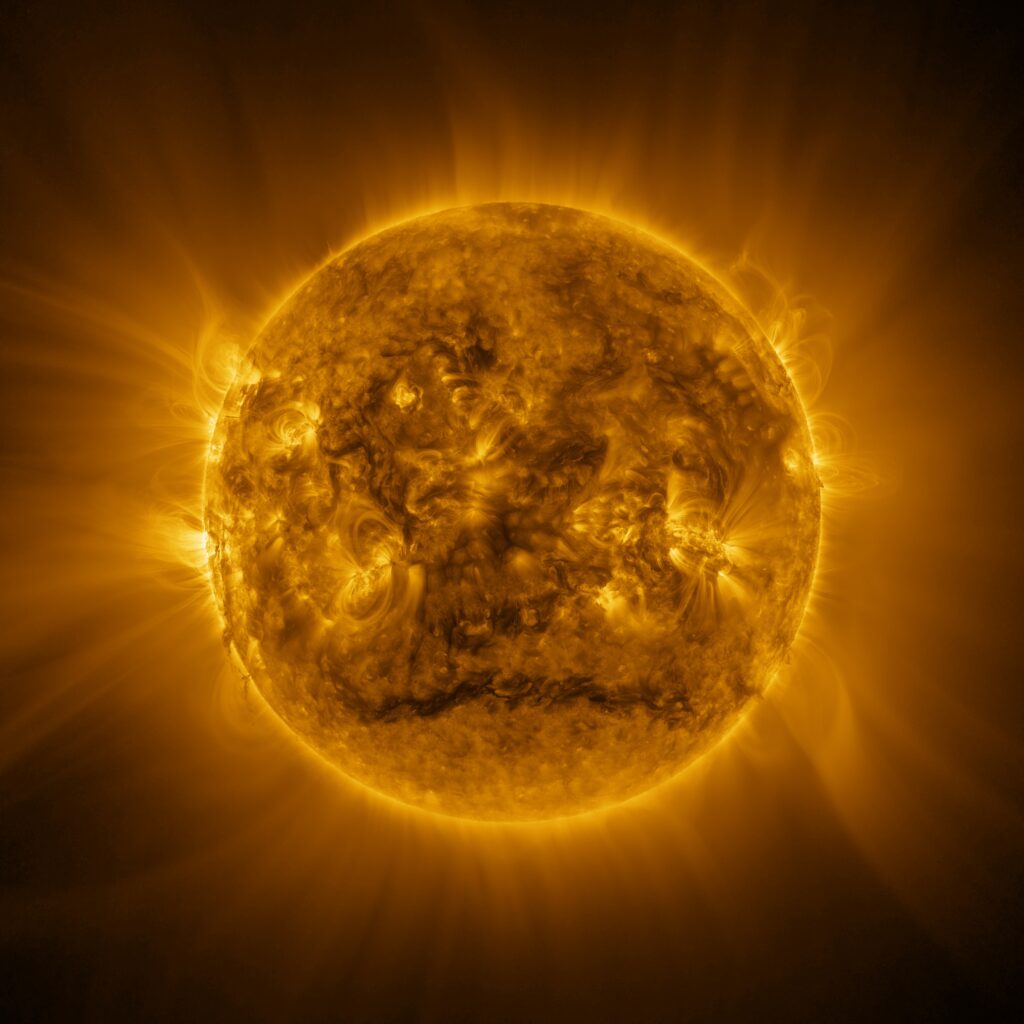
The visible surface of the Sun is called the photosphere. It is not a solid surface in the earthly sense, but the layer from which most visible sunlight reaches us. Symbolically, this is profoundly fitting. The Sun does not present itself as a hard body with a fixed material boundary, like stone or metal. It presents itself as visibility itself: a face made of light.
This corresponds to the solar themes of appearance, honor, glory, recognition, and manifestation. The Sun gives things their visible form, and even its own “surface” is not so much a surface of matter as a surface of radiance. It is the body whose exterior is light.
Here the solar principle appears in its pure form: to be visible, to make visible, and to grant visibility to others. The face of the Sun is not concealment, but disclosure.
The Corona and the Excess of Solar Fire
Around the Sun lies the corona, its outer atmosphere, which becomes visible to the naked eye during a total solar eclipse. One of the striking facts of solar physics is that the corona is far hotter than the visible photosphere beneath it. Symbolically, this may be read with caution, but with real expressive force.
The Sun is not merely a calm lamp in the sky. It is a living, dynamic, immensely powerful star. Its light gives life, but its fire exceeds ordinary measure. Solar force is beneficent when it acts at the proper distance and in the proper order; too near, too intense, or too exposed, it becomes destructive.
This corresponds exactly to the traditional warning about solar excess. The same light that reveals truth may also blind; the same warmth that ripens may also burn. Solar dignity depends upon measure. Without measure, royal fire becomes devouring heat.
Solar Cycles and the Rhythm of Life
The Sun does not signify time as mere duration so much as it makes visible the order of living cycles. Its apparent daily motion establishes the alternation of light and darkness; its annual path through the zodiac reveals the changing seasons, the height of light, the strength of heat, and the order by which earthly life ripens.
Here the solar principle must be distinguished from the Saturnian. Saturn signifies duration, aging, delay, exhaustion, decay, and the final boundary of form. The Sun belongs not to the heaviness of time as such, but to the living rhythm of manifestation: sunrise and sunset, the increase and decrease of light, awakening, growth, fruiting, ripeness, and seasonal fulfillment.
Through the Sun, life receives not an abstract measure of duration, but a visible order of unfolding. The Sun shows when things awaken, grow, appear, ripen, and reach their fullness. This is not the time of death and limit, but the rhythm of light, warmth, and living manifestation.
Sunspots and the Imperfection of Radiance
The Sun is not perfectly still or unchanging. It has cycles of activity, dark spots, flares, eruptions, and storms. These do not abolish its solar nature, but they show that even the greatest visible light has its own rhythms, tensions, and disturbances.
Sunspots are especially expressive symbolically. They appear as dark regions on the solar face, although physically they are comparatively cooler areas of the photosphere associated with magnetic activity. They do not turn the Sun into a dark body, nor do they destroy its nature as the source of light. But they remind us that even the manifestation of light may contain blemish, interruption, and irregularity.
This corresponds well to the traditional understanding of the Sun in dignity and debility. A dignified Sun shines clearly, steadily, and nobly. A corrupted Sun still seeks visibility and centrality, but its radiance becomes marked by pride, blindness, excess, or inward disturbance. The spots do not negate the Sun; they reveal the possibility of imperfection within brightness.
The Living Heart of the Planetary Order
Taken as a whole, the astronomical Sun confirms the traditional image of the Greater Luminary. It is central in the physical structure of the Solar System and central in the symbolic order of the seven traditional planets. It gives light, heat, visibility, measure, vitality, and rhythm. It holds the planets within a single gravitational field and makes their visible appearance possible.
The Sun is therefore not merely a bright object in the heavens. It is the living heart of the planetary order: the source from which light proceeds, the center around which the system is arranged, and the force by which life on Earth receives warmth, direction, and rhythmic measure.
Its astronomy does not reduce its symbolism. It deepens it. The Sun is the visible image of central life: unity radiating into multiplicity, hidden fire becoming manifest light, and sovereign power sustaining the world not by secrecy or violence, but by presence, radiance, and measure.
Medical Characteristics of the Sun
Sunlight and the Life of the Body
In medical symbolism, the Sun is first of all connected with vital force. This is not merely poetic language. Sunlight awakens the body, warms it, supports alertness, and helps it distinguish day from night, activity from rest, and outward action from restoration.
For this reason, solar medicine does not begin with a drug, but with light itself. The Sun touches the skin, the eyes, the bones, the immune system, the mood, and the whole rhythm of bodily life. It does not act as a narrow remedy for one isolated condition. It acts more like a sovereign principle of vitality—broad, ordering, warming, and life-giving.
Vitamin D3 as the Newly Revealed Solar Essence
It is worth speaking at length about vitamin D3 because it is one of the clearest modern discoveries of the Sun’s medical action in the body. Traditional medicine knew the solar power through gold, saffron, amber, warm resins, and other noble solar substances. Gold in particular was treated as the supreme mineral image of the Sun: incorruptible, radiant, royal, and life-giving.
But traditional medicine did not know vitamin D3. Modern photobiology has revealed something even more direct: a substance born from sunlight touching the skin. D3 is not merely a symbolic solar material. It is a bodily carrier of solar action.
Although called a vitamin, D3 behaves more like a hormone-like signal. Under UVB light, the skin begins the process by which D3 is formed. It then passes through further transformations in the body and becomes part of a wider regulatory system. In this way, light becomes substance; substance becomes signal; signal becomes order.
This is why D3 is so profoundly solar. It shows the Sun entering the body not as metaphor alone, but as a real chain of light, skin, chemistry, and regulation.
The Solar Center and Its Helpers
The Sun is unique. It is one, yet the whole planetary order is arranged around it. But this does not make the other planets unnecessary. On the contrary, each receives its place and helps the total order unfold.
Vitamin D3 works in a similar way. It stands at the center of solar medicine, but it does not work alone. It needs helpers. Magnesium supports the body’s use and metabolism of vitamin D. Vitamin K2 works beside D3 in the calcium order: D3 helps bring calcium into use, while K2 helps direct calcium toward the right places, especially bones and teeth. Fats and bile also matter, because D3 is fat-soluble and must be properly absorbed.
Here the solar analogy becomes very clear. D3 is like a royal solar command, but magnesium, K2, fats, bile, and other nutrients are like ministers, officers, and servants through whom the royal command becomes practical order in the body. The Sun establishes the center; the surrounding powers help that center become effective.
Bones, Teeth, and Living Form
D3 is especially important for bones and teeth because it helps the body use calcium and phosphorus. But it should not be reduced to a simple “bone vitamin.” Bones give the body form, support, and stability. D3 helps that form remain living, nourished, and strong.
Here we must distinguish the Sun from Saturn. Bones themselves have a Saturnian quality: hardness, dryness, boundary, and structure. But living bone strength is not Saturn alone. Saturn gives form and limit; the Sun gives that form vitality, mineral fullness, and living firmness.
D3 therefore reveals the solar side of bone. It is not dead hardness, but illuminated structure—a form held in life.
Immunity and the Inner Kingdom
D3 is closely connected with immune regulation. This is symbolically important, because immunity is not only war against an external enemy. A healthy immune system must distinguish self from non-self, defend the body, and avoid turning its own force against its own tissues.
This is a solar function. Mars attacks. Saturn restricts. The Sun governs. Its action is not like a sword simply cutting down an enemy, but like a king preserving order inside the realm.
This is why the connection between D3 and autoimmune conditions is so expressive. In autoimmunity, the body loses proper recognition and begins to attack itself. The inner kingdom falls into confusion. D3 should not be presented as a miracle cure, but its regulating role fits the solar principle beautifully: restore distinction, measure, and agreement within the living whole.
Against Saturnian Darkness
The Sun traditionally stands opposite Saturn: light against darkness, warmth against cold, joy against melancholy, vitality against heaviness and inward contraction. For this reason, the connection of sunlight and D3 with mood is especially meaningful.
Depression is deeply Saturnian in image: heaviness, coldness, loss of movement, lack of joy, an inward winter of the soul. D3 should not be treated as a magical cure for sadness, but its relationship with light, mood, bodily rhythm, and vitality makes it a clear physical image of solar medicine.
The solar principle does not merely “stimulate.” It restores brightness, rhythm, orientation, and the body’s capacity to turn again toward life.
Cell Order and Self-Devouring Growth
Another profound parallel appears in the subject of malignant growth. It would be crude and false to say that D3 “cures cancer.” But modern research does discuss vitamin D in relation to cell regulation, immune function, cell differentiation, and some cancer outcomes.
Symbolically, cancer can be read as a dark distortion of Saturnian matter. A part of the body separates from the order of the whole, begins to live for itself, grows without measure, and consumes the strength of the organism. It is growth without a center, increase without rightful order, a form of bodily self-devouring.
The solar principle acts differently. It restores center, measure, and the subordination of the part to the whole. In this sense, D3 can be understood as one bodily bearer of solar measure—not a Martial weapon that simply attacks, but a solar signal that helps the living kingdom remember order.
Lanolin, Sheep’s Wool, and Solar Substance
There is also a beautiful natural detail: much supplemental D3 is produced from lanolin, a waxy substance obtained from sheep’s wool. Lanolin protects the fleece, keeps it soft, and helps shield it from the outer world.
Symbolically this is striking. Sheep and rams carry a strong solar and fiery signature: white fleece, warmth, pasture, spring, Aries, the opening of the zodiacal year, and the awakening of life. Wool holds warmth and protects the animal body.
So the lanolin origin of D3 forms a rare natural correspondence. A solar vitamin connected with light, skin, warmth, and vitality is obtained from a substance that coats and protects the body of an animal marked by spring and fire. This is not proof of astrology, but it is an elegant correspondence within the solar pattern.
Skin, Sight, and Clarity of Spirit
The skin and the eyes are central to solar medicine. The skin receives light and warmth; the eyes make vision possible. Through the skin, sunlight helps initiate D3 formation. Through the eyes, light helps the body recognize day and night, wakefulness and rest.
The Sun’s traditional connection with sight is therefore not accidental. The eye does not make the world visible by itself. It needs light. Solar medicine is therefore also the medicine of clarity: seeing, waking, orienting, and standing more fully in the visible world.
When the body lacks light, it more easily turns toward heaviness. Mood darkens, rhythm weakens, and vitality contracts. Sunlight restores manifestation: things become visible again, the day regains form, and the body remembers its place under the order of heaven.
The Sun and the Living Fabric of the World
Solar medicine is not limited to the human body. Plants depend on sunlight for photosynthesis, through which light becomes the nourishment of the living world. Through plants, solar force enters food chains, supports animals and human beings, fills the biosphere with oxygen, and makes most visible life on Earth possible.
In plants, sunlight becomes food. In animals, it becomes warmth, rhythm, sight, metabolism, and vitality. In the human body, it becomes alertness, clarity, D3, mineral strength, immune measure, and inner order.
The Sun as Physician of Vital Force
Medically, the Sun may be called the physician of vital force. It does not heal by cold retention, as Saturn does, nor by sharp attack, as Mars does, nor by softening and reconciliation, as Venus does. Its medicine works through light, warmth, wakefulness, vision, rhythm, D3, mineral order, immune measure, and inward clarification.
The Sun reconnects the body with the visible order of the world. It reminds the organism when to wake and when to rest, when to grow and when to ripen, when to open outward and when to return to recovery.
Thus the medical nature of the Sun is not one remedy and not one function. It is a whole field of vital governance. The Sun vivifies, warms, strengthens, clarifies, regulates, and brings the body toward the manifest fullness of life.