

Greek Names:
- Αφροδιτη — Aphroditē: Aphrodite;
- Εωσφορος — Eōsphoros: the Dawn-Bringer;
- Φωσφορος — Phōsphoros: the Light-Bringer;
- Εσπερος — Hesperos: the Evening Star.
Arabic Name: az-Zuhara (الزهرة).
Hebrew Name: Nogah (נוגה).
Alternative Names: the Lesser Benefic · the Morning Star · the Evening Star.
Mundane Houses Ruled: Nati, Carcer.
Figures: Amissio, Puella, Caput Draconis.
Gender: feminine.
Sect: nocturnal.
Qualities: moderately cold and moist.
Element: 🜄 water.
Powers: attractive, receptive, unitive, softening, relaxing, harmonizing, beautifying, and procreative.
Colors: soft, pale, softly luminous, clean, fresh, greenish, and delicately rose-colored tones; pure white, milky white, ivory-white, pale cream, pale straw-yellow, soft green, fresh green, pale green, greenish-white, rose-white, and pale rose.
Smells: sweet, fragrant, aromatic, floral, perfumed, oily-rich, musky, amber-like, balsamic, sensually pleasing, and desire-awakening odors; the scents of roses, violets, myrtle, sweet flowers, fine perfumes, scented oils, ambergris, musk, sweet resins, ripe fragrant fruits, warm skin, and all aromas that delight the senses without harshness, foulness, smoke, or corruption.
Tastes: pleasant, sweet, luscious, rich, unctuous, oily-rich, smooth, mellow, softly savory, mouth-filling, and highly delectable tastes.
Things: soft, smooth, beautiful, graceful, charming, pleasant, fragrant, perfumed, sweet, luscious, sensual, amorous, artistic, musical, decorative, ornamental, neat, well-groomed, attractive, pleasure-giving, relaxing, harmonizing, and beautifying things; flowers, roses, violets, myrtle, garlands, perfumes, scented oils, cosmetics, cosmetic mirrors, combs, ornaments, jewelry, pearl ornaments, fine clothes, soft fabrics, silk, beds and couches of pleasure or love, musical instruments, songs, works of art, pictures, colors, love tokens, delicacies, sweet foods, soft sweet fruits, ripe pleasant fruits, and all things made for beauty, adornment, affection, sensual delight, or pleasant union.
Places: gardens, flower gardens, green meadows, decorative fountains, bridal chambers, boudoirs, private rooms prepared for intimacy, houses of sexual pleasure, dressing and cosmetic rooms, perfumeries, beauty salons, spas and bathhouses, music rooms and concert halls, dance halls and schools, theatres and cinemas, cafés and restaurants, lounges, karaoke rooms and nightclubs, amusement parks, bowling alleys and arcades, wedding halls, art galleries, and all places made chiefly for beauty, adornment, pleasure, courtship, marriage, music, dancing, sensual delight, amusement, relaxation, reconciliation, and pleasant union.
Weather: mild, serene, clear, moist, gently damp, and pleasantly refreshing weather; clear skies in warm seasons, rain in cold seasons, light snow in winter, gentle rain, soft damp air, and weather that pleases the senses and relieves dryness without harsh wind, storm, oppressive heat, severe cold, darkness, stagnation, or corruption.
Metals and Materials: copper, brass, latten, decorative copper alloys, lustrous soft fabrics, ornamental textiles, lacework, aromatic oils, floral essences, sweet perfumery resins, animalic aromatic substances used in perfumery, soft cosmetic waxes, emollient oils, cosmetic pigments, cosmetic dyes, and all soft, smooth, lustrous, fragrant, decorative, ornamental, sensual, and beautifying materials.
Stones: chrysoprase, dioptase, emerald, nephrite, jadeite, rose quartz, green aventurine, prase, amazonite, watermelon tourmaline, serpentine (with E Moon and F Mars), chrysocolla (with B Mercury), malachite (with B Mercury), azurite (with B Mercury and K Jupiter), peridot (with F Mars), thulite (with F Mars), rhodochrosite (with F Mars), and opal (with B Mercury).
Character: affectionate, gentle, receptive, graceful, charming, cheerful, sociable, peaceable, sensual, tasteful, artistic, musical, well-groomed, pleasure-loving, and naturally inclined toward beauty, adornment, love, friendship, harmony, amusement, bodily pleasure, and pleasant union; seeking ease, affection, attraction, reconciliation, and the softening of tension through charm, tact, beauty, desire, and shared pleasure; in its harsher expression—self-indulgent, comfort-seeking, idle, frivolous, coquettish, approval-seeking, conflict-avoidant, overly yielding, indecisive, superficial, careless with money for the sake of pleasure or adornment, unstable in attachments, jealous or possessive in love, and prone to sensual excess, bad company, loss of reputation, and the weakening of discipline through pleasure.
Physical Appearance: a naturally beautiful, graceful, well-proportioned, softly formed, and attractive body; smooth, pleasing, and harmonious features; bright, soft, and charming eyes; a pleasant mouth and lips; abundant or well-kept hair; and a neat, tasteful, well-groomed, and pleasing appearance.
People and Professions: women, young women, brides, wives, lovers, courtesans, prostitutes, singers, musicians, dancers, actors, performers, entertainers, artists, painters, illustrators, decorators, designers, fashion designers, dressmakers, seamstresses, embroiderers, silk workers, fine-fabric workers, drapers of fine cloth, jewelers, lapidaries, makers of ornaments, perfumers, makers of cosmetics, makeup artists, hairdressers, beauticians, florists, wedding workers, and all who are concerned with beauty, adornment, music, dance, pleasure, courtship, marriage, sensual attraction, fine clothing, perfume, cosmetics, ornaments, entertainment, or the making of things pleasing to the senses.
Anatomy: the female genital organs, the kidneys, the throat, and the left nostril.
Endocrine Gland: the pancreas, especially the pancreatic islets.
Diseases: urinary problems, obstruction of the airways, and diseases of the genital organs and kidneys.
Planetary Years: 8 traditional years; astronomical orbital cycle ~224.7 days.
Stage of Life: adolescence (ages 14–22).
Day of the Week: Friday.
Night of the Week: the night from Monday to Tuesday.
Astrological Characteristics of Venus
Beauty, Pleasure, and Pleasant Union
Venus is regarded as a nocturnal and feminine planet. In the stricter traditional scheme followed here, her temperament is moderately cold and moist, and her nature belongs primarily to the element of water. In traditional astrology she is known as the Lesser Benefic.
This title must be understood precisely. Venus is benefic, but not in the same manner as Jupiter. Jupiter benefits through order, law, wisdom, protection, abundance, and right measure. Venus benefits in another way: she makes things pleasant, gentle, beautiful, attractive, and capable of union.
Her good is not chiefly the good of authority, law, rank, or high dignity. It is the good of love, friendship, pleasure, beauty, music, bodily delight, adornment, peace, tenderness, and pleasant social exchange.
Venus softens the harshness of life. She does not overcome resistance by force, as Mars does; she does not command from the center, as the Sun does; she does not govern through law and judgment, as Jupiter does. She attracts, disposes, adorns, calms, and unites.
Yet this Venusian union must not be confused with the conjunction of Mercury. Mercury connects things through signs, roads, messages, contracts, exchanges, keys, and mediation. Venus unites through attraction, pleasure, sympathy, beauty, softness, and desire. Mercury makes contact possible; Venus makes union desirable.
Her power works through charm, desire, attractiveness, tact, affection, and the promise of pleasure.
For this reason Venus naturally signifies love, friendship, courtship, marriage, sexual union, beauty, ornaments, music, dance, pleasant speech, perfumes, fine clothing, games, amusement, and everything that makes life agreeable to the senses.
Cold Moisture and the Softening of Resistance
The coldness of Venus is not the coldness of Saturn. Saturn cools through deprivation, fear, isolation, old age, and the hardening of form. Venus cools in another way: she soothes excessive heat, relaxes tension, and softens roughness.
Her moisture is not merely lunar water or formless bodily fluid. It is the moisture by which things become soft, receptive, pleasant, fertile, and capable of mingling with one another.
This is why Venus is the natural opposite of Mars. Mars cuts, burns, pierces, inflames, separates, and drives matters into acute crisis. Venus attracts, receives, unites, softens, reconciles, and makes union desirable.
Mars breaks agreement through quarrel and rupture. Venus restores agreement through affection, pleasure, and the desire for peace. What Mars takes by force, Venus obtains through attraction. What Mars severs, Venus joins. What Mars expels, Venus relaxes and releases.
Here lies one of the subtler sides of Venus: she not only joins, but also weakens rigid attachment. She makes a person able to yield, give, spend, forgive, release, and cease struggling. For this reason Venusian loss is not always destruction. Sometimes it is liberation from tension, the ending of hostility, the passing of illness, the release from a harmful bond, or the gentle conclusion of something that has become burdensome.
Saturn preserves by holding. Mars ends by cutting. Venus ends by relaxing attachment.
Aphrodite and the Power of Desire
The mythology of Aphrodite reveals the deeper nature of Venus. Aphrodite is born from the sea foam that arose after the severing of Uranus’s generative power. In this image, water, foam, seed, sexual force, beauty, and birth are joined together. Venus does not arise from dry law, martial violence, or solar command, but from a moist, bodily, and generative principle.
This is an unusually precise image of the planet. Venus transforms crude sexual force into beauty, desire, attractiveness, and union. In her, the body is not merely biological matter, but an object of love, pleasure, adornment, and attraction.
The connection between Aphrodite and Ares is also far from accidental. In myth and art they often appear together as opposite yet mutually attracted powers. Ares signifies heat, conflict, penetration, blood, and rupture. Aphrodite signifies desire, receptivity, pleasure, softness, and union.
Venus does not destroy Mars directly. She disarms him. She does not break tension by violence, but relaxes it. She does not defeat force by force, but makes peace, love, and pleasure more desirable than struggle.
Love, Friendship, and Reconciliation
Venus governs love in both its bodily and social forms. She signifies affection, sympathy, friendship, attraction, erotic desire, sexual pleasure, courtship, and marriage.
Her nature inclines toward agreement. Where Mars readily enters opposition, and Saturn suspects, withdraws, and separates, Venus seeks closeness, pleasantness, and mutual enjoyment. She prefers peace to conflict, yielding to harshness, and pleasant union to dry separation.
For this reason Venus is important not only in romantic matters. She acts in friendship, agreements, reconciliation, hospitality, festivals, shared leisure, art, music, entertainment, and all situations in which people are brought together not by duty or fear, but because it is pleasant to be together.
Art, Music, and Adornment
Venus is the planet of art, music, and adornment. Her creativity is not solar, for the Sun creates from central vitality and light. It is not Jovian, for Jupiter grows, expands, and orders. It is not Mercurial, for Mercury invents, connects signs, and plays with intelligence.
Venus creates in another manner: she harmonizes, adorns, softens, arranges parts into pleasing form, and makes them desirable to the senses.
Music belongs to Venus because it joins separate sounds into harmony. Dance belongs to Venus because it makes bodily movement rhythmic, pleasant, and attractive. Clothing, cosmetics, perfumes, ornaments, painting, design, and decoration belong to Venus whenever their purpose is beauty, pleasure, attractiveness, or bodily and social adornment.
Venus does not merely place decoration upon a thing from outside. She shows how form becomes lovable: through proportion, softness, color, fragrance, touch, rhythm, and pleasantness.
Pleasure, Idleness, and the Corruption of Venus
The corruption of Venus arises when pleasure loses measure. Since her nature seeks pleasantness, beauty, ease, attractiveness, bodily delight, and peace, her weaknesses do not arise from cruelty, but from softness without discipline.
The principal vice of a corrupted Venus is idleness. This is not the heavy Saturnian immobility that comes from fear, coldness, and melancholy. It is the sweet idleness of pleasure: the unwillingness to exert oneself, endure what is unpleasant, enter a difficult conversation, keep measure, suffer deprivation, or do what brings no immediate delight.
In this sense, idleness may rightly be called the mother of many vices. From it comes wastefulness, because pleasure demands expense. From it comes leisure without purpose, because ease becomes more important than work. From it comes softness of character, because a person grows accustomed to comfort and loses the ability to endure difficulty. From it comes superficiality, because what is beautiful and pleasant begins to seem more important than what is true and necessary.
The desire to be liked may become dependence on approval, coquetry, and manipulation through attractiveness. The desire for peace may become avoidance of necessary conflict. Sensuality may become excess in food, sex, comfort, and adornment. Attachment may become jealousy and possessiveness. The ability to let go may become carelessness, infidelity, instability, and an inability to remain faithful to anything that requires effort.
When corrupted, Venus makes a person spoiled by comfort, weak before pleasure, unstable in attachments, careless with money for the sake of enjoyment, inclined toward bad company, sexual looseness, loss of reputation, and the weakening of the will through pleasantness.
Yet these corruptions do not negate the benefic nature of Venus. They show what happens when softness ceases to be governed by measure. In her good condition, Venus beautifies life, softens roughness, reconciles division, refreshes the senses, joins bodies and hearts through love, makes art beautiful, speech pleasant, and human life more desirable and more capable of joy.
Venus and the Demonization of Desire
When reading medieval sources on Venus, it is important to distinguish the planet’s own nature from the moral and religious anxieties of the age. In the traditional astrological system itself, Venus is the Lesser Benefic. Her nature is soft, moist, pleasant, unifying, and beautifying. She signifies love, beauty, music, pleasure, peace, marriage, sensual attraction, and the power by which life becomes desirable.
Yet in parts of medieval Christian culture, Venusian themes were often viewed through the lens of sin, temptation, and bodily danger. Female beauty, adornment, sexual desire, idleness, music, games, and pleasure could be described not simply as natural expressions of Venus, but as occasions for moral fall. In this way, the astrological nature of the planet was often mixed with the moral unease of the period.
The image of the Morning Star is especially revealing. The Latin word Lucifer originally means “light-bringer” and may refer to Venus as the morning star. But in Christian tradition, the same name became associated with the fallen angel. Thus a bright planet announcing the dawn acquired a later demonic shadow—one that belongs more to religious interpretation than to the essential nature of Venus herself.
Religious polemic may also have intensified this suspicion. Friday, the day of Venus, became associated with Islam as the day of communal prayer, and in Christian-Muslim disputes this could add another layer of mistrust to Venusian symbolism. Such associations reveal more about the fears, conflicts, and prejudices of a given age than about the planet itself.
For this reason, Venus should not be judged only by her medieval moral shadow. Her vices are real: idleness, sexual looseness, wastefulness, excess pleasure, bad company, and the weakening of discipline. But these are corruptions of Venus, not her essence.
In her pure nature, Venus is not an evil planet. She softens harshness, joins what is divided, adorns form, awakens love, makes speech pleasant, art beautiful, the body desirable, and human life more capable of joy.
Astronomical Characteristics of Venus
The Morning Star and the Evening Star
The astronomical symbolism of Venus begins with her position between the Earth and the Sun. Because Venus orbits inside the orbit of the Earth, she never appears far from the Sun in the sky. From our point of view, she is seen either shortly before sunrise as the Morning Star, or shortly after sunset as the Evening Star.
This is why ancient peoples could at first regard Venus as two different lights. The Greeks called the morning Venus Eōsphoros or Phōsphoros, the Dawn-Bringer or Light-Bringer, and the evening Venus Hesperos, the Evening Star. Later, these were understood to be one and the same celestial body, but the double appearance remained central to the imagination of Venus.
Venus does not rule the full day as the Sun does, nor does she belong to the deep night as the Moon does. She appears at thresholds: dawn and dusk, light and darkness, waking and rest, the public life of day and the more private life of evening.
As the Morning Star, Venus announces the coming of the Sun. As the Evening Star, she remains after sunset, preserving something of the day’s light after the Sun has gone. In both forms she is not the source of light, but its beautiful herald. She does not shine by solar authority from within herself; she receives, reflects, and returns light in a particularly pleasing form.
Brightness, Reflection, and the Veiled Surface
Venus is the brightest planet in the sky and the brightest natural object after the Sun and the Moon. This extraordinary brilliance explains why her morning form could be called Phōsphoros, the Light-Bringer: she appears before the Sun and seems to carry the first sign of the coming day.
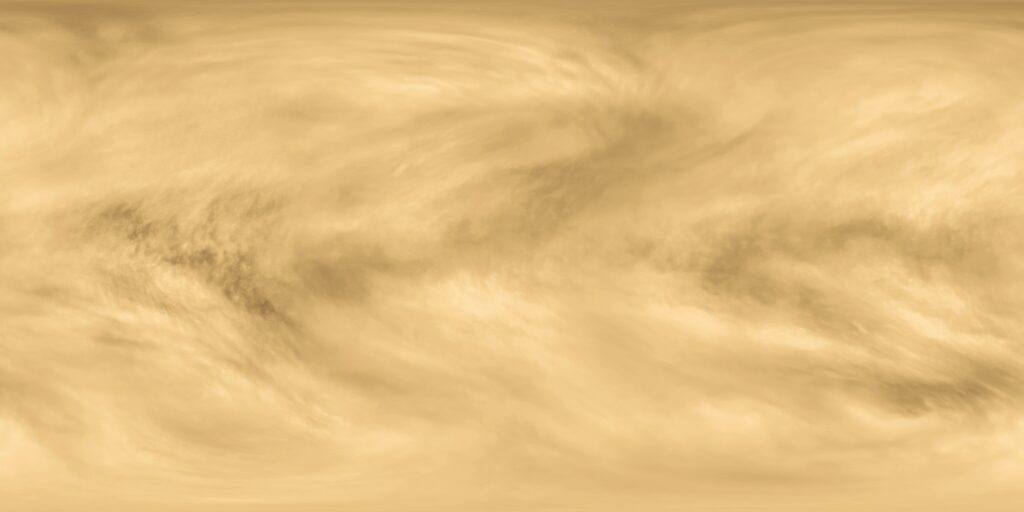
But the light of Venus is not her own solar fire. She shines by reflected sunlight. Her dense cloud cover reflects sunlight so effectively that Venus becomes visible in twilight and, under the right conditions, even in daylight.
Symbolically, this distinction is essential. Venus is not a source of light in the solar sense; she is a beautiful reflector of light. She receives radiance, softens it, and returns it in an attractive form. Her beauty is therefore not sovereign and commanding like the beauty of the Sun, but reflected, softened, and directed toward perception.
At the same time, the brilliance of Venus conceals her surface. To the naked eye, we do not see the ground of Venus, but her bright cloud cover. Her visible beauty is both appearance and veil. It reveals the planet as the brightest ornament of the sky, while hiding what lies beneath that brilliance.
Astronomical Venus therefore gives a precise image: light, beauty, reflection, attraction, and a hidden inner reality. This does not make her false. Rather, it shows the peculiar power of visible form: surface is not always mere deception; sometimes it is the way a thing becomes visible, desirable, and beautiful.
Phases, Disappearance, and Return
As an inner planet, Venus shows phases similar to those of the Moon. She may appear as a crescent, a half-disc, or nearly full, and her apparent size and brightness change as her position shifts in relation to the Earth and the Sun.
This is important. Venus is not simply a “star” that shines in one fixed manner. She changes her face. She approaches, withdraws, disappears into the Sun’s glare, and returns in another role: now morning, now evening.
The synodic cycle of Venus, as seen from Earth, lasts about 584 days. During this cycle, she is visible for roughly 263 days as the Morning Star, disappears in the solar glare, returns for roughly 263 days as the Evening Star, and then disappears again before the next cycle begins.
This rhythm has a strong symbolic connection with hidden formation, desire, and birth. It is not a literal biological identity, nor a physical proof of astrological doctrine. Yet as symbolic astronomy it is remarkably expressive: Venus appears, grows in brilliance, withdraws, passes through an invisible interval, and returns in another form.
The Greek myth of Aphrodite is not an exact image of this astronomical cycle, but it belongs to the same symbolic field. Aphrodite is not born openly and directly. She arises from the sea foam formed around the severed generative power of Uranus. Sea, foam, seed, sexual force, hidden formation, and the sudden appearance of beauty are joined in a single image.
The theme of disappearance and return is even clearer in the older Mesopotamian figure of Inanna or Ishtar, who is closely associated with Venus as both Morning and Evening Star. There, the planet’s vanishing and reappearance naturally resonate with the goddess’s descent and return.
For a planet traditionally associated with love, sexual union, fertility, women, pleasure, and birth through union, this rhythm is especially meaningful. Venus does not shine continuously in a single form. She appears, hides, passes through unseen time, and returns. Her cycle speaks of attraction and concealment, union and withdrawal, desire and the hidden interval in which something moves toward manifestation.
The Eight-Year Rhythm and the Geometry of Return
Five synodic cycles of Venus are almost equal to eight Earth years. After that interval, her position in relation to the Sun and Earth nearly repeats. This gives the visible motion of Venus a striking rhythm of recurrence.
This is not a minor astronomical detail. Among the visible planets, Venus shows measure, repetition, symmetry, and proportion with unusual clarity. Her cycle does not merely return; it forms a beautiful order. This is why later symbolism often associated Venus with the rose, the pentagram, and the harmonious pattern of her apparent celestial motion.
Here astronomy strongly supports the traditional image of Venus. Beauty is not chaotic pleasantness, but proportion. Music is not random sound, but rhythm and return. Love is not merely a flash of desire, but a repeated movement toward union. Venus shows not the straight line of conquest, but the pattern of return.
A Closed World Beneath a Bright Veil
It must be remembered that, apart from Earth, the planetary worlds of the Solar System are generally inhospitable to human life. The extreme surface of Venus should not therefore be treated as a sign of an “evil” planetary nature. Astronomical uninhabitability is not a moral quality.
Still, Venus is especially interesting because she is close to Earth in size and structure, yet has reached a radically different condition. Her visible appearance is bright, white, beautiful, almost jewel-like. Beneath that luminous cloud veil, however, lies a dense atmosphere, enormous pressure, and intense greenhouse heat.
Symbolically, this is best understood not as the “hellish essence” of Venus, but as the image of a closed world. Venus shows that beauty, warmth, moisture, and desire require measure, movement, and release. Where heat cannot escape, where circulation becomes sealed, and where atmosphere becomes enclosure, a principle close to life may pass into excess.
Modern Venus does not refute the traditional cold and moist nature of the Lesser Benefic. Rather, she displays its paradox. Venus stands very close to the themes of life, fertility, attraction, and embodied beauty, yet on the planet itself these possibilities are locked beneath a dense covering.
Scientifically, we cannot say that natural habitability on Venus lies “ahead.” The question of ancient water and past habitability remains debated. Some climate models have suggested that early Venus may once have had habitable surface conditions, while more recent work argues for a long dry history. Symbolically, however, Venus does not look like a simple dead stone. She looks like a world of enclosed possibility: close to Earth, dazzlingly bright, heavily veiled, and overheated within her own covering.
Clouds, Acid, and the Question of Hidden Life
The clouds of Venus are not ordinary water clouds. They are composed primarily of sulfuric acid droplets and lie above a dense atmosphere dominated by carbon dioxide. Venusian cloudiness should therefore not be read simply as “wateriness” or lunar moisture. It is a strange, acidic, closed atmosphere, unlike anything familiar on Earth.
And yet the cloud layer of Venus contains one of the planet’s most intriguing scientific questions. Around 50 kilometers above the surface, temperature and pressure become far milder and closer to terrestrial conditions. This does not mean that life exists there. But it explains why the clouds of Venus continue to attract astrobiological interest.
Symbolically, this is subtle. At the surface, Venus is excessive and uninhabitable. Higher in the clouds, there is a zone of possibility—not confirmed life, but a question about life. Venus again shows not open earthly fertility, but a hidden, veiled, disputed possibility enclosed within a shining atmosphere.
This must be handled carefully. Venus should not be turned into a fantasy of paradise in the clouds. But neither should she be reduced to a dead inferno. Astronomical Venus is more complex: her surface is destructive to human life, her atmosphere is chemically aggressive, yet her clouds still pose questions that science has not entirely closed.
The Unknown Absorber and the Changing Cloud-Light
Venus appears almost featureless in ordinary visible light, but in ultraviolet images her clouds reveal dark and bright markings. These markings are connected with an unknown absorber in the upper clouds—a substance, or group of substances, that absorbs ultraviolet and some visible light and affects the planet’s energy balance.
This is an important astronomical fact because Venusian brightness is not simple. The planet looks serene, pale, and smooth from afar, but her cloud layer contains hidden structure, variation, and unresolved chemistry. Even her reflected light is not uniform. It changes with atmospheric circulation, cloud chemistry, and the still-unidentified absorber that shapes how Venus receives and returns solar radiation.
Symbolically, this deepens the same theme without forcing it. Venus is not merely a blank white jewel. Her beauty is atmospheric, layered, moving, chemically active, and partly mysterious. She is not false because she is veiled; she is veiled because her visible form is produced by a complex and living-looking atmosphere.
Atmospheric Superrotation
Venus rotates extremely slowly, but her atmosphere moves with extraordinary speed. The cloud layer can circle the planet in about four Earth days, while the solid planet itself takes about 243 Earth days to rotate once on its axis. This phenomenon is known as atmospheric superrotation.
This is one of the most striking astronomical features of Venus. Her surface is slow, hidden, and almost motionless in comparison with the visible atmosphere. But her cloud veil is swift, fluid, and constantly in motion. The outer appearance of Venus moves faster than the planet beneath it.
Symbolically, this is a profoundly Venusian image: surface, atmosphere, veil, impression, and visible form are not passive coverings. They are active powers. Venus acts not only from hidden depth, but through appearance, atmosphere, surface motion, and the impression she gives.
Slow Retrograde Rotation
Venus rotates very slowly and in the opposite direction from most planets. Her axial rotation takes about 243 Earth days, while her orbit around the Sun takes about 225 Earth days. In other words, the sidereal day of Venus is longer than her year.
Because of this retrograde rotation, the Sun would rise in the west and set in the east on Venus. This is not merely an astronomical curiosity, but a defining feature of the planet as a celestial body. Venus does not follow the ordinary rotational rhythm of most planets. She is slow, reversed, unusual, and contrary to the expected direction.
Symbolically, this should not be reduced to a crude “proof” of her feminine or nocturnal nature. But as an image it is expressive. Venus does not act in a direct martial manner. Her power is indirect, reflective, delaying, and returning. She does not move like an attack in a straight line, but changes the direction of perception and desire.
Volcanism and Hidden Inner Activity
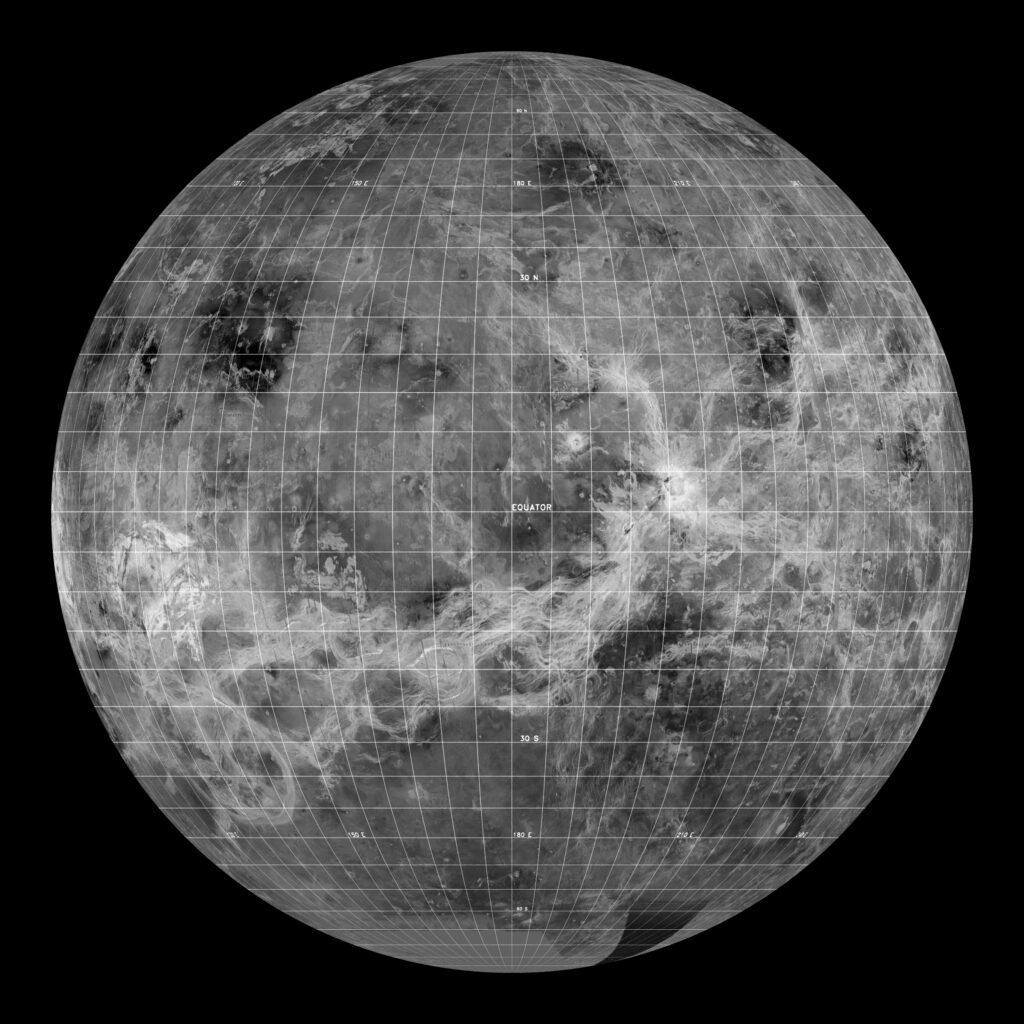
For a long time, Venus could be imagined as a beautiful but sealed and geologically stagnant world. Modern analyses of spacecraft data have complicated this picture. Radar observations from NASA’s Magellan mission have revealed evidence of recent or ongoing volcanic activity, suggesting that Venus may be more geologically active than once assumed.
This matters symbolically. Venus is not simply a shining shell over a dead surface. Beneath her dense veil there is internal heat, pressure, movement, and material activity. She is hidden, but not necessarily inert.
Here Venus differs from a world whose vitality belongs only to the past. She suggests hidden present activity: something working under cover, unseen by ordinary sight, but not absent. Her softness and beauty do not mean emptiness or weakness. Behind the bright surface there may be immense internal force, expressed not openly and violently, but enclosed beneath atmosphere and cloud.
Earth’s Twin and the Fate of a Closed World
Venus is often called Earth’s twin because the two planets are similar in size and general structure. Yet their fates are profoundly different. Earth became a living world with open water, breathable air, and an exposed surface. Venus became a closed, overheated, cloud-covered world whose surface is hidden and hostile to ordinary terrestrial life.
This contrast is symbolically powerful. Venus is close to life, close to beauty, close to fertility, close to Earth itself. Yet she is not life in the full solar or terrestrial sense. She is the power that makes life desirable. If that power becomes sealed within itself, it may become suffocating, excessive, and deprived of free circulation.
In this sense, astronomical Venus teaches the same measure required by astrological Venus. Beauty must not become concealment without truth. Pleasure must not become imprisonment. Softness must not become weakness. Desire must not become a closed atmosphere in which nothing can freely breathe.
At her best, Venus reflects light into beauty, joins what is separate through attraction, and makes life pleasant, lovable, fragrant, musical, and graceful. At her worst, she becomes a shining veil over pressure, heat, and suffocation. The same planet that appears as the herald of dawn and the jewel of evening reminds us that pleasure requires measure, beauty requires truth, warmth requires release, and love requires the freedom to breathe.