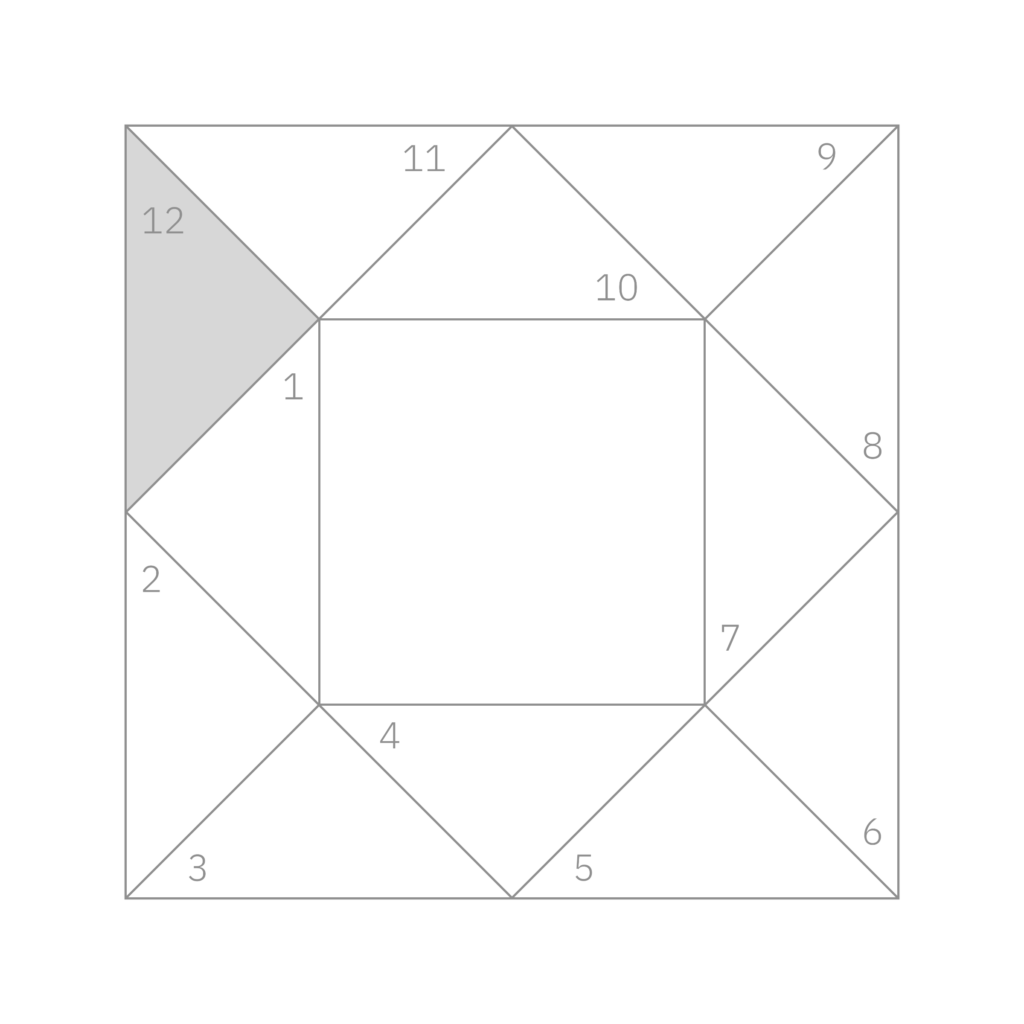
Latin Name: Prison (Carcer).
Greek Name: Bad Spirit (Κακος Δαιμων — Kakos Daimōn).
Arabic Names:
- بيت الحبس — Bayt al-Habs: the House of Confinement;
- بيت الأعداء — Bayt al-Ada: the House of Enemies;
- بيت السجن — Bayt as-Sijn: the House of Prison.
Hebrew Names:
- בית הרוחות הרעות — Beit ha-Ruhot ha-Raot: the House of Evil Spirits;
- בית האויבים — Beit ha-Oyevim: the House of Enemies.
Alternative Name: the Evil Spirit.
House Type: cadent (decline).
House of ‘Joy’: for the figures of L Saturn ( Carcer, Tristitia).
House of ‘Sorrow’: for the figures of F Mars ( Puer, Rubeus).
Mundane Planetary Ruler: C Venus.
Direction: south-east.
Anatomy: feet.
The twelfth house has traditionally been associated with secrets, isolation, hidden enemies, addictions, imprisonment, suffering, and self-destruction. Yet beneath all these meanings lies a single archetypal principle: the twelfth house describes those forces of the psyche that exist outside the field of clear conscious control.
Astrologically, this is unsurprising. The twelfth house forms no natural aspect to the Ascendant and therefore symbolizes everything hidden from a person’s direct awareness. It is the realm of the repressed, the suppressed, the unconscious, and that which remains inwardly separated from the ego.
It is no coincidence that in Hellenistic astrology the twelfth house was called the “Place of the Bad Spirit.” This ancient name conveys its essence with remarkable precision. The matter at hand is not merely misfortune or external adversity, but invisible forces capable of seizing the psyche from within, distorting perception, driving a person toward self-destruction, and keeping consciousness trapped in a state of inner conflict.
Core Meanings of the Twelfth House
- hidden motives;
- the individual’s own secrets;
- what is concealed from the individual;
- inner conflicts;
- self-deception;
- unconscious fears;
- hidden influence;
- and all that acts upon a person subtly and imperceptibly, gradually bringing him under its control.
Prenatal Experience and the Origins of Psychic Fragmentation
The twelfth house is closely connected with the period preceding birth. This refers not merely to physical existence in the womb, but to the primordial psychic experience that arises before the formation of a stable ego.
In the early stages of prenatal development, the child possesses no developed system of concepts or images through which experience may be consciously interpreted. Yet the psyche already responds to the emotional state of the mother, tensions within the family, the atmosphere of the lineage, and the surrounding environment. Psychologically, this condition may be described as a state of maximum openness to collective and inherited psychic material.
For this reason, many deep fears and future negative patterns are experienced as something irrational, ancient, and greater than one’s personal experience. They seem to have existed prior to the emergence of conscious personality itself.
Forms of Psychic Division in the Twelfth House
Symbolically, the twelfth house is linked to primordial psychic splits and those internal structures that may later manifest as:
- trauma;
- inner conflict;
- obsessive patterns;
- chronic fears;
- destructive forms of behavior.
Yet these divisions are not purely negative in themselves. The psyche often fragments experience as a means of survival. For this reason, the twelfth house may conceal not only the roots of suffering, but also immense latent resources that become accessible only through the integration of repressed aspects of the personality.
“Demons” as Autonomous Psychic Complexes
Traditional symbolism surrounding the twelfth house frequently includes demons, evil spirits, sorcery, and hidden malefactors. Psychologically understood, this language refers to partially autonomous psychic contents capable of influencing behavior independently of conscious will.
Modern psychology and psychiatry have repeatedly encountered conditions in which individuals experience aspects of their own psyche as alien and independent from themselves. In dissociative disorders, people may hear inner voices, sense the presence of “other personalities,” or experience sudden changes in behavior, memory, facial expression, voice, and even handwriting. In some cases, a person speaks as though another will exists within him, possessing its own desires, emotions, and intentions.
This is precisely why the phenomenon of “possession” has never disappeared from human culture. In many instances, what religious environments interpreted as demonic possession is associated in modern psychology with dissociation, traumatic fragmentation of the psyche, psychotic states, or autonomous unconscious complexes.
Particularly revealing is the phenomenon of glossolalia—states in which a person begins speaking incomprehensible speech or language resembling a foreign tongue. Such conditions have been described both in religious exorcistic practices and in psychiatric observation. In certain cases, individuals unexpectedly uttered Latin, ancient, or otherwise unfamiliar words, traditionally interpreted as signs of possession. Modern psychology more commonly explains such phenomena as unconscious reproduction of previously heard linguistic fragments, trance states, and divisions within consciousness.
Clinical descriptions of states interpreted as possession also include:
- abrupt changes in voice;
- the sensation of an alien presence;
- loss of bodily control;
- gaps in memory;
- observing oneself as though from outside;
- automatic movements;
- sudden outbursts of aggression;
- a sense of inner compulsion;
- the experience of another presence existing within the psyche.
Modern psychology has repeatedly observed that certain inner complexes possess a high degree of autonomy. A person may fully recognize the destructiveness of his behavior and yet continue acting against his own interests. This is why the twelfth house has traditionally been called the House of Self-Undoing and the House of Hidden Enemies—above all, inner ones.
From this perspective, the language of ancient astrology proves astonishingly precise. The “demons” of the twelfth house are not necessarily literal entities, but those unconscious forces that begin living lives of their own, seizing a person’s attention, will, and behavior. This is why many ancient descriptions of possession bear such striking psychological resemblance to severe dissociation, compulsions, and internal psychic fragmentation.
What Lies Behind the Image of “Demons”
The “demons” of the twelfth house most often conceal the following unconscious psychic contents:
- repressed fears;
- suppressed impulses;
- inner divisions;
- traumatic material;
- compulsive patterns;
- unconscious forms of self-sabotage.
These forces act covertly, gradually drawing the individual into recurring destructive patterns. Thus the twelfth house reveals the manner in which a person becomes his own enemy.
In a certain sense, the inner “demons” of the twelfth house function as guardians of repressed regions of the psyche. This is precisely why it is so difficult for a person to free himself from destructive patterns: the psyche often guards its divisions as fiercely as it guards trauma or fear.
Why We “Feed” Our Demons
The symbolism of the twelfth house becomes even deeper when viewed through the system of derivative houses. The first house signifies the person himself—his body, personality, and manifested self. The second house from the first shows what nourishes and sustains him: resources, food, means of survival, and all that strengthens and maintains life.
Yet the first house is simultaneously the second house from the twelfth. In other words, the individual himself becomes the source of nourishment for the forces symbolically represented by the twelfth house.
This describes the nature of inner “demons” with remarkable precision. They do not exist separately from the individual, but are sustained by his own psychic energy: fears, repression, unconscious repetition, addictions, compulsive reactions, and continual emotional involvement in destructive patterns. The more unconsciously a person identifies with his fears and traumas, the more he quite literally “feeds” the inner forces of his own self-destruction.
For this reason, the twelfth house is connected not only with suffering, but also with the phenomenon of psychic self-perpetuation of destructive states. Many fears, addictions, and inner conflicts continue to exist precisely because the psyche repeatedly supplies them with attention, energy, and emotional investment.
In this sense, one of the central tasks of the twelfth house lies not in “fighting demons” as though they were external entities, but in ceasing the unconscious nourishment of those inner processes that keep a person imprisoned within himself.
The Twelfth House as the House of Sin
In traditional astrology, the twelfth house is often called the House of Sins and Vices. Yet the original meaning of these concepts was far deeper than simple moralism.
Within the context of the twelfth house, “sin” refers not merely to the violation of religious prohibition, but to any condition or form of behavior that objectively destroys the individual, deprives him of inner freedom, weakens the will, and disrupts psychic integrity.
Self-Destructive Manifestations of the Twelfth House
For this reason, the twelfth house is fundamentally connected with:
- addictions;
- compulsive behavior;
- escape from reality;
- self-destructive impulses;
- loss of control;
- gradual inner disintegration of the personality.
Environments and Forms of Degradation
On a practical level, this may manifest through:
- alcoholism;
- drug addiction;
- gambling addiction;
- destructive sexual compulsivity;
- criminal environments;
- as well as any setting that intensifies psychological degradation and loss of freedom.
The meaning of the twelfth house does not lie in moral condemnation, but in describing those forces capable of subjugating consciousness itself.
Fears, Phobias, and Inner Imprisonment
One of the most important manifestations of the twelfth house is fear. Unlike rational caution, the fears of the twelfth house are often irrational in nature and experienced as something not entirely subject to conscious control.
For this reason, the twelfth house is associated with:
- phobias;
- anxiety states;
- an inner sense of persecution;
- unconscious expectation of danger.
A person often becomes imprisoned within his own inner states. From this emerges another essential meaning of the twelfth house: confinement.
Traditionally, the twelfth house signifies:
- prisons;
- captivity;
- detention facilities;
- closed institutions and hospitals;
- beds as places of illness, helplessness, or isolation;
- monasteries (in earlier times) and other places of voluntary seclusion;
- as well as the broader theme of restricted freedom.
Psychologically, this symbolizes states in which the psyche loses the ability to move freely and becomes seized by its own internal structures.
Hidden Enemies and Covert Influence
Because the twelfth house is connected with the invisible and concealed, it has traditionally been associated with hidden enemies—in contrast to the seventh house, which signifies open adversaries.
This includes:
- secret intrigues;
- concealed hostility;
- slander;
- denunciations;
- covert sabotage;
- as well as psychological or magical influence carried out in secrecy.
From this arise the traditional significations of:
- witches;
- sorcerers;
- the evil eye;
- curses;
- harmful incantations;
- and all forms of hidden attack carried out from the shadows.
Even when interpreted purely psychologically, the twelfth house still retains its association with covert psychic influence, manipulation, and unconscious contagion through fear.
The Twelfth House and the Theme of Birth
The twelfth house is linked with the moment preceding a person’s emergence into the world. For this reason, it has traditionally been associated with pregnancy and childbirth.
Symbolically, it is the space of transition:
- between free existence and incarnation;
- between the unconscious and individual life;
- between potentiality and limitation through matter.
Thus the theme of confinement appears once again. The child remains within an enclosed space, entirely dependent upon external conditions and incapable of directing his own fate.
Large Animals and the “Animal Axis”
Traditional astrology connects the sixth and twelfth houses through the common theme of animals.
If the sixth house pertains to smaller animals, the twelfth house signifies larger creatures:
- horses;
- bulls;
- cows;
- elephants;
- large wild beasts.
Archetypally, this is linked with the image of vast and potentially dangerous animal force, experienced by ancient man as something beyond his control and therefore fearsome.
Key Notes on the Twelfth House
Derived Significations of the Twelfth House
In the system of turned houses, the twelfth house may signify maternal uncles and aunts as the third house from the tenth.
Derived Twelfth Houses in Questions of Imprisonment
In questions concerning imprisonment, one must examine not only the radical twelfth house, but also the derived twelfth house of the relevant significator.
For example, if the question concerns another person, that person’s imprisonment may be shown either by:
- the radical twelfth house of the chart;
- or the derived twelfth house belonging to that individual.
Thus, in the question: “Will my brother be imprisoned?” one must analyze both the radical twelfth house and the twelfth house from the third house—namely, the radical second house—since the third house signifies the querent’s brother.
Such an approach reflects the fundamental principle of turned houses: the meaning of the twelfth house remains the same, but is transferred onto the person represented by the relevant significator.
Examples of Twelfth House Questions
- Is this horse suitable for purchase?
- Will N be convicted and imprisoned?
- Has someone placed a curse upon me?
- Am I afflicted by the evil eye?
- Are rumors being spread about me?
- Will I overcome my fear of flying?
Quotes on the Twelfth House
In the twelfth house, we ask about life-threatening attacks and about accidents and about large beasts that are cows, mules, horses, deer, and the rest of things in this manner, and about enemies.
Lectura Geomantiæ
Because the twelfth house is cadent, and because its sign—following the order of the zodiacal signs—always possesses an active nature different from that of the Ascendant sign (that is, in the system of equal houses reckoned from the ascending degree), which constitutes the principal nature of the sign, it signifies quarrels, defamation, and disgrace. Because it is not configured by aspect with the degree of the Ascendant, it signifies imprisonment. And because portions of the Ascendant sign may fall within the twelfth house when the ascending degree is not at the beginning of the sign, it is said to signify animals used by man for riding.
Abraham Ibn Ezra, The Beginning of Wisdom, Chapter III
A planet in the twelfth house is like a man in confinement.
Abraham ibn Ezra, The Beginning of Wisdom, Chapter VIII, § 120
This twelfth house, which is called the Evil Spirit, gives a true and determinate judgement of private and secret enemies, licentious, envious persons, imprisonments, evil thoughts, whisperings, great beasts and cattle, and of all things good and evil which happen in the travail of women, and of harlots; also it signifies hatred and dissensions, and certain diseases and sicknesses… Joy of L Saturn. It rules the feet and gout.
Claude Dariot, A Brief and Most Easy Introduction to the Astrological Judgment of the Stars, Chapter XII
This house has signification of secret enemies, enemies, great cattle, as horses, oxen, etc.; also of prisons, captivity, witches, and evil spirits, malicious persons, etc… Of the parts of man, it rules the feet. It is a cadent house.
John Middleton, Practical Astrology, Chapter XI
It has signification of private enemies, of witches, great cattle, as horses, oxen, elephants, etc. Sorrow, tribulation, imprisonments, all manner of affliction, self-undoings, etc., and of such men as maliciously undermine their neighbours, or inform secretly against them… L Saturn does much joy in that house, for naturally L Saturn is author of mischief; and it rules in man’s body the feet… It is a cadent house… and vulgarly sometimes called Cataphora, as all cadent houses may be.
William Lilly, Christian Astrology, Chapter VII