Latin Name: Saturnus.
Greek Names:
- Κρονος — Kronos: Cronus.
- Φαινων — Phainōn: the Shining One.
Arabic Name: az-Zuhal (الزحل).
Hebrew Name: Shabbatai (שבתאי).
Alternative Name: the Greater Malefic.
Mundane Houses Ruled: Vita, Mors.
Domiciles: j Capricorn, k Aquarius.
Figures: Carcer, Tristitia, Cauda Draconis.
Gender: masculine.
Sect: diurnal.
Qualities: extremely cold and dry.
Element: 🜃 earth.
Powers: retentive and preservative.
Colors: dark, obscured, heavy, muted, and lightless colors; black, pitch-black, leaden gray, ash-gray, smoky blue-black, dark earthy brown, dull dark green, and corrupted yellow darkened or mixed with black.
Smells: acrid and unpleasant odors, vinegar-like and foul smells.
Tastes: bitter, sour, or harshly unpleasant tastes.
Things: old, black, difficult, hard, heavy (both literally and symbolically), restrictive, restraining, limiting, enclosing, preserving, freezing, buried or underground, decaying, ruinous, dry, cold, isolated, agricultural, historical, corrupted, or dead things.
Places: deserts, dark and isolated places, caves, pits, mountains, graveyards, ruins, abandoned buildings, prisons, places of exile and ascetic withdrawal, coal mines, wells, underground places, wastelands, barren fields, and foul-smelling or filthy locations.
Weather: cold, dark, cloudy, gloomy, foggy, or stagnant weather; dense dark clouds.
Metals and Materials: lead, magnetite (lodestone), dross and residue from other metals, refuse, and all impure, coarse, or low-quality materials.
Stones: antimonite, cerussite, chiastolite, galenite, jet, morion, petrified wood, sphalerite.
Character: serious, solitary, contemplative, restrained, patient, disciplined, cautious, prudent, frugal, secretive, enduring, and deeply self-controlled; inclined toward silence, austerity, realism, perseverance, hidden or ancient knowledge, and mastery gained through hardship, limitation, and time; seeking stability, structure, permanence, and self-sufficiency through restraint and endurance; in its harsher expression—fearful, suspicious, envious, miserly, rigid, pessimistic, deceitful, withdrawn, emotionally cold, joyless, stubborn, gloomy, malicious, and chronically dissatisfied.
Physical Appearance: a dry, lean, bony, and somewhat stooped figure; medium to tall height; a pale, dark, or earthy complexion; dark, black, or coarse hair; small dark eyes with a heavy or downward gaze; large ears; heavy, thick, or overhanging brows; sharp, harsh, angular, or sunken facial features; a large mouth and heavy lips; a sparse beard or little facial hair; broad shoulders; and a serious, melancholic, stern, gloomy, or withdrawn expression.
People and Professions: old people, monks, ascetics, sectarians, laborers, peasants, farmers, gardeners, shepherds, miners, coal workers, gravediggers, undertakers, builders, masons, brickmakers, potters, leatherworkers, tanners, sweepers, plumbers, chimney sweeps, sanitation workers, refuse workers, stable workers, servants, clerks, administrators, tax collectors, beggars, people of low social status, and all occupations connected with earth, underground places, death, isolation, hard labor, decay, monotony, or dirty work.
Anatomy: skin, bones, joints, teeth, the right ear, the middle finger of the hand, the spleen, the immune system (with F Mars), and the bladder.
Endocrine Gland: the pineal gland.
Diseases: obstruction of the spleen, noise and ringing in the ears, madness, gout, tuberculosis, deafness, weakness, and dropsy.
Planetary Years: 30 (~29.5-year orbital cycle).
Stage of Life: old age (ages 68–98).
Day of the Week: Saturday.
Night of the Week: the night from Tuesday to Wednesday.
Astrological Characteristics of Saturn
Coldness, Distance, and Limitation
Saturn is regarded as a diurnal and masculine planet. Its temperament is considered extremely cold and dry, and its nature is associated with the element of earth and the melancholic humor. Among the seven traditional planets, Saturn is both the slowest in motion and the most distant from Earth. For this reason, it became associated from antiquity with coldness, remoteness, severity, and limitation. Its nature signifies isolation, distance, austerity, and heaviness, but also responsibility, seriousness, and discipline.
The dim and pale light of Saturn was traditionally connected with night, darkness, and everything obscure or fearsome. From this arise its associations with fear, misfortune, occult knowledge, and matters related to decay and decline.
In late antiquity, the figure of Kronos gradually became associated with Chronos—Time itself. This connection was not accidental. The slowest and most distant of the traditional planets naturally became the symbol of duration, aging, and the gradual dissolution of form through time.
Time, Age, and Decline
At the same time, Saturn signifies deep contemplation and inward concentration. It governs memory, strategy, caution, and the capacity for prolonged reflection. Because of its slow movement, Saturn naturally became the symbol of time, maturity, old age, and gradual dissolution. Thus the planet may appear either as the wise and venerable elder possessing knowledge and experience, or as the image of frailty, decay, and deterioration.
Not by chance, in Greek mythology Kronos-Saturn devours his own children. This myth expresses one of the deepest Saturnian principles: time gives birth to form, yet gradually consumes it again. Everything born inevitably returns beneath the dominion of aging, decay, and completion. Saturn does not merely restrict life—it devours life back into time.
Structure, Duty, and Restraint
The Saturnian nature is likewise connected with order, structure, restraint, frugality, and difficult sustained labor. Everything belonging to Saturn demands endurance, duty, and the ability to submit to necessity.
In traditional astrology Saturn is known as the Greater Malefic. Since its qualities are cold and dry, it stands in opposition to the principle of life, which is hot and moist. For this reason Saturn is associated with endings, exhaustion, weakening, and the decline of vital force.
Yet in its stronger and nobler manifestation, Saturn signifies depth, precision, patience, severity, and strategic intelligence.
Despite its severe nature, Saturn in ancient tradition was also associated with the Golden Age—a primordial era of simplicity, stability, natural order, and sufficiency. This was not a Jovian world of abundance and expansion, but rather a condition in which life remained restrained within natural limits, untouched by excess, greed, and corruption.
In its harsher expression, Saturn manifests as fear, suspicion, greed, pettiness, jealousy, rigidity, distrust, and concealed hypocrisy.

Astronomical Characteristics of Saturn
The Rings and the Nature of Boundaries
Saturn reveals its symbolism even through its astronomical properties. Its famous rings immediately evoke the ideas of boundary, isolation, and separation from the outer world—qualities traditionally associated with this planet. Yet the rings themselves are astonishingly thin and sharp, almost blade-like. Here one can perceive the connection between the Greater Malefic and the Lesser Malefic—Mars: Saturnian limitation united with the Martian principle of cutting, pain, and destruction.
Modern research suggests that Saturn’s rings consist of the remnants of shattered moons and other celestial bodies torn apart by the planet’s gravity. Symbolically, they resemble a vast cosmic graveyard—the matter of destroyed forms and ruined bodies suspended in an intermediate state between existence and final dissolution.
Yet this decay is not static: the material of the rings slowly falls back onto the planet through the process known as ring rain. This deepens the image of Saturn even further: it signifies not merely death and the end of form, but the very transition from one state of being into another. In the traditional understanding, Saturn governs not simple annihilation, but the boundary itself between life, death, and subsequent transformation. Significantly, this entire process unfolds with almost imperceptible slowness, subject to the rhythm of time—Saturn’s supreme force, which gradually erodes even the most enduring structures.
Even the gaps within the rings are maintained by so-called “shepherd moons,” preventing matter from straying beyond its assigned orbit. Saturn quite literally organizes, restricts, and disciplines the surrounding space.
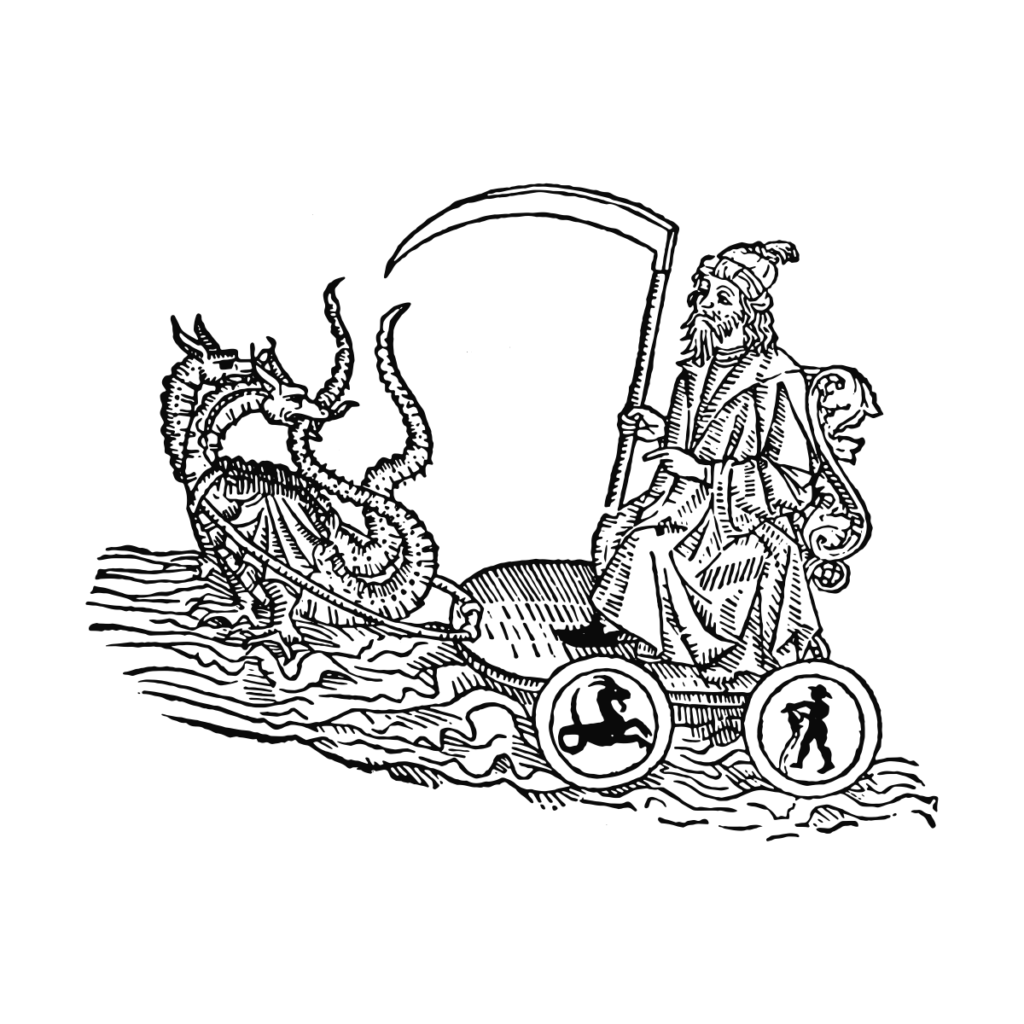
Not by chance was Kronos-Saturn traditionally depicted with a sickle or scythe—the instrument of cutting, separation, harvesting, and termination. The same principle appears astronomically in Saturn’s rings: matter held in a perpetual state of division, prevented from fully joining into unified form. Saturn fixes boundaries, separates, and limits manifestation.
The Hexagon and Order Within Chaos
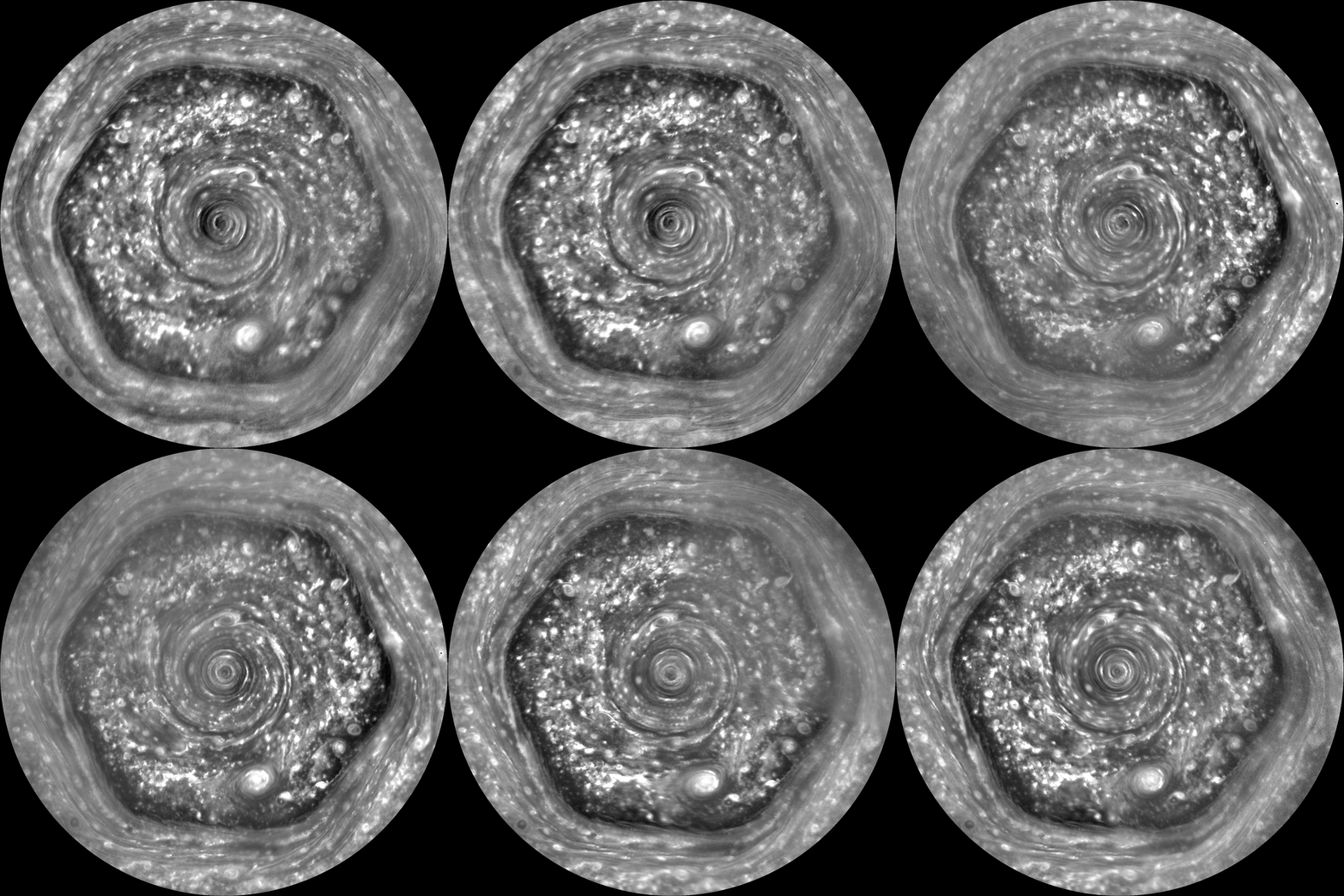
At Saturn’s north pole lies a gigantic atmospheric hexagon nearly 25,000 kilometers across—a stable geometric structure observed continuously since at least the early 1980s. Amid chaos, storms, and turbulence, Saturn imposes an almost impossible order. Although modern science associates the hexagon with massive atmospheric waves and jet streams, the mechanism behind its extraordinary long-term stability remains not fully understood. Particularly striking is the fact that no comparable structure exists at the planet’s south pole. Even now, the hexagon remains one of the most unusual examples of enduring geometry anywhere in the Solar System.
Symbolically, it may be understood as an image of cosmic law and the closed structure of the manifested world. Even within perpetual motion and the chaos of time, Saturn preserves form, subjecting change itself to rigid order.
Pressure, Time, and the Equalizing Force of Death
Saturn’s atmosphere exists under such extreme pressure that the familiar distinctions between gas, liquid, and solid begin to blur. The planet itself is visibly flattened at the poles, as though compressed by an immense force. Throughout its nature one senses pressure, condensation, and the subjugation of form.
Under such pressure, distinctions between weak and strong, hard and soft gradually disappear: everything is slowly ground down, simplified, and reduced toward a single condition. In this, one may easily recognize the ancient Saturnian image of time and death, before which all things are ultimately made equal. Saturn does not destroy chaotically—it slowly erases distinctions, subjecting all things to the single law of time.
Saturn as the “Black Sun”: The Hidden Energy of Time
Though Saturn outwardly appears cold, motionless, and immensely heavy, an enormous energy remains concealed within it. The planet radiates more heat than it receives from the Sun. If the Sun traditionally symbolizes life, light, and vital force, Saturn is associated with time, old age, and death. Yet death here is understood not as emptiness or mere absence of life. It possesses its own nature, its own power, and acts with the same inevitability as time itself.
Particularly significant is the fact that Saturn’s internal energy source differs fundamentally from that of the Sun. The Sun generates energy through thermonuclear fusion and expansion. Saturn, by contrast, sustains its heat through gradual gravitational contraction: the planet slowly compresses beneath its own weight, transforming pressure and compression into heat. In addition, Saturn experiences what scientists call “helium rain,” in which helium separates from hydrogen and slowly descends deeper into the planet, releasing energy through this inward motion.
If solar energy is associated with radiation, light, and expansion, Saturnian energy emerges through pressure, condensation, and the downward movement of matter. Not a burst, but a slow compression. Not expansion, but concentration. If solar energy manifests itself through immediate radiance and active emission, Saturn’s energy acts almost imperceptibly, yet continuously and inevitably—much like time itself.
Solar energy is generous by its very nature: the Sun continuously spreads light and warmth in all directions. In traditional symbolism, this naturally became associated with life, magnanimity, optimism, and the fullness of being. Its light extends equally to all things.
Saturn’s nature is the opposite. Its energy does not unfold outwardly, but is retained and concentrated within. Instead of radiation—compression; instead of generosity—restriction; instead of expansion—inward closure. If the solar principle affirms life through openness and the diffusion of force, the Saturnian principle is associated with contraction, inner heaviness, and gradual decline. In this sense, Saturn becomes the opposite pole of solar optimism.
Yet Saturn is not merely the absence of the solar principle, but its mirrored opposite—a kind of “Black Sun” within traditional cosmology. The Sun sustains life through light and constant outward giving, whereas Saturn preserves its own power through inward pressure, limitation, and the descent of matter into depth. One principle reveals forms and makes them visible; the other gradually returns them toward the limit where distinctions begin to disappear.
Jupiter and Saturn: Expansion and Limit
Against this background, the traditional astrological opposition between Saturn and Jupiter becomes especially revealing. Jupiter represents growth, expansion, abundance, and outward development. Saturn, by contrast, is associated with limitation, contraction, form, and boundary.
Even their physical natures unexpectedly reflect this ancient symbolism. Jupiter manifests its power through external expansion and immense radiation, whereas Saturn sustains itself through internal pressure, compression, and the gradual descent of matter into depth. One symbolizes the fullness of life and growth; the other, the dominion of time and form over all expansion.
It is perhaps for this reason that the conjunctions of Jupiter and Saturn were regarded in traditional astrology as major markers of historical eras: together they express the interaction of two fundamental cosmic principles—expansion and limitation, becoming and completion.
The Paradox of Heaviness and the Final Boundary
Despite its grim symbolism, Saturn’s average density is lower than that of water—which is why it is often said that, hypothetically, it could float upon a sufficiently vast ocean. This creates a striking symbolic paradox. The planet traditionally associated with heaviness, pressure, time, and death proves physically lighter than water.
Perhaps this contains a subtle hint that humanity’s greatest fears belong more to perception than to the nature of reality itself. Or perhaps it suggests that death, which consciousness experiences as unbearably heavy, is in truth only another transition of form.
Saturn was the last planet visible to the ancient world with the naked eye. Beyond its orbit, traditional cosmology perceived the beginning of the unknown. For this reason, Saturn naturally became the symbol of the limit, the threshold, and the boundary between the manifested world and that which lies beyond it.