
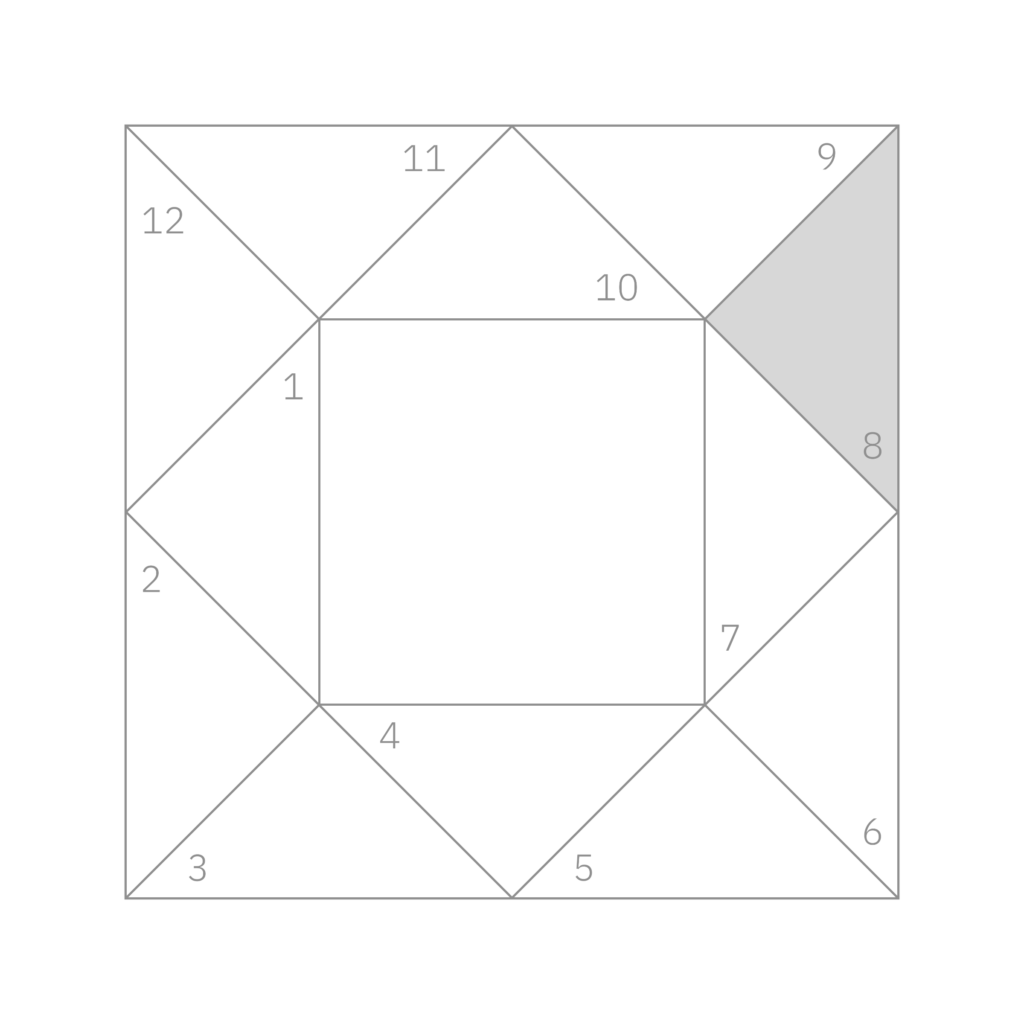
Latin Name: Death (Mors).
Greek Name: Idle (Αργος — Argos).
Arabic Name: the House of Death (بيت الموت — Bayt al-Mawt).
House Type: succedent.
Mundane Planetary Ruler: L Saturn.
Direction: south-west.
Anatomy: organs of excretion, anus.
The second and eighth houses operate together as a unified archetype of “mine versus another’s.” If the second house signifies the querent’s own resources, then the opposing eighth house represents "foreign territory"—primarily in a psychological and material sense. It is the domain of others’ resources.
Other People’s Resources and Foreign Currency
From this it follows that:
- the eighth house describes the resources of others, including other people’s money and everything that, by analogy, pertains to the second house;
- it also signifies currency in circulation in a “foreign country” or on “another territory.”
Sunset and the Signification of Death
It is important to note that, from a geometrical standpoint, the eighth house corresponds to the place of the setting of all stars—it is the house of sunset, of symbolic death. Therefore, it traditionally signifies death as the moment of leaving behind all material possessions and the departure of the soul from the body.
Common Error
The Eighth House as the “House of Transformation and Orgasm”
In modern astrology, the eighth house is often associated with “transformation” and even “orgasm.” This, however, is a misconception.
Historically, this notion arose as follows. At a certain time, astrologers adopted an informal professional code which discouraged delivering negative predictions to clients, particularly those concerning death. This was seen as incompatible with the prevailing humanitarian ideals of the time. As a result, the direct and concrete meaning of the eighth house—death—was replaced with the more abstract concept of “spiritual transformation.”
Within esoteric circles, death was often interpreted as a form of “rebirth” or “transformation of the spirit,” which further reinforced this substitution. Later, in an effort to soften the original meaning even more, some astrologers began associating the eighth house with sexual climax, viewing it as a form of “transformation.”
Nevertheless, if one maintains the right to speak of the future without distortion, the eighth house should be understood in its original sense—as the house of physical, inevitable death.
Death and Inheritance
The concept that links death and money is inheritance. Accordingly, the eighth house signifies wills and inheritance in a general sense (e. g., “Will I ever receive an inheritance?”).
If the question concerns inheritance from a specific individual (“Will I inherit the money of such a person?”), then, regardless of whether that person is alive or deceased, one must consider that person’s derived second house. For example: "Will I inherit my mother’s money?"—the first and eleventh houses are examined.
Bodily Correspondence and Places of Excretion
Anatomically, the eighth house corresponds to the organs of excretion. Therefore, it is associated with toilets and bathrooms—places where bodily waste is expelled.
Key Notes on the Eighth House
Exchange Rates and Foreign Currency
- In questions concerning exchange rates, the querent and their country are assigned to the first house, and the currency of that country to the second. The foreign country is assigned to the seventh house, and its currency to the eighth.
Banks, Loans, and Borrowed Money
- In questions about loans, the bank is treated as “other people” (the seventh house), and its money as the eighth house.
Gambling, Winnings, and the Opponent’s Money
- In gambling matters, the bookmaker, casino, or dealer is represented by the seventh house, and their money by the eighth. The fifth house pertains to amusement (“Will I enjoy myself at the casino?”), but not to winnings.
Radical and Derived Eighth Houses in Death Questions
- In questions concerning death, both the radical and derived eighth houses must be considered. For example, in the question “Will my dog die?”, the death of the dog may be shown either by the radical eighth house or by the derived eighth house (that is, the first house of the radical chart).
On Fear and Distress
William Lilly states that the eighth house signifies the querent’s fears and mental anguish. This means that if the significator of the querent is found in the eighth house without a clear reason (such as a question concerning death or another’s money), it indicates inner anxiety and distress.
Abraham Ibn Ezra expressed a similar idea:
A planet in the eighth house is like a man seized by fear.
The reason lies in the aversion between the first and eighth houses. This aversion indicates a state of alienation: the querent becomes estranged from themselves, unable to perceive what the Ascendant signifies—including their own person and judgment—as if losing their head to fear.
From a psychological perspective, many forms of distress conceal an underlying fear of death. This is precisely what is indicated by the movement of the querent’s significator into the eighth house. In geomancy, as in astrology, the transition of a significator into a house shows what occupies or absorbs the querent—here, emotional distress that may be understood as a “lesser form of death.”
At the same time, fear as a distinct subject (for example, “Will I overcome claustrophobia?”) belongs to the twelfth house.
Examples of Eighth House Questions
- Will I ever receive an inheritance?
- Has N died?
- Was X a suicide or a murder?
- What will my death be like?
- Will the bank grant me a loan?
- Will I win the bet?
Quotes on the Eighth House
In the eighth house, we ask about the death of the querent and about all their dangers.
Lectura Geomantiæ
In the eighth house, these things are considered: whether someone will die at a predestined point; if the querent will get possession of the remains of the dead; if in the land to which he goes he will be enriched; if his adversary has much money; if something reached the person to whom it was sent; if he will die as a result of a particular illness; whether something he fears has truly come upon him.
Modus Judicandi Quaestiones Secundum Petrum de Abano Patavinum
The eighth house is adjacent to the seventh house, which stands opposite the first house, yet it does not behold it by aspect; therefore it has been said that it is the house of death.
Abraham Ibn Ezra, The Beginning of Wisdom, Chapter III
A planet in the eighth house is like a man seized by fear.
Abraham ibn Ezra, The Beginning of Wisdom, Chapter VIII, § 116
This house signifies death, labours, sadness, and heaviness, the inheritance of the dead, and the end of life. For this reason, it is called the House of Death. It also signifies hidden treasures, deadly poisons, fears, and configurations concerning a man and his affairs. It rules the womb, the bladder, stones, and the genitals.
Claude Dariot, A Brief and Most Easy Introduction to the Astrological Judgment of the Stars, Chapter XII
The eighth house signifies the death of the native or querent, its nature and quality; the estates of deceased men; their wills, legacies, and testaments; and the portion or dowry of the wife. In suits of law, it signifies the defendant’s friends; in duels, the adversary’s second… In the human body, it governs the private parts.
John Middleton, Practical Astrology, Chapter XI
The estate of men deceased; death, its quality and nature; the wills, legacies, and testaments of men deceased; the dowry of the wife; the portion of the maid, whether much or little, whether easy to be obtained or with difficulty. In duels, it represents the adversary’s second; in lawsuits, the defendant’s friends. It signifies what kind of death a man shall die, and fear and anguish of mind; who shall enjoy or be heir to the deceased. It rules the private parts… Hemorrhoids, the stone, strangury, poisons, and the bladder are ruled by this house.
William Lilly, Christian Astrology, Chapter VII