
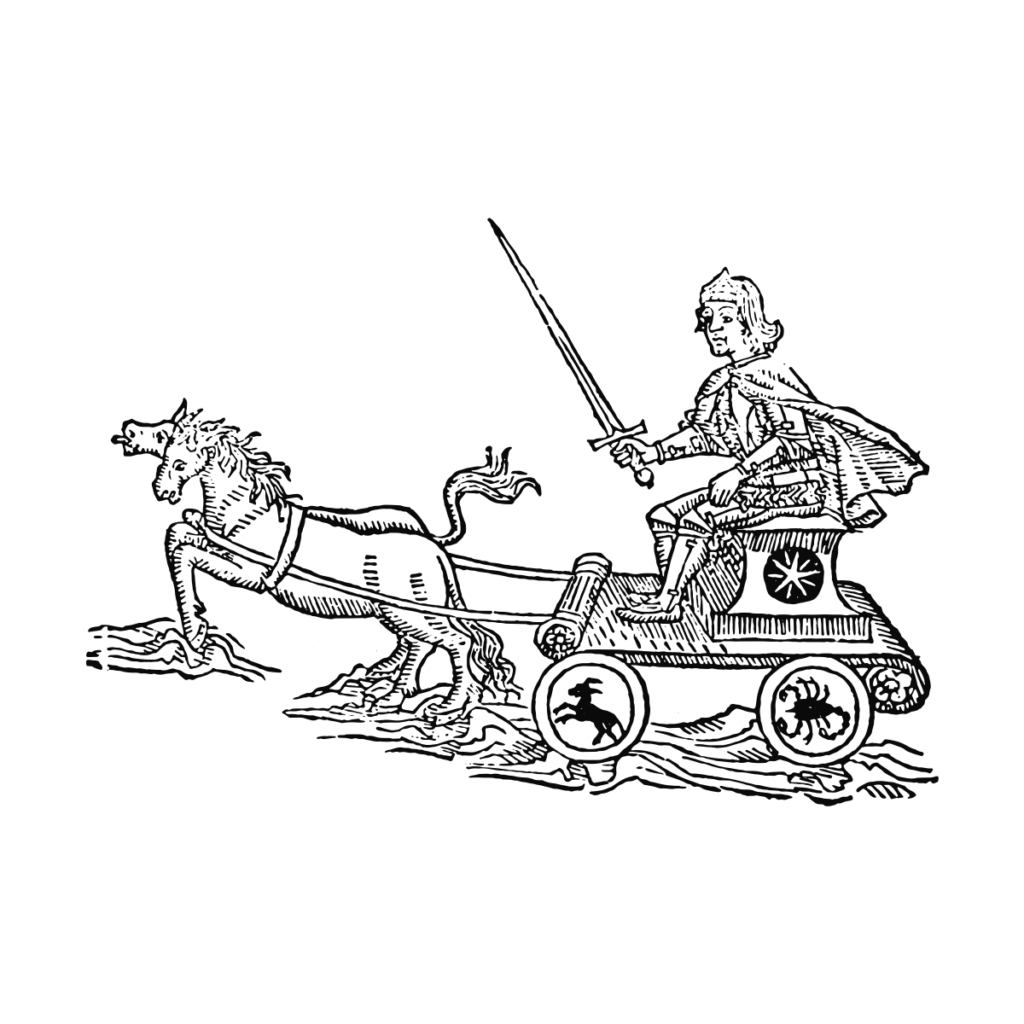
Latin Name: Mars.
Greek Names:
- Αρης — Arēs: Ares;
- Πυροεις — Pyroeis: the Fiery One.
Arabic Name: al-Mirrikh (المريخ).
Hebrew Name: Ma’adim (מאדים).
Alternative Name: the Lesser Malefic.
Mundane Houses Ruled: Fratres, Regnum.
Domiciles: a Aries, h Scorpio.
Figures: Puer, Rubeus, Cauda Draconis.
Gender: masculine.
Sect: nocturnal.
Qualities: extremely hot and dry.
Element: 🜂 fire.
Powers: passionate, penetrating, severing, destructive, and expulsive.
Colors: fiery, heated, blood-stained, iron-like, rusty, and flame-colored tones; scarlet, blood-red, crimson, iron-red, rust-red, fiery red, orange-red, burnt orange, and saffron-yellow.
Smells: sharp, pungent, smoky, sulfurous, acrid, spicy, metallic, burnt, and blood-like odors.
Tastes: bitter, sharp, spicy, hot, burning, peppery, acrid, caustic, and strongly heating tastes.
Things: sharp, cutting, piercing, burning, heated, irritating, corrosive, sulfurous, disinfecting, violent, destructive, blood-stained, iron-like, weapon-like, red-colored, flame-colored, and heat-damaged things.
Places: smithies, forges, furnaces, kilns, ovens, chimneys, foundries, ironworks, armories, slaughterhouses, butcheries, battlefields, military camps, places of execution, volcanic places, places where fire, iron, weapons, blood, sulfur, fuel, bricks, charcoal, smoke, or violent heat are found, and hot, smoky, dangerous, blood-stained, burning, corrosive, or destructive locations.
Weather: excessively hot, dry, harsh, stormy, and oppressive weather; red clouds, thunderclouds, thunderstorms, lightning, dry storms, squalls, heatwaves, drought, smoky or dusty air, and unhealthy air corrupted by excessive heat, dryness, smoke, fumes, or putrefaction.
Metals and Materials: iron, steel, cast iron, wrought iron, magnetic iron, iron ore, sulfur, antimony, forged, tempered, hardened, sharpened, cut, drilled, milled, welded, cast, stamped, or pressed materials, and all hard, sharp, iron-bearing, sulfurous, fire-hardened, heat-treated, pressure-formed, force-worked, corrosive, caustic, fumigating, or irritant substances.
Stones: hematite, red jasper, bloodstone, vivianite, magnetite, tiger iron, mookaite, carnelian (with C Venus), sard (with C Venus), red garnet, rhodonite, and eagle stone.
Character: courageous, passionate, direct, forceful, decisive, assertive, competitive, impulsive, strong-willed, and impatient of restraint; inclined toward risk, rivalry, desire, sexual drive, domination, self-assertion, and the immediate discharge of tension; seeking victory and the overcoming of resistance through speed, force, and direct action; in its harsher expression—angry, violent, rash, cruel, reckless, shameless, domineering, intrusive, coercive, vengeful, predatory in desire, and prone to aggression, injury, bloodshed, oppression, and ruin.
Physical Appearance: a strong, compact, muscular or sinewy figure, with a dry, firm, and hardened build; ruddy, reddish-brown, sunburnt, or flushed complexion; red, reddish, sandy, auburn, or coarse hair; sharp, bright, focused eyes with a direct, bold, heated, and fearless gaze; sharp and firm facial features, thin lips, a quick or forceful stride, and a fierce, confident, combative, or easily angered expression.
People and Professions: soldiers, warriors, mercenaries, commanders, generals, conquerors, military rulers, usurpers by force, police officers, guards, judicial officers, executioners, robbers, raiders, brigands, violent criminals, torturers, armorers, blacksmiths, ironworkers, metalworkers, welders, machinists, locksmiths, cutlers, furnace workers, firefighters, surgeons, veterinary surgeons, dentists, butchers, slaughterers, hunters, athletes, fighters, boxers, wrestlers, porters, and all who are concerned with war, command, conquest, force, punishment, weapons, fire, iron, metals, cutting tools, surgery, wounds, blood, heat, physical struggle, danger, coercion, or forceful bodily labor.
Anatomy: the left ear, the right nostril, bile, iron in the blood, and the male genital organ.
Endocrine Gland: thyroid gland.
Diseases: abscesses, boils, excessive discharge of bile, frenzy, rabies, fistulas, redness of the face, sudden delirium, inflammations, burning fever, and kidney stones.
Planetary Years: 15 traditional years; astronomical orbital cycle ~1.88 years.
Stage of Life: mature adulthood (ages 41–56).
Day of the Week: Tuesday.
Night of the Week: the night from Friday to Saturday.
Astrological Characteristics of Mars
Excessive Heat and Malefic Action
Mars is regarded as a nocturnal and masculine planet. Its nature is excessively hot and dry, and therefore it belongs to the element of fire and to the choleric temperament. In traditional astrology Mars is called the Lesser Malefic, and this should be understood plainly: its natural action is harmful, inflammatory, divisive, and destructive.
The heat of Mars must be distinguished from the heat of the Sun. The Sun also signifies heat and fire, but its heat is moderate, life-giving, royal, and formative. It illuminates, warms, reveals, and sustains life. The heat of Mars is different: excessive, dry, irritating, and inflammatory. It does not nourish so much as burn; it does not gently vivify so much as force matters into crisis; it does not reveal form so much as cut, scorch, harden, and disturb its integrity.
For this reason Mars is associated not only with war, but with every condition in which wholeness is violated by force: anger, rivalry, weapons, blood, fire, iron, wounds, burns, inflammations, operations, punctures, ruptures, quarrels, divorces, punishments, and all actions in which resistance is overcome by pressure, incision, impact, or intrusion.
Cutting, Penetration, and Coercion
The nature of Mars is direct, swift, and violent. It does not incline toward reconciliation, deliberation, or gentle order. Its action is the blow, the cut, the puncture, the breach, the collision, the invasion, the compulsion, and the forceful overcoming of resistance.
This is why Mars appears not only in the soldier, but also in the surgeon who opens the body; in the needle that pierces the skin; in the blacksmith who subdues metal by fire and hammer; in legal punishment, where judgment is enforced by power; in the quarrel that breaks agreement; and in divorce, where what was once joined is legally severed.
These examples do not justify Mars or turn it into a benefic. On the contrary, they reveal its nature more precisely. Even when Mars becomes necessary, it still acts through injury, pain, pressure, rupture, or violent intervention.
Sulfur, Iron, and Necessary Harm
The paradox of Mars is not that it is secretly good beneath a harsh exterior. Mars is truly malefic. Its paradox is that the same harmful force may sometimes be restricted, directed, and used against a greater harm.
Sulfur expresses this Martial logic with particular clarity. It belongs to fire, smoke, sharp odor, volcanic heat, irritation, fumigation, and disinfection. It may poison and inflame, yet it may also cleanse by destroying corruption. This is not gentle healing, but purification by attack: the harmful thing is burned, dried, driven out, or made unable to remain.
Iron shows the same principle in a denser form. It is fire given a hard and earthly body. In iron, heat becomes blade, weapon, tool, nail, armor, surgical instrument, and engine of force. In the body, iron belongs to the blood and to the carrying of force into action; externally, it becomes the material of striking, cutting, piercing, fastening, and compelling.
Thus Mars does not heal by nourishment, reconcile by affection, or order by wisdom. It intervenes sharply, painfully, and coercively. Even when placed in the service of law, medicine, discipline, or necessity, Mars does not cease to be malefic. It becomes a malefic whose harm is limited and directed.
Courage, Force, and Discipline
When well-conditioned, Mars gives courage, decisiveness, endurance in danger, bodily strength, martial skill, and the power to act where hesitation would bring defeat. It belongs to soldiers, surgeons, smiths, executioners, butchers, fighters, hunters, and all whose work involves iron, fire, blood, danger, sharp instruments, physical struggle, or coercive force.
Yet even in its nobler expression Mars remains dangerous. Its virtue is not gentleness, mercy, or harmony, but force placed under command. Mars may serve a good end when subordinated to necessity, discipline, law, or the governance of the benefics. But its manner of action remains Martial: heat, iron, incision, risk, pain, and compulsion.
This is why the sword of justice belongs to Mars. It may not be the knife of a robber, but it is still an instrument of punishment and coercion. Likewise divorce belongs to Mars: in its corrupt form it appears as hatred, strife, and the destruction of the household; in its necessary form it is the lawful severing of a bond that has become harmful, dangerous, or dead. Yet even then Mars does not unite. It divides.
Corruption and Acute Damage
The corruption of Mars arises from excess of heat and dryness. Heat excites, irritates, and inflames; dryness makes things harsh, rigid, coarse, and incapable of union. A corrupted Mars therefore signifies quarrels, aggression, insolence, cruelty, rashness, boasting, violence, wounds, bloodshed, fires, inflammations, ruptures, and the destruction of bonds.
Unlike Saturn, which harms through coldness, delay, deprivation, exhaustion, and long decline, Mars harms swiftly and openly. It cuts, burns, pierces, spills blood, and brings matters to an acute crisis.
Saturn wears down; Mars strikes. Saturn confines; Mars breaks through. Saturn withers; Mars inflames.
Mars, Ares, and the Power of Violation
The Greek Ares reveals Mars in its most raw and bloody form: the fury of collision, the clash of weapons, the madness of battle, slaughter, and the destructive side of violence. He is not chiefly the wise ruler of war, but the dangerous heat of conflict itself. This is why, in the Greek imagination, Ares often stands below Athena, who represents strategy, calculation, and the disciplined intelligence of warfare.
The Roman Mars reveals another layer of the same power. He is not only connected with battle, but also with the protection of the people, the land, the boundary, law, and the ordered space of civic life. Yet this protective function does not make him gentle. Mars guards by threat, force, exclusion, and the violent removal of what is judged hostile or harmful.
In this sense Mars is the power by which boundaries are both defended and violated. It may repel an enemy, or it may itself invade. It may cut away corruption, or it may wound the living. It may end a conflict through force, or it may create the conflict in the first place.
Its essence is not peace, but the violent decision of a matter through heat, iron, rupture, and force.
Astronomical Characteristics of Mars
The Red Planet and the Body of Iron
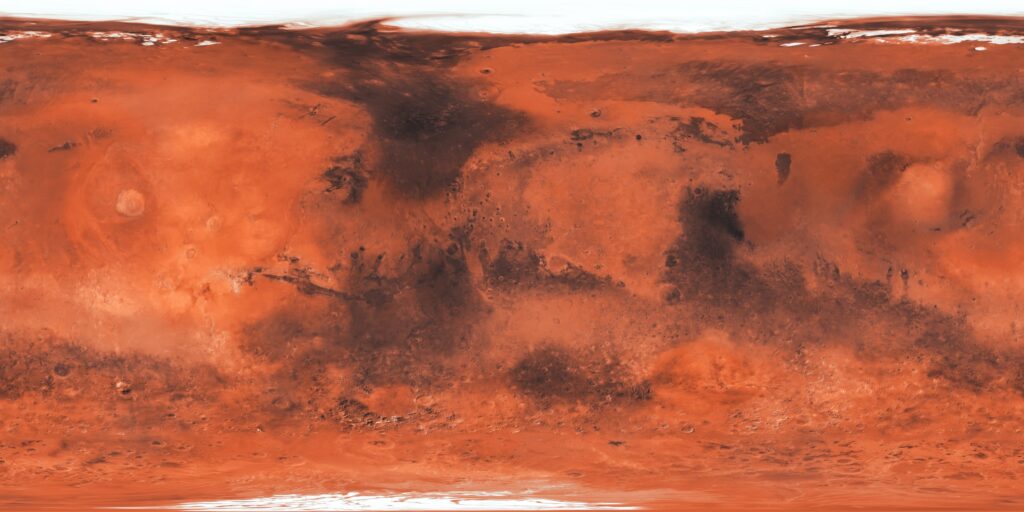
Mars reveals its nature first of all through its color. Its red appearance is not a mere accident of light, but the result of oxidized iron compounds spread through its rocks, soil, and dust. The planet is literally marked by iron exposed, dried, weathered, and reddened. In this way, the traditional association of Mars with iron, blood, rust, weapons, and heat receives an unusually direct astronomical expression.
Yet this redness is not the living red of fresh blood. It is the dry red of oxidation: iron altered by exposure, dust, and time. Mars does not appear as a fertile fiery world, but as a scorched, desiccated, and wounded one. Its color suggests not only blood and fire, but also rust, dryness, abrasion, and the traces of ancient damage.
In this sense Mars is not merely “the Red Planet.” It is iron made visible on the face of an entire world.
Volcanoes and Subterranean Fire
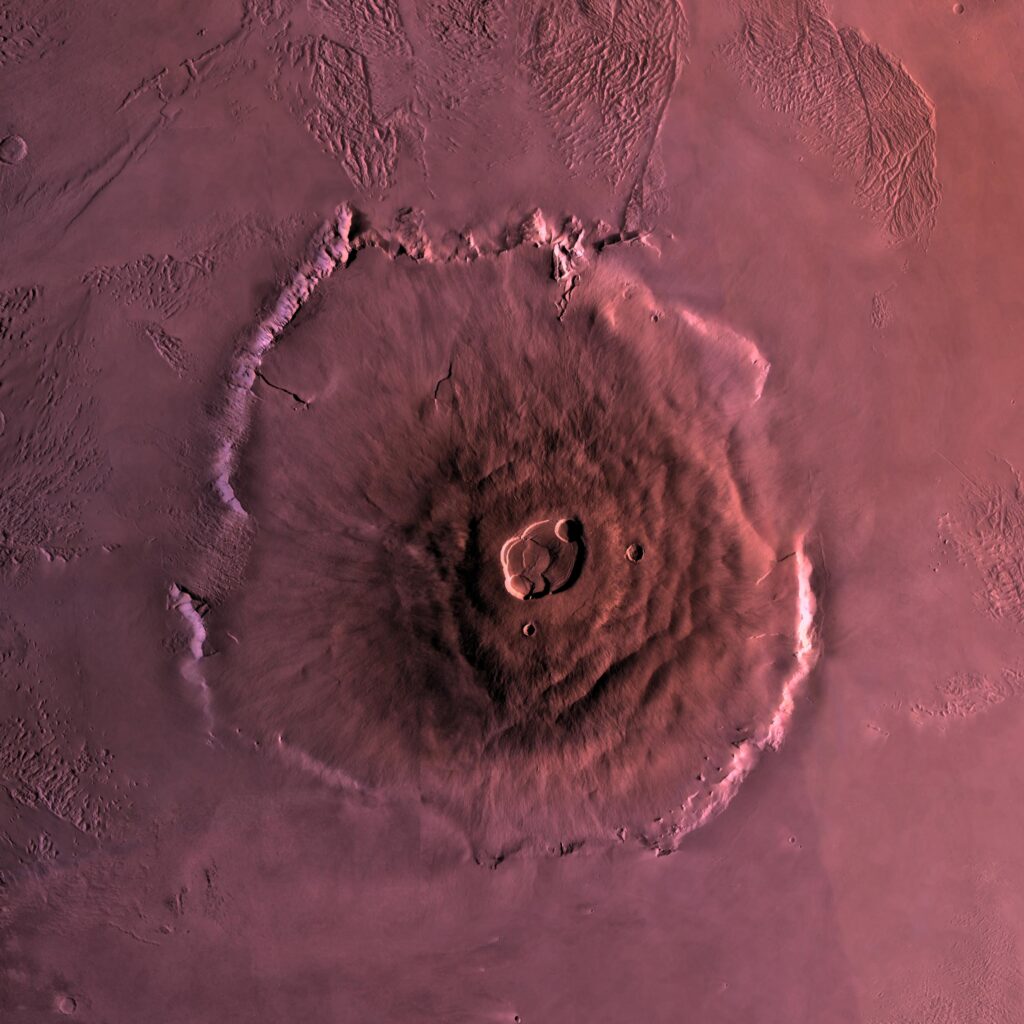
Mars possesses the largest volcanic structures known in the Solar System. Olympus Mons rises roughly 26 kilometers above the surrounding plains, and the Tharsis region forms a vast volcanic swelling on a planetary scale. Here the Martial symbolism is almost literal: fire rising from the depths, pressure breaking through the crust, and the surface shaped by eruptions of internal force.
This is not solar fire. It does not shine from above or vivify the world through light. It is chthonic, iron-bearing, volcanic fire, rising from below. It does not reveal form gently, but forces its way through the surface and leaves behind immense, hardened, and massive formations.
Mars therefore contains a strange paradox. Its surface is now cold, dry, and largely lifeless, yet the body of the planet preserves the memory of colossal fire. Like a weapon after battle, it has cooled, but the marks of violence remain.
Valles Marineris and the Principle of Rupture
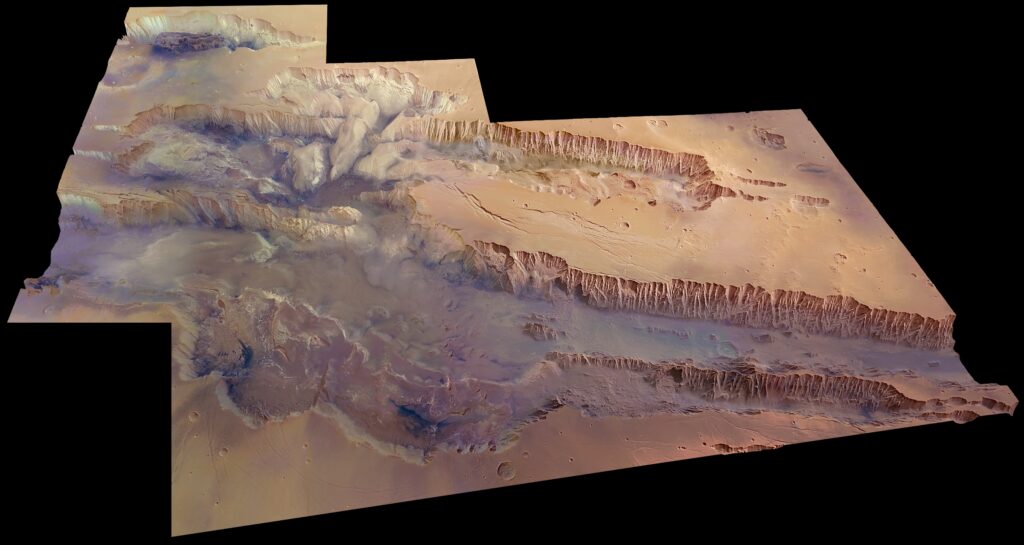
If Olympus Mons shows Mars as the upward eruption of internal fire, Valles Marineris shows Mars as rupture. This immense canyon system stretches for more than 4,000 kilometers across the planet. It is not merely a valley, but a planetary wound: a vast opening in the crust, as though the body of Mars itself had been cut.
Symbolically, this is one of the clearest astronomical images of Mars. Here form is not preserved or joined, but torn open. The surface is not unfolded gently, as in growth or maturation, but opened through damage. One of the chief Martial principles appears here with extraordinary clarity: breach, incision, exposure of the interior, and the violation of wholeness.
Valles Marineris may therefore be understood as the great scar of Mars: the image of the cut, the wound, and the violent opening of a surface.
Thin Atmosphere, Dust, and Dry Disturbance
The atmosphere of Mars is thin, harsh, and composed mostly of carbon dioxide. Suspended dust gives the Martian sky its reddish haze. Unlike the atmosphere of Earth, which softens, protects, and participates in the maintenance of life, the Martian atmosphere offers little shelter. It leaves the surface exposed.
Here again the astronomical Mars corresponds closely to its traditional nature. It is dry, uncovered, abrasive, and insufficiently protected. Martian winds can raise dust storms on regional and even global scales. Because the atmosphere is so thin, these storms do not have the same mechanical force as terrestrial hurricanes; yet they can darken the skies, cover the surface with dust, and disable machines.
This is Martial weather in a precise sense: not fruitful rain, not temperate air, but dust, dryness, irritation, obscuration, and disturbance.
Lost Water and the Desiccation of a World
Modern exploration has shown that Mars was not always as it appears today. Ancient riverbeds, deltas, lake deposits, and water-formed minerals indicate that liquid water once shaped significant portions of its surface.
For this reason the present condition of Mars becomes even more symbolically powerful. It is not merely a dry world. It appears as a world that has lost much of its former moisture, atmospheric protection, and capacity for stable habitability. Its current state is an image of desiccation after the withdrawal of life-bearing moisture.
In traditional language, this corresponds strongly to the excessive dryness of Mars. Mars does not preserve the soft continuity of life. It disrupts the conditions by which life is joined, moistened, sheltered, and sustained.
Iron Core and the Lost Shield
Mars contains iron not only on its surface. Its interior also bears the signature of iron. Seismic data have shown that Mars possesses a liquid core rich in iron and lighter elements.
Symbolically, this is important. Mars is iron not only outwardly, but inwardly. The same planet that reddens through oxidized iron at the surface also contains a hidden metallic heart. Yet unlike Earth, Mars no longer possesses a strong global magnetic field. Its ancient planetary dynamo appears to have ceased billions of years ago, leaving only remnant magnetism in portions of the crust.
The result is deeply Martial: iron is present, but the shield is broken. Without a global magnetic field, the planet became more vulnerable to the solar wind, contributing to the gradual loss of atmosphere and water. Mars therefore appears not as a protected fortress, but as a wounded body whose defense has been breached.
Phobos and Deimos: Fear Before the Blow
Mars has two small moons, Phobos and Deimos, named after the companions of Ares: Fear and Terror. At first glance, these images might seem more Saturnian, since fear, paralysis, darkness, and the expectation of misfortune belong naturally to the cold nature of Saturn. Around Mars, however, they acquire a different meaning.
This is not Saturnian fear: slow, heavy, and immobilizing, bound to time, deprivation, and death. It is fear born in the field of violence: alarm before attack, terror in battle, panic before shouting, blood, fire, and sudden impact. Phobos and Deimos do not express deep Saturnian melancholy. They accompany Martial action as its natural attendants.
Astronomically, both moons are small, irregular bodies, resembling captured asteroids or ancient debris. Phobos is especially expressive: it orbits extremely close to Mars, circles the planet several times during a Martian day, and is slowly drawing nearer. In the distant future, it will likely either break apart into a ring or crash into the planet.
This is significant. The rings of Saturn already present the image of boundary, death, disintegration, and matter held after destruction. Around Mars, however, we do not yet see the completed stillness of dead remains, but the tension before a future blow: approach, threat, instability, and expected destruction.
Around Mars move not peace and harmony, but Fear and Terror — not as its essence, but as the inevitable companions of a force that wounds, invades, and brings matters to collision.
Mars as the Wounded Brother of Earth
Mars is the planet most often compared with Earth. It has seasons, polar caps, ancient water-shaped landscapes, volcanoes, canyons, and a day not greatly different from our own. It is not alien to us in the same way as the giant planets. It is close enough to appear almost fraternal.
But this brother is wounded, dried, reddened, and stripped of protection. Where Earth preserves oceans, a dense atmosphere, and a global magnetic field, Mars shows a world after the loss of moisture, shelter, and vital continuity. Its surface remains exposed to dust, cold, radiation, and impact.
Here lies the deeper astronomical symbolism of Mars. Mars is not the planet of war merely because it is red. It is Martial because its very body displays iron, rust, scars, fractures, volcanic fire, lost water, a thin atmosphere, dust, vulnerability, and the memory of ancient violence.
Mars is the image of force entered into matter: fire hardened into iron, pressure breaking through crust, water driven from the world, protection weakened, and the surface left red through exposure and damage. Its astronomy does not soften the traditional image of the Lesser Malefic. It confirms it.