
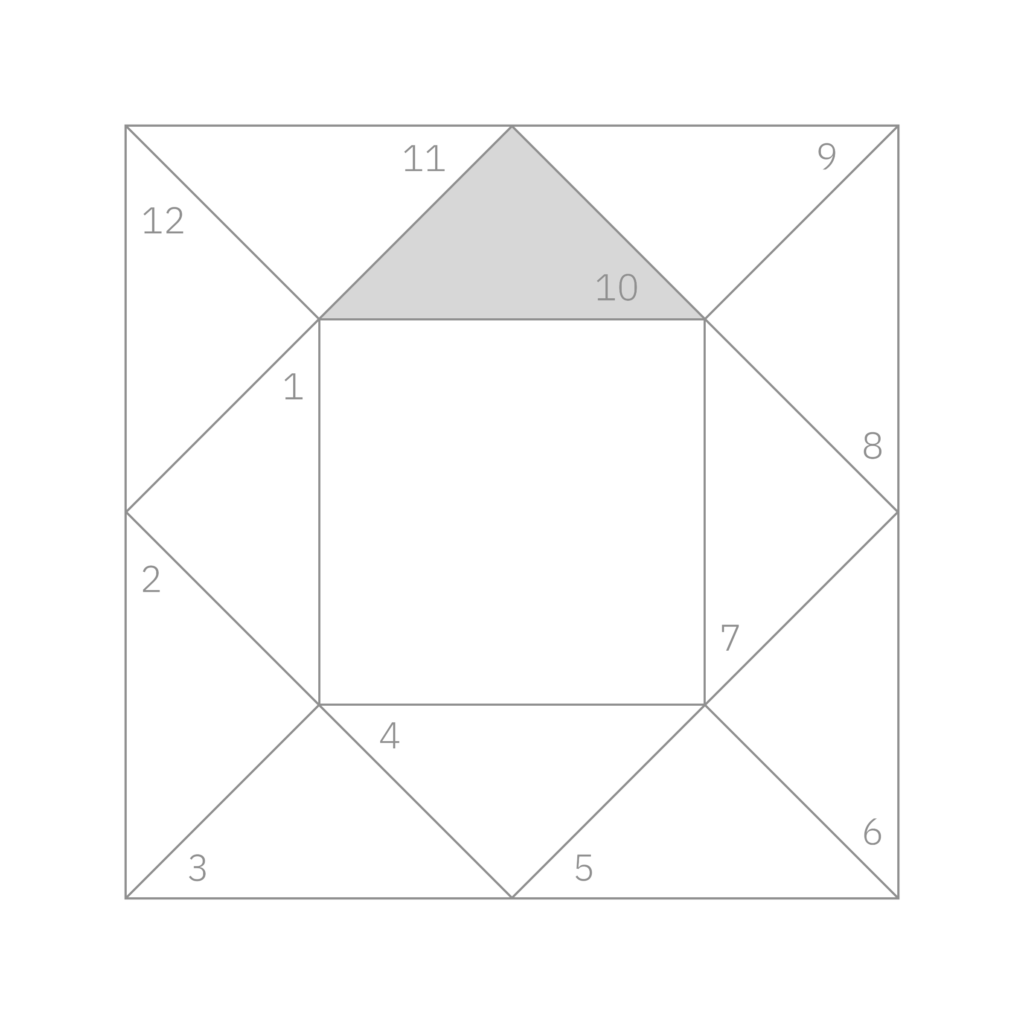

Latin Names:
- Regnum: Kingdom;
- Medium Coeli: the Middle Point of the Heavens.
Greek Name: Midheaven (Μεσουρανημα — Mesouranēma).
Arabic Names:
- بيت السلطان — Bayt as-Sultan: the House of Authority;
- بيت الملك — Bayt al-Mulk: the House of Kingship.
Hebrew Name: the Kingdom (המלכות — ha-Malkhut).
Alternative Names: the Angle of the Heavens · the South Angle.
House Type: cardinal (angle).
Mundane Planetary Ruler: F Mars.
Direction: south.
Anatomy: knees.
If the fourth house represents the foundation of a person’s life—his origins, roots, and the ground from which he arises—then the tenth house represents the summit of his earthly existence: the position he attains among men. The axis of the fourth and tenth houses forms the vertical structure of human life itself: the fourth house signifies origin and foundation, while the tenth house signifies elevation and attainment; the fourth house belongs to what is private and hidden, whereas the tenth house governs what is public, visible, and socially consequential. For this reason, the tenth house is the house of authority, honor, reputation, high position, and every activity through which a person becomes known in the world.
In traditional astrology, a house is not a collection of arbitrary meanings. All significations of a house must proceed from a single underlying principle. The tenth house is the culmination of the chart—its highest point, the place of maximum visibility and strength. Consequently, it signifies everything that possesses superiority, authority, weight, or elevation, whether literal or symbolic.
The Midheaven and the Nature of Elevation
Geometrically, the tenth house corresponds to the Medium Coeli, the highest point of the heavens. A figure (that is, the planet connected with the matter) placed there becomes maximally visible, influential, and active. For this reason, the significations of the tenth house are connected with everything that stands above the native, governs, carries social weight, or becomes visible to all.
Therefore, the tenth house signifies:
Authority and Social Superiority
- authority, command, and every superior station—bosses, rulers, kings, presidents, and all persons placed above the querent within the social hierarchy;
Judgment and Official Power
- judgment and official rulings—judges, prosecutors, juries, and all those empowered to render socially binding decisions;
Profession and Social Attainment
- profession and worldly attainment—career, office, trade, business, vocation, and every occupation through which a person assumes a definite place in society;
Fame, Honor, and Reputation
- fame, honors, and public recognition—reputation, titles, esteem, distinction, dignity, and elevated social standing;
Victory and Social Triumph
- victory and the attainment of supremacy—success in contests, competitions, political struggles, professional advancement, sports, and every arena in which rank, superiority, or triumph may be achieved;
Elevated Places and the Heights of the World
- all elevated places in the literal sense—the sky, weather, rooftops, towers, upper floors, hills, mountains, and all things situated high above the earth.
Profession, Career, and Social Position
For this reason, questions concerning profession and career belong to the tenth house. The matter is not merely labor itself, but the position a person occupies in society through his activity. Even if a man serves in a subordinate capacity, his profession nevertheless belongs to the tenth house, because it describes his social role and his place within the hierarchy of the world.
The Tenth House and the Mother
The tenth house exerts the greatest influence upon human life because it is the culmination of the chart and the highest point of earthly existence. And the one person who, from earliest childhood, most profoundly shapes the life of the child—directing his development and forming his path within the social order, family, or class into which he is born—is the mother.
As Bert Hellinger, the German psychotherapist, philosopher, and theologian, once remarked:
Success has the face of the mother.
Although traditional astrology does not require modern psychology in order to justify its principles, it is nevertheless striking that modern psychology arrives at a similar conclusion: namely, that the child’s primary relationship with the mother largely determines his inner sense of place in the world, his capacity for achievement, and his ability to rise socially.
For this reason, the tenth house traditionally signifies the mother—not merely as a biological parent, but as the archetype of the supreme formative and directing power, the “great sovereign lady” who determines the course of the native’s life. By extension, the house may also signify the stepmother, insofar as she occupies the maternal role within the family structure.
The opposing fourth house, meanwhile, pertains to the father, ancestry, lineage, and the foundation of life itself. It is no accident that in older Latin texts the fourth house is explicitly called Genitor—"the Father" or “Begetter of the Line.”
A Clarification Concerning Teachers and the Tenth House
Some older astrological sources assign teachers to the tenth house rather than the ninth. This reflects the social realities of the ancient and medieval world, in which a teacher was often not merely a learned man, but also a figure of direct authority over the student’s life and work.
In traditional societies, education was commonly transmitted through apprenticeship. A master blacksmith, mason, physician, or craftsman was simultaneously instructor, employer, disciplinarian, and social superior. The apprentice lived under the master’s authority, worked for him, obeyed him, and depended upon him economically and socially. In such conditions, the teacher naturally belonged to the tenth house as a superior, authority figure, and governor of the student’s worldly advancement.
In the modern world, however, these functions are usually separated. A teacher today is typically regarded as a learned specialist who transmits knowledge rather than as a personal ruler or master exercising direct authority over every aspect of the student’s life. Therefore, in contemporary practice, teachers are more properly assigned to the ninth house as learned persons and transmitters of higher knowledge, while the tenth house should remain reserved for bosses, rulers, employers, and figures of institutional authority.
Examples of Tenth House Questions
- Will I obtain the position of sales consultant?
- Will I receive a promotion?
- How will my business develop?
- How will the judge respond to my lawsuit?
- Will I gain recognition or fame?
- Will our team win the championship?
- What will the weather be like next week?
- Will the expedition succeed in climbing the mountain?
- What illness does my mother suffer from?
Quotes on the Tenth House
In the tenth house, we ask about kings and about princes and about judges and about officials and about all people having dominion on the earth whether through force or office.
Lectura Geomantiæ
In the tenth house, these things are considered: if the querent will be king or a powerful man or an elected official; if he will be bailiff to a king or official, that is, will have land or people placed under him by the king; if the king will be honored in his kingdom or despised or if he will be deposed; if having been deposed he will regain the throne; if he will govern the kingdom well; if the kingdom will be at peace; if the kingdom will be increased; if the querent will have hope of gaining honors; if the kingdom will be increased; if the querent will have hope of gaining honors; if the querent will be honored; if he will be fortunate in his relations with the king or a prince or his particular lord; if the querent’s teacher be faithful in all things; if the querent is esteemed by the king or prince or his lord; if his teacher knows the branch of knowledge which he has promised to teach; if the querent is esteemed by his mother; how his widowed mother will fare; if he will profit by a manual art; if the manual art about which he asks will be useful and lucrative to him; if on an appointed day it will rain, or what kind of wind will blow, or what kind of weather there will be.
Modus Judicandi Quaestiones Secundum Petrum de Abano Patavinum
Every line is constituted by two pillars: one the pillar of elevation and the other the pillar of the depth. Therefore it is said that these pillars signify the parents.
The ancients held that the fourth house signifies the father and the tenth the mother, whereas Ptolemy reversed this. The ancients, however, are correct, for the sign of the mother must be visible.
Because the fourth house is the most hidden of all, it signifies treasures, storehouses, treasuries, and everything concealed. And since it is the last of the pillars, it signifies the end of every matter and the grave in which a person is buried. It also signifies lands, houses, and fields.
The tenth house signifies great authority, because it is the highest of the pillars. It also signifies the craft or profession through which a person becomes known and by which his name is mentioned.
Abraham Ibn Ezra, The Beginning of Wisdom, Chapter III
A planet in the tenth house is like a man in authority, powerful and occupied with his business.
Abraham ibn Ezra, The Beginning of Wisdom, Chapter VIII, § 118
This tenth is a royal house, for by this we learn to judge of empire and rule, dignities, offices, arts, mother, and all things that are lofty; and this is called the Medium or Angle of Heaven, the mystery or art that a man is inclined unto. It signifies the half of the years of life to dignify… It rules the knees and hams.
Claude Dariot, A Brief and Most Easy Introduction to the Astrological Judgment of the Stars, Chapter XII
The tenth house signifies honour, dignities, offices, magistracy, kings, princes, dukes, earls, judges, and all commanders in general, and all persons in rule and authority. It signifies the querent’s mother, and has signification of preferment, whether attainable or not; also what profession it is best for anyone to follow… It is called the Medium Coeli, or Midheaven… Of the body of man, it rules the knees and hams.
John Middleton, Practical Astrology, Chapter XI
Commonly it personates kings, princes, dukes, earls, judges, prime officers, commanders in chief, whether in armies or towns; all sorts of magistracy and officers in authority, mothers, honour, preferment, dignity, office, lawyers, and the profession or trade anyone uses. It signifies kingdoms, empires, dukedoms, and counties. It rules the knees and hams. It is called the Medium Coeli, or Midheaven… either K Jupiter or the A Sun greatly fortify this house when they are placed therein. L Saturn or the Q South Node usually deny honour to persons of quality, or give but little esteem in the world to a common person, and not much joy in his profession, trade, or mystery, if he is a mechanic.
William Lilly, Christian Astrology, Chapter VII