

Latin Name: Mercurius.
Greek Names:
- Ερμης — Hermēs: Hermes;
- Στιλβων — Stilbōn: the Gleaming One.
Arabic Name: Utarid (عطارد).
Hebrew Name: Kokhav (כוכב).
Alternative Names: the Hermaphrodite · the Messenger.
Mundane House Ruled: Valetudo.
Figures: Albus, Conjunctio.
Gender: variable—masculine when oriental (rising before the A Sun) and feminine when occidental (setting after the A Sun).
Sect: variable—diurnal when oriental and nocturnal when occidental.
Qualities: moderately cold and dry, with dryness predominating.
Element: 🜃 earth.
Powers: rational, clarifying, discriminative, conjunctive, transmissive, calculative, inventive, and adaptive.
Colors: complex, mixed, variegated, changeable, reflective, iridescent, and liquid-metal colors; gray mixed with sky-blue, dove-neck blue-gray, bluish gray, silvery white, quicksilver-gray, mirror-like silver-gray, many-colored patterns, mottled and speckled tones, and hues composed of several colors joined together without becoming one simple color.
Smells: complex, compound, subtle, volatile, quickly diffusive, penetrating, dry, medicinal, apothecary-like, elusive, and mentally clarifying odors; odors composed of several ingredients or carried swiftly through the air.
Tastes: complex, compound, contrasting, subtle, penetrating, strange, dry, medicinal, elusive, and difficult to name; tastes composed of several qualities joined together without resolving into one simple flavor, such as sweet-sour, sweet-salty, herbal-medicinal, or medicinal-aromatic combinations.
Things: mixed and compound things, such as sweet-sour sauces, cocktails, pizzas, and other things made from several unlike parts; small things found in large numbers, such as seeds, currants, grains, and similar clustered things; flatulence-producing foods and wind-making devices, such as beans, peas, lentils, chickpeas, bellows, fans, and wind turbines; things enclosed in shells or resembling the brain, such as nuts and walnuts; objects of writing and record-keeping, such as documents, books, journals, stationery, account books, and receipts; objects of trade and calculation, such as coins, money, scales, counters, ledgers, invoices, and calculators; objects of transaction and obligation, such as contracts, agreements, promissory notes, seals, and signed papers; objects of access and passage, such as keys, tickets, passes, passports, and maps; objects of science, such as scientific instruments, laboratory notebooks, diagrams, and measuring tools; objects of astrology, such as astrolabes, ephemeris tables, horoscopic charts, and calculation tables; objects of magic, such as magic squares, inscribed sigils, written formulas, and talismanic diagrams; objects of communication and technical intelligence, such as phones, computers, routers, modems, network cables, and smart speaking devices; objects of theft, deception, and substitution, such as lockpicks, false keys, forged papers, counterfeit goods, forged identity papers, marked cards, and loaded dice; objects of humor, mockery, sarcasm, and practical joking, such as caricatures, comic masks, whoopee cushions, fart machines, trick boxes, and joke devices; and things that imitate human speech, thought, movement, or behavior, such as puppets, dolls, mechanical figures, talking toys, and speech-synthesis devices.
Places: places of trade and exchange, such as shops, markets, fairs, bazaars, exchange offices, counting houses, brokerage offices, and merchants’ stalls; places of learning, writing, copying, and records, such as schools, classrooms, libraries, bookshops, printing houses, clerks’ offices, accounting offices, registry offices, newsrooms, and editorial offices; places of communication, delivery, access, and transit, such as crossroads, gates, bridges, corridors, doorways, ticket offices, post offices, courier offices, reception desks, railway stations, bus terminals, airports, telegraph offices, telephone exchanges, and call centers; places of gambling and games of chance, such as casinos, gambling houses, betting shops, card rooms, and gaming halls; places of science, astronomy, astrology, geomancy, magic, and technical arts, such as laboratories, observatories, planetariums, astronomical-clock towers, astrology schools, occult shops, divination salons, alchemical laboratories, instrument-makers’ workshops, and mapmaking and surveying offices; places of medicine and pharmacy, such as pharmacies, apothecaries, dispensaries, clinics, physicians’ offices, diagnostic centers, and medical laboratories.
Weather: windy, changeable, unsettled, restless, stormy, and mixed weather; irregular and shifting winds, gusts, turbulent air, sudden changes in the atmosphere, broken clouds, passing showers, wind-driven rain, squalls, and, when moisture is present in unstable conditions, hail, thunder, lightning, or tempests; traditionally also earthquakes, earth tremors, and fissures, understood as the effect of winds or vapors trapped and moving within the earth.
Metals and Materials: mercury (quicksilver), mercury-bearing compounds, amalgams, chemical reagents, apothecary powders, pharmaceutical mixtures, inks, writing pigments, and all quicksilver-like, volatile, amalgamating, powdered, or chemically mixed materials.
Stones: agate, colored tourmaline, cinnabar, flint, and feldspar; mixed Mercurial stones include kyanite (with K Jupiter), emerald (with C Venus), aquamarine (with the E Moon and K Jupiter), opal (with C Venus and the E Moon), and other beryls when marked by inclusions, internal lines, variegation, or mixed optical character.
Character: intelligent, quick-minded, observant, articulate, analytical, curious, witty, precocious, inventive, dexterous, adaptable, versatile, diplomatic, resourceful, playful, and mentally agile; inclined to notice differences, compare things, ask questions, learn quickly, explain clearly, imitate skillfully, negotiate, mediate, bargain, joke, find loopholes, and discover practical ways through difficulty; able to move between different people, languages, opinions, roles, trades, social circles, and bodies of knowledge, and to handle obscure, hidden, delicate, or transitional matters with unusual ease; seeking understanding, useful knowledge, mobility, exchange, advantage, connection, and the ability to turn one thing into another through words, signs, numbers, tools, remedies, tricks, or agreements; in its harsher expression—restless, scattered, nervous, unstable, superficial, evasive, shamelessly clever, mocking, sarcastic, sophistical, double in speech, imitative without depth, opportunistic, deceptive, lying, thievish, fraudulent, manipulative, clever without conscience, and prone to gossip, tricks, forgery, false reasoning, theft, and the misuse of speech, knowledge, or skill.
Physical Appearance: a slender, lightly built, quick, and mobile body, more narrow or long-limbed than broad; a long or narrow face, high or prominent forehead, thin nose, thin lips, dark, gray, or lively moving eyes, a mixed or muted complexion—pale, olive, chestnut-brown, swarthy, or muddy rather than clear in tone—brown or dark hair, expressive hands, and long or slender fingers; a youthful, alert, and sometimes androgynous appearance, with features that may be difficult to place as strongly masculine or strongly feminine.
People and Professions: writers, scribes, copyists, editors, printers, publishers, clerks, secretaries, notaries, legal clerks, contract drafters, translators, interpreters, teachers, tutors, grammarians, logicians, orators, rhetoricians, journalists, satirists, comic writers, stand-up comedians, messengers, couriers, ambassadors, negotiators, mediators, accountants, bookkeepers, auditors, money-changers, brokers, merchants, dealers, salespeople, financial traders, mathematicians, geometers, surveyors, calculating clerks, programmers, data analysts, laboratory analysts, laboratory technicians, instrument-makers, astrologers, geomancers, interpreters of signs, ritual magicians who work through formulas, sigils, tables, and written methods, occult interpreters, diagnostic physicians, pharmacists, apothecaries, craftsmen of fine manual skill, sleight-of-hand performers, impersonators, voice imitators, ventriloquists, gamblers, cardsharps, thieves, forgers of documents, seals, or money, counterfeiters, swindlers, fraudsters, and confidence tricksters; in general, professions based on speech, writing, copying, editing, translation, calculation, trade, interpretation, mediation, documents, contracts, diagnosis, pharmacy, astrology, geomancy, technical magic, manual dexterity, imitation, verbal wit, redaction, compilation, or clever deception.
Anatomy: nervous system, tongue, fingers, hands, mental faculties, alveoli.
Endocrine Gland: the adrenal glands—the only paired endocrine gland.
Diseases: vertigo, stuttering, flatulence, central nervous system disorders, hypersalivation, cough.
Planetary Years: 10 (~88-day orbital cycle).
Stage of Life: childhood (ages 4–14).
Day of the Week: Wednesday.
Night of the Week: the night from Saturday to Sunday.
Astrological Characteristics of Mercury
Neutrality, Contact, and the Intelligence of Signs
Mercury is regarded as a neutral, mixed, common, and changeable planet. Its nature is not simply masculine or feminine, benefic or malefic. It varies according to the planet’s condition, position, and contact with other celestial bodies.
With masculine planets Mercury acts in a more masculine manner; with feminine planets, in a more feminine manner. With benefic and well-ordered influences it becomes useful, intelligent, eloquent, inventive, and skillful. With corrupted or malefic influences the same mobility and dexterity may become deceit, mockery, theft, fraud, empty talk, and cleverness without conscience.
For this reason Mercury is traditionally called hermaphroditic or common. This does not mean that it lacks nature. On the contrary, its nature is double, receptive, and able to take the form of that through which it acts. Mercury stands between opposites and carries one thing into relation with another: masculine and feminine, day and night, thought and speech, speech and writing, sign and meaning, road and destination, visible and hidden things.
When Mercury is oriental, rising before the Sun, it inclines more toward its active and diurnal side. When it is occidental, setting after the Sun, it inclines more toward its receptive and nocturnal side. Already in this we see its essential nature: Mercury is not fixed in one simple state, but acts as mediator, translator, and conductor between different orders.
In the traditional scheme followed here, Mercury is cold and dry, with dryness predominating. Yet this coldness is not the heavy coldness of Saturn, bound to old age, fear, deprivation, and death. Nor is this dryness a barren rigidity or immobility. Mercury dries in another way: it distinguishes, separates, defines, compares, and brings things into clear conception.
For this reason Mercury is naturally connected with reason, speech, writing, learning, counting, interpretation, trade, mediation, transport, technique, manual dexterity, and all arts in which one meaning is carried, translated, exchanged, or transformed into another through sign, word, number, contract, instrument, or method.
The Messenger, the Mediator, and the Trader
Through its changeable nature, Mercury represents the principles of communication and contact. It is the messenger of the gods—that is, the one who carries will, meaning, and message from one order into another. Therefore language, writing, education, documents, news, roads, markets, negotiations, transport, calculation, contracts, and all forms of exchange fall under its rule.
Yet communication here should not be understood merely as conversation. Mercury governs the whole field of transmission: thought becoming word; word becoming written text; number becoming account; sign requiring interpretation; promise fixed as contract; knowledge passing from teacher to student; goods passing from seller to buyer.
Mercury does not rule from the center, as the Sun does; it does not establish law and higher order, as Jupiter does; it does not unite through love and pleasure, as Venus does; it does not overcome resistance by force, as Mars does. Mercury connects in another way: through message, road, writing, map, key, contract, translation, calculation, explanation, and practical resourcefulness.
In commerce Mercury appears with special clarity. Goods pass from one person to another; price is calculated; value is translated into money; promise becomes contract; possession changes through agreement. Jupiter signifies wealth as abundance, dignity, and lawful prosperity. Mercury signifies the movement of goods, money, papers, information, and the conditions of exchange.
Mercury is therefore not only the planet of speech, but also the planet of practical intelligence. It knows how to ask, where to go, what to say, how to prepare the paper, how to find the passage, how to use the rule, how to open what is closed, and how to pass through an obstacle not by force, but by precision of understanding.
The Key to Mercury’s Correspondences
Among all the planets, Mercury is especially difficult to understand through lists of correspondences alone. With the other planets, the general image usually forms more quickly because their primary signatures are more immediately visible: Saturn is recognized in coldness, age, heaviness, fear, and limitation; Jupiter in law, honor, faith, abundance, and beneficent growth; Mars in heat, iron, blood, anger, and violence; the Sun in light, life, authority, glory, and dignity; Venus in love, beauty, pleasure, softness, and union; the Moon in cold moisture, night, the feminine principle, soft and liquid things, infants, the mother, common people, and changeability.
Mercury is different. At first glance its correspondences may seem scattered or even incompatible: books, markets, keys, thieves, medicines, jokes, computers, parrots, contracts, maps, riddles, actors, scribes, astrologers, and forged papers appear to belong to different worlds. If one looks only at the outward form of things, Mercury seems chaotic.
The key is that Mercury does not signify one visible substance or one emotional quality. It signifies a function. A thing becomes Mercurial when it carries meaning, creates contact, imitates speech or thought, records information, opens passage, translates one thing into another, measures, counts, negotiates, diagnoses, exchanges, or uses dexterity to pass through difficulty.
A word is Mercurial because it carries thought to the listener. A document is Mercurial because it translates intention into obligation. A key is Mercurial because it joins what is closed to what is accessible. A map is Mercurial because it translates space into sign. A price is Mercurial because it translates a thing into a measure of value. A diagnosis is Mercurial because it connects a visible symptom with a hidden cause. A joke is Mercurial because it carries meaning through unexpected substitution. A forgery is Mercurial because it imitates the sign of truth without possessing truth itself.
Once this principle is understood, Mercury’s apparent disorder becomes coherent. Mercury belongs wherever there is sign, passage, exchange, imitation, interpretation, calculation, technique, dexterity, or the transformation of one thing into another. Its domain is therefore broader and more mobile than that of most other planets. It is not so much a “thing” as the manner by which things are connected, transmitted, and changed in state.
Hermes and the Crossing of Boundaries
The mythology of Hermes reveals Mercury’s nature with particular clarity. Hermes is the god of roads, boundaries, messages, trade, cunning, theft, eloquence, music, and guidance between worlds. He does not belong only to one place or one order. His domain is passage.
One of the most important myths tells how the newborn Hermes invents the lyre from a tortoise shell, steals Apollo’s cattle, hides the tracks, denies the theft with astonishing verbal dexterity, and then turns conflict into exchange by giving Apollo the lyre. In this myth, almost the whole nature of Mercury is shown in action.
Hermes steals, but at the same time he invents. He deceives, but he also negotiates. He disturbs order, but then creates a new agreement. He does not defeat Apollo by force, nor does he submit to him in silence. He acts through mind, speech, music, exchange, and the ability to turn one thing into another.
Here the Mercurial principle appears clearly: crossing the boundary, clever transgression, invention, mediation, substitution, translation, and transformation. Theft becomes trade. Dispute becomes agreement. Sound becomes music. A shell becomes an instrument. A hidden act becomes a newly recognized place among the gods.
As psychopomp, Hermes reveals an even deeper level of the same nature. The one who carries messages between gods and men may also guide souls between life and death. Mercury governs passage itself—between languages, places, states, worlds, the visible and the hidden.
Dignity and Corruption of Mercury
When well-conditioned, Mercury gives subtle and strategic intelligence, eloquence, perceptiveness, cultural refinement, skill in discussion, love of learning, curiosity, inventiveness, commercial ability, and the desire to investigate what is unknown. It makes the mind receptive, quick, observant, and able to deal with complex or hidden matters.
Such a Mercury can explain, translate, calculate, teach, trade, persuade, negotiate, interpret signs, diagnose, draft texts, and find a practical path where others see only obstruction. It is especially strong in ambiguous situations, where what is needed is not brute force, authority, or inspiration, but precise understanding, the right word, the correct sign, a useful method, and a timely move.
In weakened or corrupted condition, Mercury’s actions become restless, contentious, and scattered. It gives disorganized thought, empty talk, lying, boasting, mockery, provocation, ridicule, sophistry, double speech, forgery, fraud, theft, and the ability to mislead others.
The corruption of Mercury is especially dangerous because it may appear intelligent. The violence of Mars is easily recognized; the heaviness of Saturn is unmistakable; the softness of Venus reveals itself through the pursuit of pleasure. But corrupted Mercury can hide behind wit, learning, argument, technique, and verbal skill. It makes falsehood persuasive, emptiness subtle, mockery clever, and fraud almost legitimate.
Thus, in good condition, Mercury clarifies, teaches, translates, calculates, connects, and opens the way. In corrupted condition, it distorts, falsifies, mocks, scatters, deceives, and turns intelligence into an instrument of disorder.
Astronomical Characteristics of Mercury
Nearness to the Sun, Swiftness, and Difficult Visibility
Mercury’s astronomical nature begins with its closeness to the Sun. It is the nearest planet to the Sun and the smallest planet in the Solar System. From the earthly point of view, Mercury never appears far from the solar light: it is seen shortly before sunrise or shortly after sunset, and then quickly disappears again into the Sun’s brilliance.
Symbolically, this corresponds very closely to Mercury’s traditional nature. Mercury is not a king, as the Sun is, nor does it possess the majestic autonomy of Jupiter. It works near the source of light and authority, like a messenger, secretary, scribe, translator, or right hand of a ruler. Its strength lies not in dominion, but in transmission, formulation, communication, and swift movement between the center and the rest of the world.
Mercury completes its orbit around the Sun in about 88 Earth days and is the fastest planet in its orbital motion. Yet this swiftness should not be understood too crudely. Mercury is not merely “fast.” Its movement is intricate, changeable, and bound to repeated appearances, disappearances, approaches, and withdrawals. This is not the direct force of Mars, nor the majestic expansion of Jupiter, but the agile motion of a mediator who appears at the right moment, delivers the message, and slips out of sight again.
The Servant Near the Solar Court
Mercury has no moons and no rings. In this it differs sharply from planets that gather visible systems around themselves. Jupiter has many moons, like a king or teacher surrounded by a court and disciples. Saturn is encircled by rings, expressing boundary, separation, and the preservation of form. Mercury is different. It does not create a separate kingdom around itself.
This is especially fitting for a planet traditionally associated with servants, scribes, messengers, agents, and intermediaries. Mercury does not gather others around itself; it moves between others. Its place is not the throne, but the road to the throne; not the palace, but the office, the letter, the commission, the passage, the key, and the message.
Its closeness to the Sun strengthens this image. Standing near the royal light, Mercury cannot draw attention by its own brilliance. It must be flexible, quick, exact, and ready to disappear once its work is done. This agrees well with the traditional image of Mercury as one who acts not through personal grandeur, but through usefulness, skill, knowledge, and the ability to transmit another’s will.
Phases, Eccentric Motion, and Double Rhythm
As an inner planet, Mercury has phases. Its visibility changes according to its position in relation to the Earth and the Sun. This connects it naturally with changeability, doubleness, and dependence upon position. Mercury is morning and evening, oriental and occidental, visible and hidden, approaching the light and withdrawing from it.
Its orbit is also markedly eccentric. Mercury does not move in a calm, nearly even circle. It approaches the Sun and withdraws from it, accelerates and slows, constantly changing its relation to the solar center. Symbolically, this strengthens its nature as mediator, trickster, and planet of indirect motion—not the straight line, but the shift, the deviation, the side path, and the change of position.
Even Mercury’s day is strange. Because of the relation between its orbital motion and its rotation, a solar day on Mercury lasts longer than its year. This is an almost Mercurial paradox: the fastest planet in orbit has an exceptionally long solar day. Mercury again shows that its nature cannot be reduced to simple speed. Its rhythm is complex, double, and requires exact understanding.
A Surface of Marks, Traces, and Hidden Voids
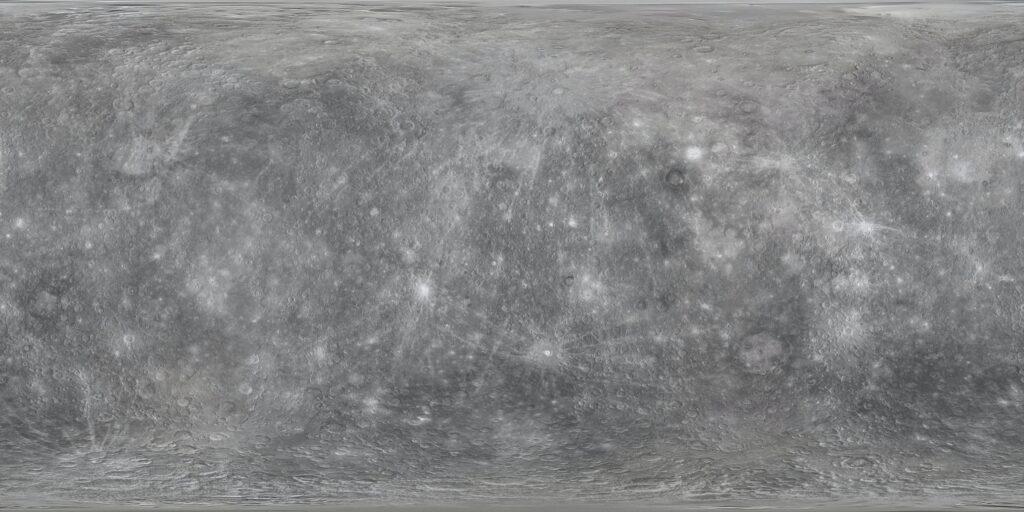
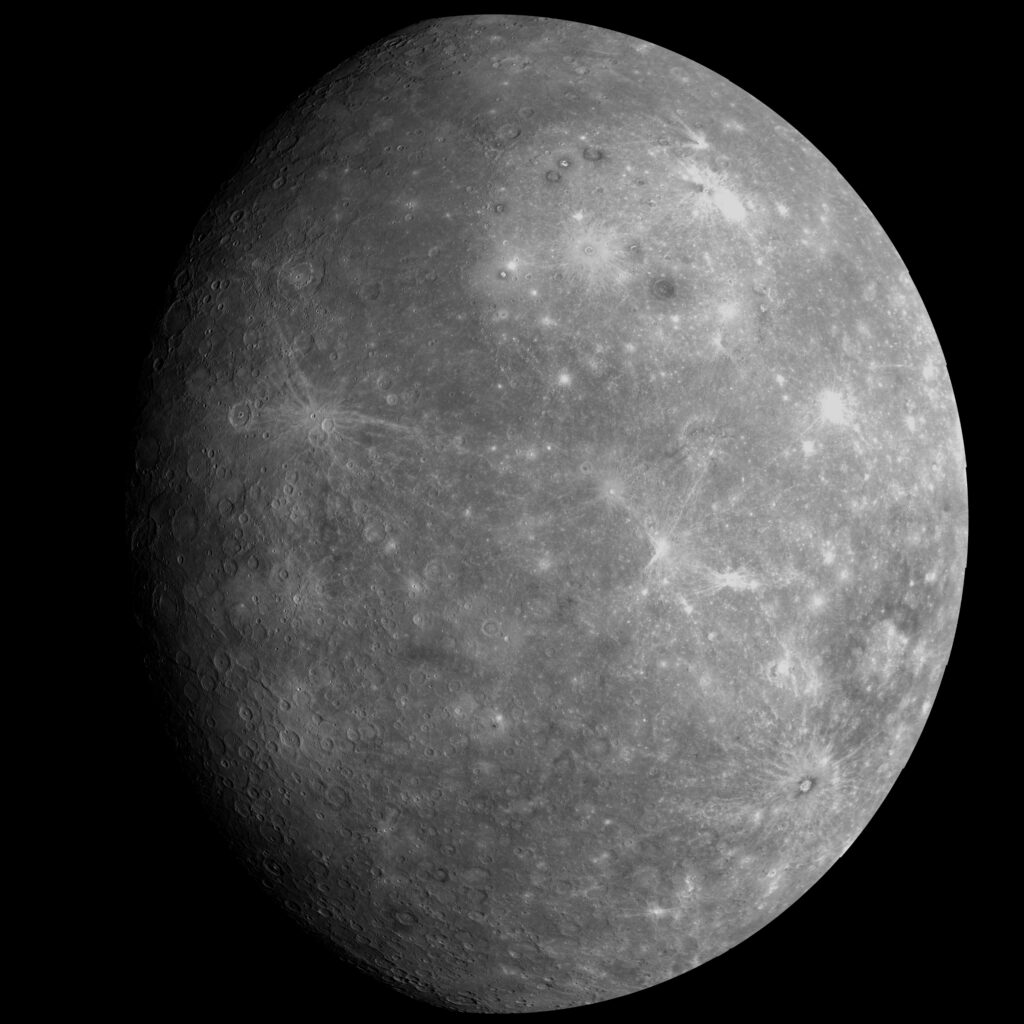
Mercury’s surface resembles the Moon in many ways: it is covered with craters, scarps, ridges, plains, and traces of ancient impacts. Yet symbolically this surface is especially suitable for Mercury. It does not appear as a smooth body, but as a surface written over with marks, lines, scars, and traces.
Such an appearance naturally connects Mercury with signs, records, tracks, messages, and interpretation. What matters here is not Venusian beauty of form, nor solar splendour, but the surface itself as a field of marks. Mercury seems to preserve not one unified image, but many small indications that must be read.
Particularly expressive are the strange bright hollows discovered on Mercury. They appear as irregular depressions, places where material has been lost or altered. This suits the Mercurial theme of volatility, passage, and transformation: the solid becomes absent; the trace points to a hidden process; the surface is not a fixed wall, but a record of changes.
Extreme Heat, Hidden Ice, and a Thin Envelope
Mercury is the closest planet to the Sun, but it is not simply a planet of heat. Because it has no dense, stable atmosphere, its day side can become extremely hot, while its night side becomes extremely cold. This sharp contrast between heat and cold expresses Mercury’s double nature with unusual force: it stands between light and darkness, proximity and withdrawal, appearance and disappearance.
Mercury does not possess a thick atmosphere capable of retaining heat and creating a stable surrounding medium. Instead, it has a thin exosphere—a weak and changeable envelope of particles knocked from the surface by the solar wind and micrometeoroids. This is especially appropriate for Mercury. Its surrounding medium is not firmly held, but continually renewed, scattered, and formed again.
Still more striking is the evidence for water ice in permanently shadowed polar craters on the planet nearest the Sun. Symbolically, this is one of the strongest images of Mercury: beside solar fire there is hidden cold; beside clear light there is concealment; beside visibility there is the unseen. Mercury is not simply exposed to light. It preserves passages, corners, shadows, and hidden information.
The Iron Core and Hidden Inner Force
Despite its small size, Mercury possesses a very large metallic core and a real magnetic field, though far weaker than Earth’s. Here it is important not to turn Mercury into Mars merely because iron is strongly present in its composition. In Mars, iron is displayed outwardly—in the red surface, in the imagery of blood, weapons, rust, and open force. In Mercury, the metallic power is hidden within.
This corresponds well to Mercury’s nature. Mercury is small, mobile, and outwardly lacking in grandeur, yet within it lies a dense structure that allows it to maintain itself near the immense force of the Sun. Its strength is not demonstrative. It acts as a hidden mechanism, a core, an internal calculation, and the capacity to endure difficult conditions.
Mercury’s magnetic field is also symbolically fitting. It is not like Jupiter’s immense magnetosphere, spreading authority across vast space. It is weaker, narrower, and more restless, constantly interacting with the solar wind. This is not a royal field of dominion, but a quick system of response, conduction, and contact—almost an astronomical image of Mercurial nervousness and receptivity.
Vulcan and the Mercurial Phantom
One of the most curious episodes in the history of astronomy was the hypothesis of the planet Vulcan. The unusual motion of Mercury’s perihelion could not be fully explained by earlier calculations, and so astronomers proposed the existence of another planet inside Mercury’s orbit. Later, the need for Vulcan disappeared: Mercury’s anomaly was explained by the general theory of relativity.
Symbolically, this is an almost perfect Mercurial story. Mercury’s motion produced an intellectual puzzle, a hypothesis, a false trail, and the phantom of a non-existent celestial body. Where observation and calculation failed to agree, the mind invented an intermediary to fill the gap.
Yet Mercury ultimately demanded a subtler theory. Its strangeness was not a meaningless error. It revealed the limit of an older explanation and forced thought to move to a new level. Even in the history of science, Mercury shows its nature: it creates the question, conceals the direct answer, offers a misleading path, and then compels the search for a more exact language with which to describe reality.