

Latin Name: Iuppiter.
Greek Names:
- Ζευς: Zeus;
- Φαεθων — Phaethōn: the Radiant One.
Arabic Name: al-Mushtari (المشتري).
Hebrew Name: Tzedek (צדק).
Alternative Name: the Greater Benefic.
Mundane Houses Ruled: Lucrum, Itineris.
Domiciles: i Sagittarius, l Pisces.
Figures: Acquisitio, Lætitia, Caput Draconis.
Gender: masculine.
Sect: diurnal.
Qualities: moderately hot and moist.
Element: 🜁 air.
Powers: nourishing, augmentative, life-giving, ordering, and integrative.
Colors: bright, luminous, and dignified colors; azure, royal blue, violet, purple, burgundy-red, saffron, and yellowish-white tones.
Smells: sweet, pleasant, wholesome, and temperate fragrances; rich but moderate aromas.
Tastes: sweet, rich, and mildly bittersweet tastes.
Things: large, expansive, prosperous, fertile, fruitful, noble, dignified, merciful, just, religious, scholarly, teaching, ceremonial, well-crafted, socially elevated, spreading, or purple.
Places: temples, sanctuaries, mosques, churches, pilgrimage sites, courts of law, universities, libraries, places of learning and judgment, and all honorable, prosperous, clean, and well-ordered places.
Weather: warm, temperate, clear, and fruitful weather; healthy air, bright open skies, gentle winds, and beneficial rains.
Metals and Materials: tin, fine and noble materials, and all rich, pure, well-formed, and high-quality substances.
Stones: Afghan lapis lazuli, amethyst (with F Mars), blue topaz, charoite, larimar (with E Moon), and turquoise (with E Moon and C Venus).
Character: noble, wise, generous, just, magnanimous, temperate, merciful, faithful, honorable, dignified, and protective; inclined toward wisdom, justice, religion, higher learning, benevolence, prosperity, good counsel, and the guidance and upliftment of others; seeking harmony, order, abundance, and lawful balance in both worldly and spiritual matters; in its excessive expression—self-indulgent, extravagant, complacent, overconfident, dogmatic, pompous, morally self-righteous, indulgent in pleasures and comforts, and inclined toward excess, pride, and overexpansion.
Physical Appearance: a tall and well-proportioned figure, with a tendency toward fullness, noble and pleasing appearance, ruddy complexion, a full oval face, fair or chestnut hair, large bright eyes, and strong thighs.
People and Professions: judges, lawyers, senators, chancellors, priests, bishops, theologians, scholars, professors, teachers, gurus, aristocrats, and all who are concerned with law, religion, governance, wisdom, and higher learning.
Anatomy: the liver, the lungs (with B Mercury), cartilage, blood, and semen.
Endocrine Gland: the hypothalamus.
Diseases: inflammation of the liver and lungs, itching, hemoptysis, tumors and growths, pustules, measles, frequent fevers, and a rapid, forceful pulse.
Planetary Years: 12 (~11.86-year orbital cycle).
Stage of Life: the height of life (ages 56–68).
Day of the Week: Thursday.
Night of the Week: the night from Sunday to Monday.
Astrological Characteristics of Jupiter
Harmony, Wisdom, and Beneficent Expansion
Jupiter is regarded as a diurnal and masculine planet. Its temperament is moderately hot and moist, and its nature is associated with the element of air and the sanguine humor. Among the seven traditional planets, Jupiter is one of the brightest and most majestic. Its elevated brilliance and calm, deliberate motion made it, from antiquity, the celestial image of harmony, justice, prosperity, and lawful order.
Standing between the severity of Saturn and the violence of Mars, Jupiter moderates extremes, reconciles opposites, and restores proportion through wisdom and balance. For this reason, the planet became associated with kingship, religion, law, philosophy, generosity, and all forms of higher order that preserve society from both chaos and tyranny.
For this reason Jupiter became associated with judges, priests, kings, counselors, scholars, and all who govern through moral authority, knowledge, and lawful guidance rather than force.
Growth, Prosperity, and Social Order
Because its nature is warm and moist, Jupiter sustains vitality, fertility, abundance, generosity, confidence, and social concord. It governs growth that remains ordered and fruitful: increase guided by moderation, dignity, and proportion rather than chaos and excess.
Thus Jupiter signifies prosperity honestly attained, honorable rank, mercy, hospitality, sacred tradition, higher learning, and the civilizing principles that preserve kingdoms, laws, and religious institutions. Its influence favors healthy air, fruitful rains, ceremonial dignity, and all flourishing, prosperous, and well-ordered things.
Nobility, Faith, and Good Judgment
The Jovian temperament inclines toward magnanimity, fairness, benevolence, prudence, piety, and trust. Jupiter seeks reconciliation over conflict, guidance over domination, and lawful stability over disorder. As the Greater Benefic, it protects, uplifts, preserves, and grants hope, confidence, dignity, liberality, and faith in both divine and human order.
At its highest expression, Jupiter signifies wisdom tempered by moderation, authority restrained by conscience, and power exercised through justice and mercy.
Excess, Inflation, and Corruption
Yet because Jupiter expands whatever it touches, its corruption arises through excess rather than deprivation. When imbalanced, its virtues become swollen and disproportionate. Wisdom turns into dogmatism, dignity into pomp, confidence into arrogance, generosity into extravagance, and piety into hypocrisy or empty ceremonialism.
In its harsher manifestation Jupiter may signify complacency, vanity, boastfulness, indulgence, misuse of privilege, false moral superiority, and claims to wisdom or authority unsupported by true merit, discipline, or understanding.
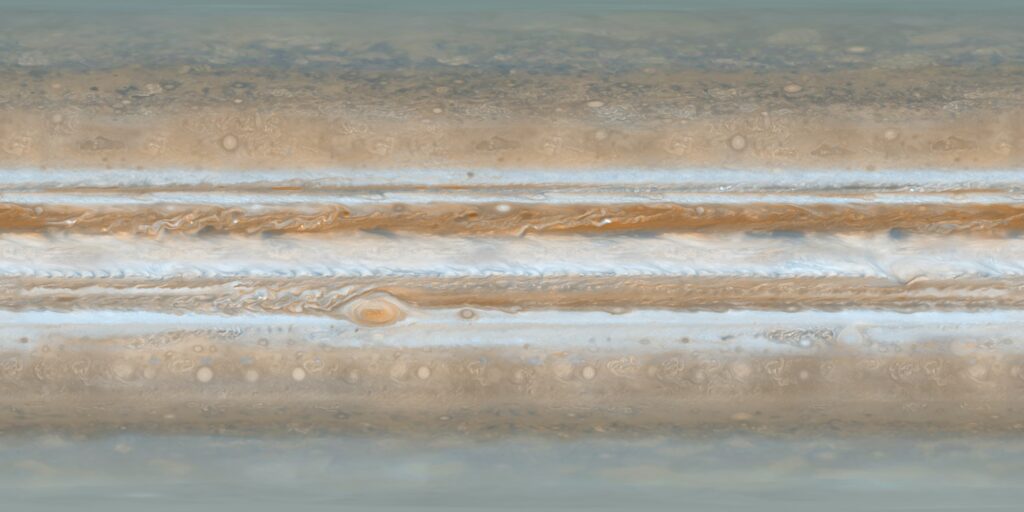
Astronomical Characteristics of Jupiter
Expansion, Influence, and the Sustaining of Life
Jupiter reveals its nature already through its very astronomical constitution. It is the largest planet in the Solar System, whose mass exceeds that of all the other planets combined. In traditional astrology, Jupiter is the Greater Benefic—the planet of growth, prosperity, protection, and the fullness of life. Symbolically, this is especially striking: the forces of preservation, sustenance, and organization prove stronger than the forces of destruction, limitation, and decay.
Yet Jovian expansion does not signify a mere mechanical increase in size. Jupiter does not destroy form—it expands and organizes it. Its colossal gravity influences the stability of a vast portion of the Solar System, holding numerous bodies within a unified order and affecting the movement of comets, asteroids, and countless other objects. Jupiter does not merely occupy space—it organizes the space around itself. Here the ancient image of Jupiter as protector, guardian of law, and sustainer of life receives a direct astronomical expression.
Unlike Saturn, whose nature is associated with limitation, fixation, and separation, Jupiter manifests itself through the extension of influence, integration, and the outward activity of force. Its atmosphere is a gigantic system of continuous circulation: streams, vortices, storms, and energetic exchange. What matters here is not turbulence alone, but the capacity to preserve stable order within perpetual motion. This becomes one of the defining astronomical characteristics of the Jovian nature.
The Jovian System and the Principle of Integration
One of the most important manifestations of Jupiter’s nature lies in the very structure of its planetary system. Unlike Saturn, where the rings visually dominate—vast masses of divided and fragmented matter—Jupiter’s defining feature is its moons: numerous bodies held within a single gravitational order.
This distinction is deeply symbolic. Saturn’s rings consist of innumerable fragments distributed within rigid boundaries and unable to unite into a complete body. They evoke Saturnian principles of division, limitation, isolation, and incomplete formation. Many of Saturn’s moons directly participate in maintaining and shaping the ring structure, preserving its separation and stable boundaries.
Jupiter’s system, however, is arranged differently. Its moons do not form a fragmented field of debris, but a complex yet integrated hierarchy surrounding a dominant center. Symbolically, this corresponds remarkably well to the traditional meanings of Jupiter: kingdoms, laws, priesthoods, universities, spiritual schools, courts, and all forms of organized social life.
In the Indian tradition, Jupiter is known as Guru—the teacher who gathers disciples around himself. Astronomically, the very structure of the Jovian system reflects this image. Unlike Saturn, whose rings consist of divided masses of matter confined within strict boundaries, Jupiter is defined by an immense system of satellites: an integrated hierarchy of bodies organized around a single center. Symbolically, it resembles a royal court, a sacerdotal hierarchy, or a circle of students surrounding a spiritual master.
Even Jupiter’s influence upon other bodies of the Solar System bears the character not of destruction, but of attraction, retention, and organization. Jupiter gathers numerous separate bodies into a unified system and creates around itself a sphere of integrated influence.
Radio Emissions, the Magnetosphere, and Celestial Authority
Jupiter possesses the largest magnetosphere in the Solar System, extending millions of kilometers into surrounding space and at times nearly reaching the orbit of Saturn. This magnetosphere generates the most powerful planetary radio emissions in the Solar System. Jupiter quite literally spreads its presence through space.
Symbolically, this is especially important because Jupiter is traditionally associated with the element of Air. In Hermetic and traditional thought, air signifies not merely the physical atmosphere, but the very medium through which influence, speech, law, teaching, and communication are transmitted between beings. Jupiter’s radio emissions strikingly resemble precisely such a diffusion of power: not a closed existence confined within its own boundaries, but a continuous transmission of influence outward.
This corresponds closely to Jovian principles of law, religious teaching, education, civilization, and spiritual authority—forces that disseminate order and unite large communities through the transmission of ideas and influence.
Particularly expressive here is the ancient image of Zeus the Thunderer. Jupiter’s atmosphere is filled with gigantic storms, immense lightning, and colossal electromagnetic activity. Its heavens are literally the heavens of the thunder-god. Yet Jovian lightning differs profoundly from Martian destructiveness. It is not a chaotic burst of violence, but the manifestation of celestial authority, royal command, and power ruling over immense expanses.
If the Saturnian nature inclines toward enclosure, limitation, and fixed structure, the Jovian reveals itself through the expansion of influence, atmospheric dominion, and the unification of space within a single order.
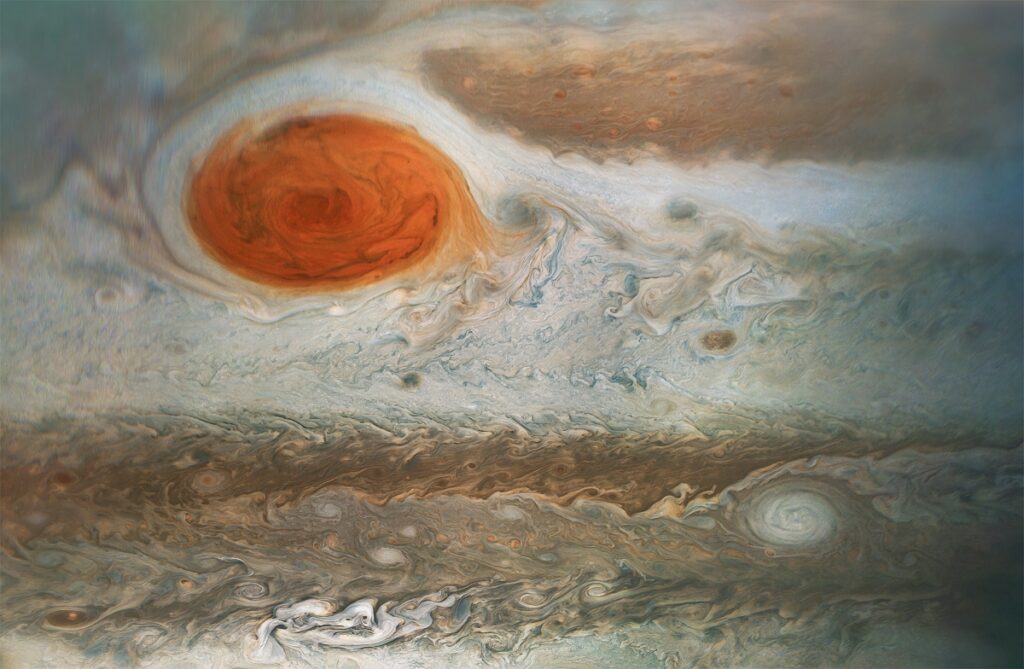
The Great Red Spot and Living Order
One of Jupiter’s most astonishing features is the Great Red Spot—a gigantic storm larger than Earth itself, persisting for centuries. Yet what matters most is not merely the existence of the storm, but the nature of its organization.
The Red Spot does not crystallize into rigid geometric form, nor does it freeze into immobile structure. It remains alive, fluid, and ever-changing, while nevertheless preserving stability within the greater order of the atmosphere.
Here the distinction between Jovian and Saturnian order becomes especially clear. In Saturn, order manifests through rigid geometry, fixed boundaries, and almost crystalline immobility—as in the famous hexagon at the planet’s north pole. In Jupiter, however, order is living and dynamic. Harmony is preserved not through the cessation of motion, but through the coordination of countless motions within a unified system.
Jupiter sustains order not through stillness, but through the stable harmonization of many movements.
Polar Cyclones and the Harmony of Many Forces
Recent studies of Jupiter have revealed enormous stable cyclones surrounding its poles, arranged in intricate symmetrical systems. Particularly striking is the fact that these gigantic vortices do not consume one another or merge into a single formation, but continue to exist as distinct forces within a shared equilibrium.
This bears a remarkable resemblance to the traditional Jovian principle of social harmony. Jupiter is associated neither with the destruction of differences nor with the total subjugation of all things to a single center, but with the unification of many autonomous forces within a higher law and order.
If the solar principle represents the absolute center of authority, the Jovian principle represents a coordinated system of many powers held together within a single harmony.
The Diffuse Core and the Softening of Rigid Boundaries
Modern studies of Jupiter also suggest that its core may not be a completely isolated solid center. Data from the Juno mission indicate the existence of a vast “diffuse” inner region in which heavy elements intermingle with surrounding layers of matter.
Symbolically, this is profoundly revealing. The Saturnian nature strives toward strict boundaries, rigid separation, and fixed form. In Jupiter, however, even the central region appears less isolated and more permeable.
Jupiter does not abolish form entirely, but softens excessive rigidity of boundaries, spreading and connecting what Saturn inclines to divide and isolate.
Heat, Radiation, and Jovian Energy
Jupiter radiates more heat than it receives from the Sun. Its energy does not remain sealed within itself, but constantly pours outward. This corresponds deeply to traditional conceptions of Jupiter as the planet of generosity, abundance, and the diffusion of vital force.
Jovian energy is outward by nature: it expands, binds together, and sustains life within a greater system. This stands in sharp contrast to the Saturnian mode of energy.
Saturn is associated with compression, limitation, slowing, and the fixation of structure. Even its famous rings represent matter confined within rigid boundaries and incapable of uniting into a complete body. Saturn’s hexagon likewise expresses the principle of geometric stabilization and fixed order.
Jupiter, by contrast, manifests not frozen structure, but an immense circulation of force perpetually spreading outward.
Jupiter and the Sun
Among all the planets, Jupiter comes closest to the solar principle. Some astronomers have observed that, with significantly greater mass, it might have approached stellar ignition. Symbolically, this is especially evocative.
Yet the distinction between the Sun and Jupiter remains fundamental. The Sun is the absolute center of the system and the source of its own light. Jupiter, however, does not generate life directly—it sustains, expands, and organizes the already existing order of life around itself.
If the Sun represents the king and central source of being, Jupiter resembles the high aristocracy, priesthood, counselors, law, and civilization surrounding the throne. Its power manifests not as absolute dominion, but as the maintenance of order, prosperity, and harmony within an already existing world.
Expansion and Excess
Yet precisely because Jupiter expands everything it touches, its danger lies in excess.
Traditional astrology taught that the vices of Jupiter arise whenever growth loses measure and proportion. Wisdom becomes dogmatism, confidence turns into arrogance, generosity into extravagance, dignity into pomposity, and religion into empty ceremonialism.
Even astronomically, Jupiter manifests a continual overflowing of force: immense scale, colossal energy, and an unceasing expansion of influence. Expansion itself becomes dangerous when it ceases to submit to law, harmony, and inner measure.
Jupiter and Saturn
The traditional opposition between Jupiter and Saturn becomes especially striking in light of their astronomical nature. Jupiter symbolizes growth, vitality, expansion, integration, and fullness; Saturn symbolizes limitation, division, pressure, concentration, and the power of time.
Even in their astronomical organization these planets express opposing principles. Jupiter embodies the integration of many bodies, the expansion of influence, and living dynamic equilibrium. Saturn embodies rings of separated fragments, rigid boundaries, geometric structure, and the principle of limiting form.
Together they express two fundamental cosmic laws: growth and limit, expansion and contraction, life and time. Expansion without limitation collapses into chaos, while limitation without growth leads to sterility and decline. This is why the conjunctions of Jupiter and Saturn were regarded in traditional astrology as supreme markers of historical epochs: together they symbolize the interaction of the two great forces of the manifested world—fullness and limit.