
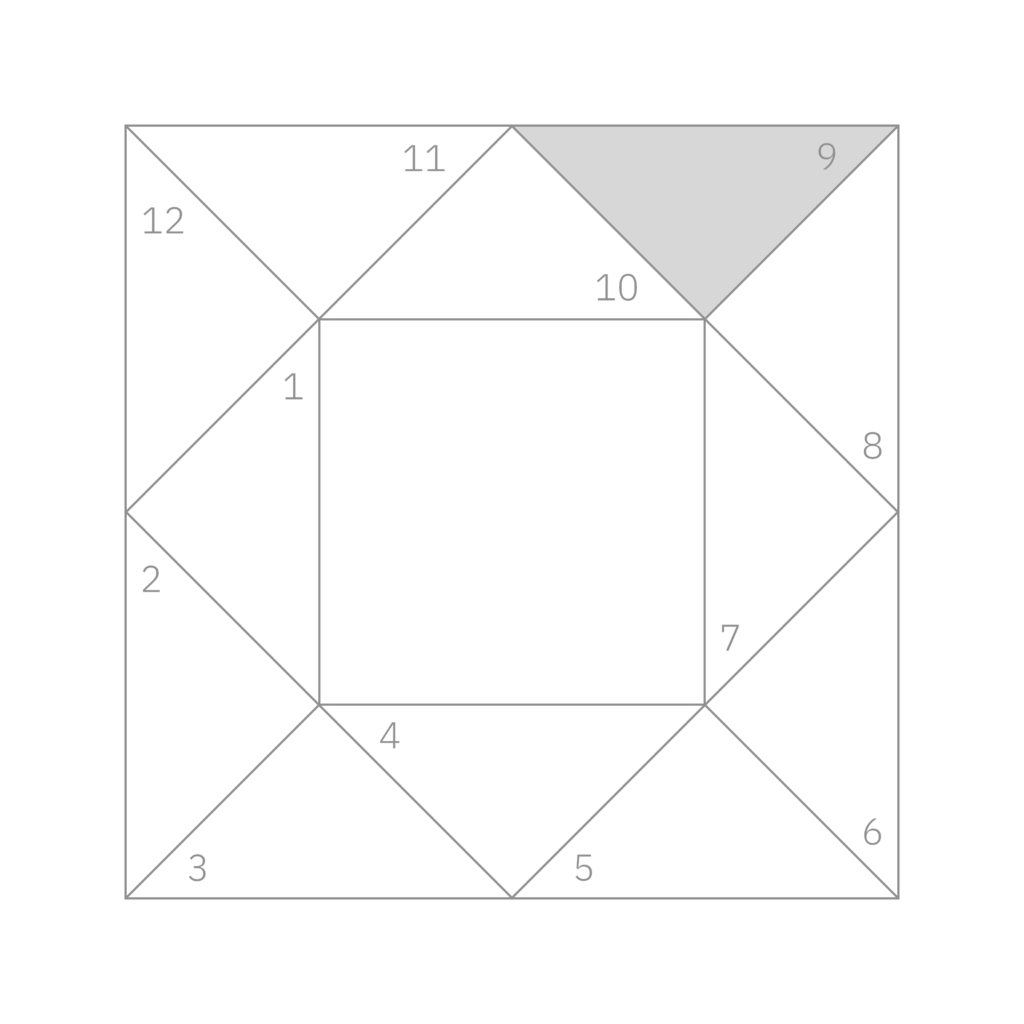
Latin Names:
- Itineris: Journeys;
- Pietas: Piety.
Greek Name: God (Θεος — Theos).
Arabic Names:
- بيت الأسفار — Bayt al-Asfar: the House of Journeys;
- بيت الدين — Bayt ad-Din: the House of Religion;
- بيت السفر — Bayt as-Safar: the House of Travel.
House Type: cadent (decline).
House of ‘Joy’: for the figures of A Sun ( Fortuna Major, Fortuna Minor).
House of ‘Sorrow’: for the figures of E Moon ( Populus, Via).
Mundane Planetary Ruler: K Jupiter.
Direction: south-south-west.
Anatomy: thighs and buttocks.
If the third house is associated with exploring one’s immediate surroundings and the nearby world, as well as with the acquisition of elementary and practical knowledge, then the opposite house, the ninth, pertains to the exploration of distant lands, far-off worlds, and the attainment of higher knowledge.
Long Journeys, Foreign Lands, and Pilgrimages
Particular manifestations of exploring distant territories include sea voyages, the conquest of overseas lands, and the study of foreign cultures. Accordingly, the ninth house signifies long-distance journeys and voyages, extraordinary travels, and especially spiritual pilgrimages and visits to holy places—even when this means regularly attending a nearby temple or other religious sanctuary. Vacations, holidays, and foreign countries likewise belong to this house insofar as they represent distant and unfamiliar realms.
Because unusual journeys are often longer than the ordinary movements associated with the third house, the ninth house also encompasses most prolonged travels. Yet the defining feature of ninth-house journeys is not their duration, but their exceptional or meaningful character.
Dreams and Wandering Beyond the Ordinary World
For this reason, dreams too belong to the ninth house, as they may be understood as a form of distant wandering undertaken by the soul through other planes of existence.
Foreigners, Religion, and Communion with the Divine
The ninth house also signifies people of foreign cultures and nations—strangers and foreigners. Knowledge that comes “from beyond one’s own land” likewise belongs here. Thus the ninth house governs “higher” communication: communion with the Divine, as well as the places, traditions, and ministers through which such communion is mediated in different religions and systems of belief—churches and priests, synagogues and rabbis, mosques and mullahs, monasteries and monks, and so forth.
Higher Knowledge and Spiritual Authority
This house signifies “higher knowledge”: everything that goes beyond ordinary everyday communication, as well as teachings believed to originate from higher powers. It also governs those who transmit such knowledge—teachers, sages, mentors, priests, gurus, and other spiritual or intellectual authorities. By contrast, the third house concerns the transmission of acquired knowledge to students and disciples, as well as the students themselves.
Universities, Sciences, and Learned Professions
The ninth house governs medicine and physicians, jurisprudence and lawyers, astrology and astrologers, geomancy and geomancers, all sciences understood as forms of higher knowledge, and the scholars devoted to them. It likewise signifies the institutions connected with such pursuits: universities, academies, higher schools, theological seminaries, madrasas, centers of religious learning, philosophical schools, astrological academies, research institutes, libraries, and other places devoted to the acquisition and transmission of higher learning.
Wisdom, Prophecy, and Esoteric Knowledge
Among its other significations are the wisdom acquired with age, distant relatives—such as brothers-in-law and sisters-in-law on one’s wife’s side—predictions, prophecies, meditative practices, magic understood as a higher science that may be mastered, and related subjects.
A Clarification Concerning Monasteries and the Twelfth House
During the Middle Ages, monasteries often served as places of exile, confinement, or forced seclusion. This older perception survives in expressions akin to “you’ll end up shut away in a monastery.” For that reason, monasteries were at times associated with the archetypal role of the twelfth house. In the modern world, however, monasteries primarily fulfill their original purpose: they are places of prayer, contemplation, and retreat, and therefore belong by nature to the ninth house.
Key Notes on the Ninth House
Derived Meanings of the Ninth House
As a derived house, the ninth also signifies letters, messages, and other communications sent to the querent by another person, since it is the third house from the seventh. However, if one expects a letter from a specific individual—for example, from an uncle—then the derived third house from that person’s house should be used instead. In the case of an uncle, this would be the eighth house (the third from the sixth).
The Ninth House and Matchmakers
As the house of wisdom and wise counselors, the ninth house plays an important role in marriage matters in certain traditions, particularly in Indian astrology. It may signify a marriage bureau or intermediary acting in the role once fulfilled by a local sage responsible for matching suitable marriage partners.
Examples of Ninth House Questions
- Will I travel to China this year?
- How will my holiday go?
- Was my dream truthful?
- Is the prophecy accurate?
- Will I be admitted to a university?
- Will I receive a letter from my wife today?
Quotes on the Ninth House
Because the ninth house is cadent from the Pivot, and the A Sun, when located there, declines from the line of the Pivot, the Midheaven, it is said to be the house of journeys and to indicate one who has been deprived of rank or office (that is, of social standing or authority, since it is the twelfth house from the tenth by derivative reckoning). And because the wisdom of the soul resembles a human being traveling from place to place in search of knowledge, it is said to be the house of wisdom; likewise, it is the house of faith, because faith proceeds from wisdom.
Abraham Ibn Ezra, The Beginning of Wisdom, Chapter III
A planet in the ninth house is like an exile, or like a man deprived of authority.
Abraham ibn Ezra, The Beginning of Wisdom, Chapter VIII, § 117
By the ninth house: religion, faith, visions, wisdom, the deity, the true worshipping, rumors and tales, dreams, declarations of things to come, ambassadors, long journeys, and the latter half of man’s life may be foreknown; and it is called the House of Religion, or God. Also ecclesiastical dignities, wisdom, arts, and the configuration of F Mars and K Jupiter, who, being placed in the ninth, signify truly religious persons… It rules the fundament, buttocks, and hips; joy of the A Sun, which fortifies it, and it is infortunated by F Mars and L Saturn.
Claude Dariot, A Brief and Most Easy Introduction to the Astrological Judgment of the Stars, Chapter XII
From this house we give judgment of long voyages, dreams, pilgrimages, and religion, and all sorts of ecclesiastical persons and ministers, books, learning, church livings or benefices, and the brethren and kindred of the querent’s wife. Of man’s body, it governs the hips and thighs.
John Middleton, Practical Astrology, Chapter XI
By this house we give judgment of voyages or long journeys beyond the seas; of religious men, or clergy of any kind, whether bishops or inferior ministers; dreams, visions, foreign countries, books, learning, church livings or benefices, advowsons; of the kindred of one’s wife, and the contrary likewise.
Of man’s body, it rules the fundament, hips, and thighs… If K Jupiter is placed herein, it naturally signifies a devout man in religion, or one modestly inclined. I have often observed that when the Q Dragon’s Tail, F Mars, or L Saturn have been unfortunately placed in this house, the querent has been little better than an atheist or a desperate sectarian. The A Sun rejoices to be in this house.
William Lilly, Christian Astrology, Chapter VII