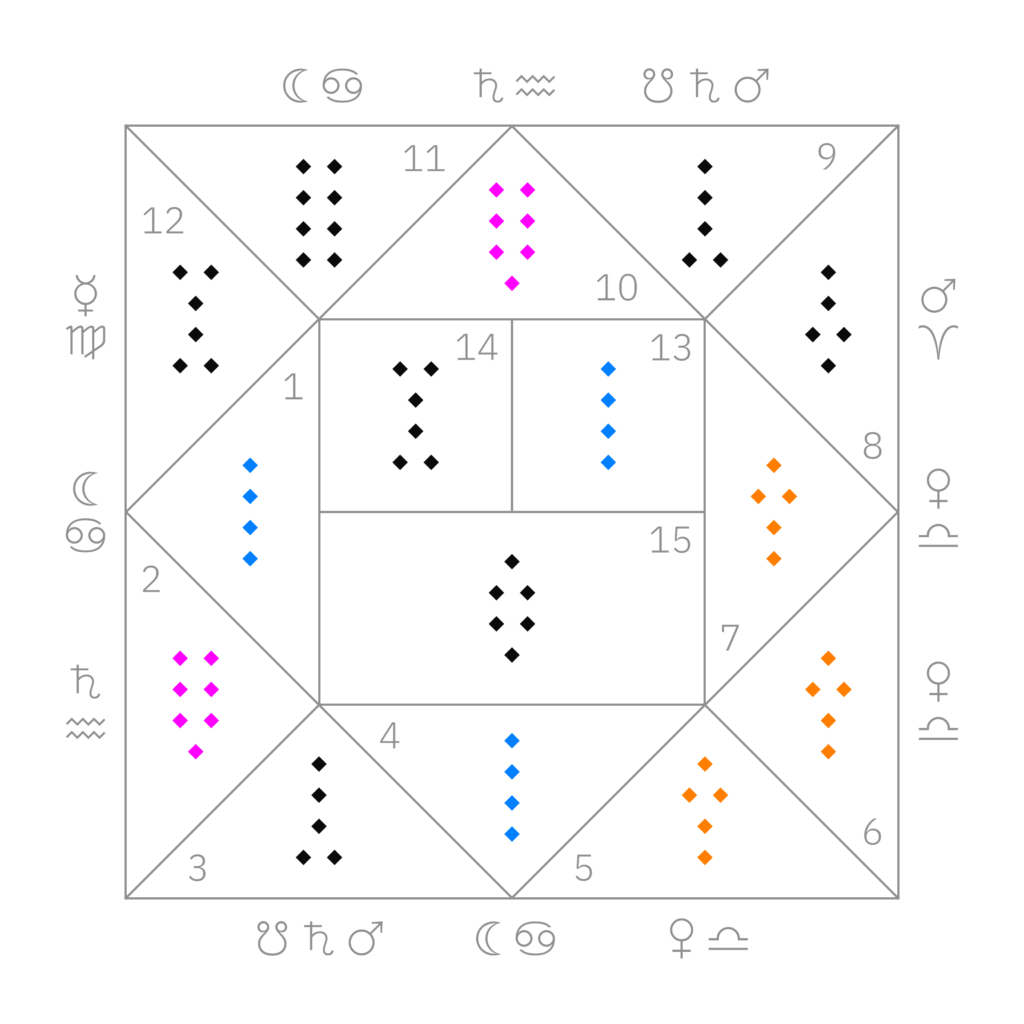
Chart Information
Cast By: The Querent
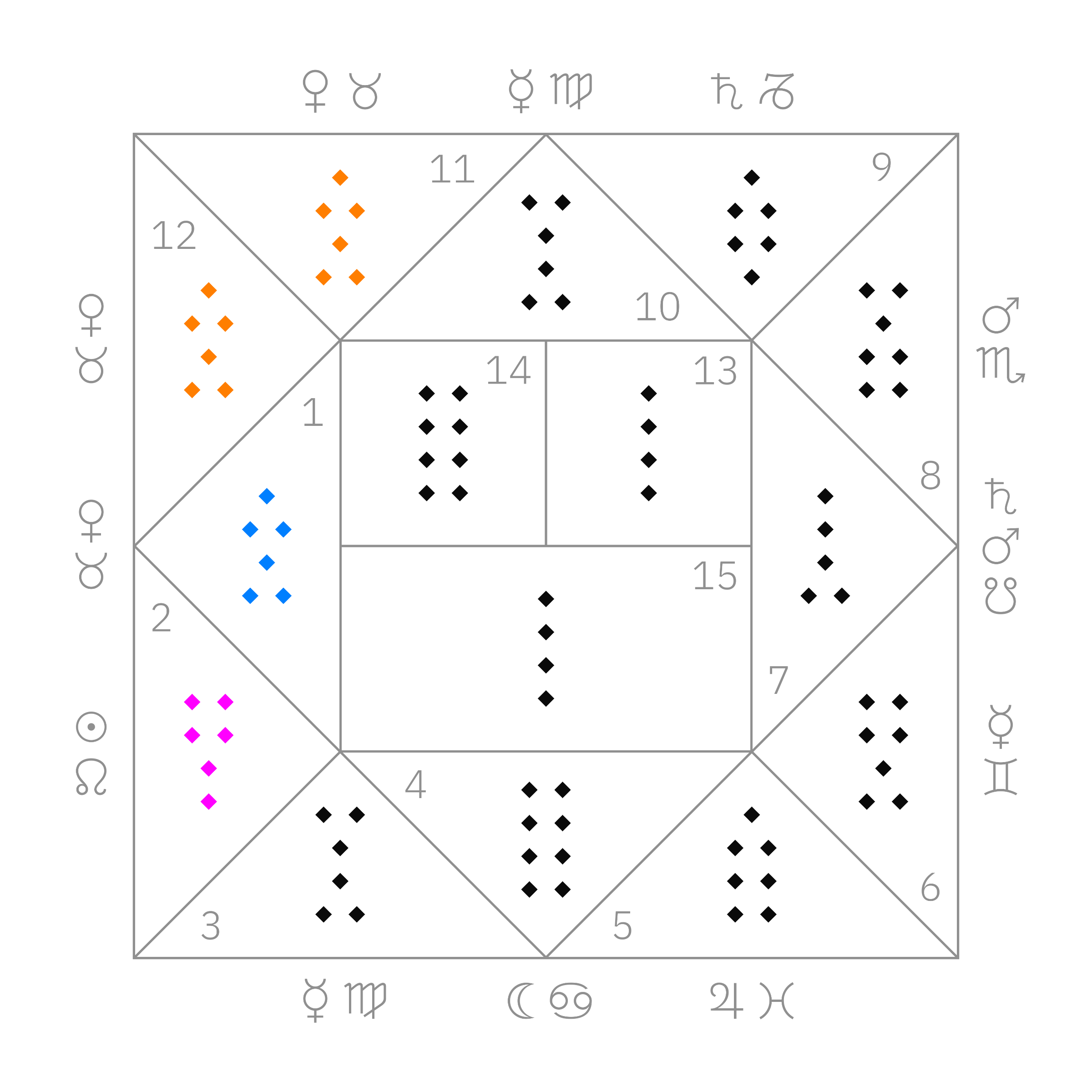
The Four Mothers: Via · Tristitia · Cauda Draconis · Via
Permalink: Open in Geomancy.Tools
Preface
The querent is a student of my school who has been investing in cryptocurrencies for many years. He came to me with a specific question: would ₿ Bitcoin see a significant rise in 2027? With that intention, he cast a chart and sent it to me.
The chart was cast in November 2026, at the height of a panic. The Fear & Greed Index stood at Extreme Fear. Anyone who has spent time in the crypto market on days like these knows the atmosphere: prices keep creeping lower, the chats are full of gloom, every headline is grimmer than the last, and the word FUD (fear, uncertainty, and doubt) is heard more often than “good morning.” Almost no one believes in ₿ Bitcoin anymore, and people are seriously debating whether crypto has finally come to an end.
This post is not financial advice. The purpose of this analysis is different: to show how geomancy handles a field the old masters could never have imagined—modern financial technology. As they say in the crypto world, nobody is shilling anything here. If you decide to become a crypto investor after reading this, the responsibility for your money rests entirely with you.
The Querent and the Quesited
The time frame of the question is the whole of 2027, from the first day to the last. That is how the querent intended it.
The querent receives H1 and Via within it. Via passes into H4 and appears once more as the Right Witness. With the quesited—the rise of ₿ Bitcoin—things become more interesting: before looking for it in the chart, we must decide which house governs it.
The Second House: ₿ Bitcoin as the Querent’s Money
If we follow the generally accepted rules of horary astrology, any investment is simply the querent’s money, which means H2 and its ruler. In geomancy, this is the figure of H2. This is also how John Frawley, one of the most authoritative horary astrologers of our time, approaches the question. For him, H2 is the querent’s money in any form:
It is the querent’s money, in whatever form that takes: currency, bank account, stocks and bonds.
John Frawley, The Horary Textbook, ch. 3, “The Houses,” p. 18
Hence his approach to questions about investments:
So questions about investments should be judged from the state of the 2nd house and the condition and actions of Lord 2.
John Frawley, The Horary Textbook, ch. 16, “Second House Questions,” p. 157
Let us try it. By this logic, ₿ Bitcoin is what the querent turns his money into. In H2 we find Tristitia, L Saturn in k Aquarius—a figure of decline, not growth. It passes into H10, directly into X opposition with the querent’s figure in H4. H10 is angular and therefore strong, so the decline is a serious one as well. The picture is bleak.
Nor is the situation saved by the rule of sign fertility, which Frawley also uses. For him, the watery signs are fertile and promise growth; c Gemini, e Leo, and f Virgo are barren; the rest are neutral. k Aquarius is not among the fertile signs.
If my investments are in a fertile sign they are more likely to grow than if they are in a barren.
John Frawley, The Horary Textbook, ch. 5, “The Signs,” p. 42
We can also approach the matter from a third angle: take H2 as the investments themselves, and the derived H2 from H2—the radical H3—as the profit they bring. There we are met by Cauda Draconis, a barren and malefic figure. Here, too, growth is out of the question.
So we have three approaches, and all three say the same thing: there will be no growth. But I judge such questions differently.
My Approach: The Fifth and Sixth Houses
Over years of practice, my students and I have examined literally hundreds of charts concerning investments in cryptocurrencies and the stock market. My conclusion is unequivocal: in horary astrology and geomancy, such questions should be judged from H5 and H6 of the radical chart. These are my rules for judging cryptocurrencies. I am sharing them here for the first time—and not in full but only the part without which this chart cannot be explained.
The Essence of the Matter: Investment or Gambling?
A horary or geomantic chart is an imprint of the querent’s unconscious. It reflects his strongest feelings and emotions at the moment of the question: what he truly experiences and thinks about, not what he himself calls it. On paper, cryptocurrency is an investment. But Aristotle taught us long ago to look past the outward features of a thing to its essence. And in essence, investing in cryptocurrency is gambling.
People have always played for money. Dice, cards, wagers in taverns, roulette in casinos. Gambling is one of the oldest and most powerful archetypes, and it takes hold of a man completely. Many people go to Las Vegas not for the winnings but for that thrill while the ball is still spinning around the wheel. In the crypto market, this feeling has a name of its own: FOMO, the fear of missing out. Anyone who has ever watched a coin he did not buy do a few x in a single week knows exactly what it feels like.
Scientists have noticed the resemblance as well. Researchers at the Center for Gambling Studies at Rutgers University found that frequent cryptocurrency trading is closely linked to problem gambling: more than half of the regular gamblers they surveyed had traded cryptocurrency in the past year (Mills & Nower, Addictive Behaviors, 2019). The study’s lead author, Devin Mills, described crypto trading as the same old gambling, only anonymous, unregulated, and available around the clock.
In the crypto market, you can win and you can lose, and no one knows for certain which it will be. Funds with armies of analysts and decades of experience lose millions here, and sometimes billions of dollars. No one has put it better than the broker Mark Hanna, Matthew McConaughey’s character in Martin Scorsese’s The Wolf of Wall Street:
Nobody knows if a stock is gonna go up, down, sideways or in f***ing circles.
Mark Hanna (Matthew McConaughey), The Wolf of Wall Street, dir. Martin Scorsese, 2013
A minute later, he calls the whole thing “fugazi”: a fake, a nothing, fairy dust.
The Fifth House: The House of Games
In astrology, games live in H5. This is how Lilly describes it:
By this house we judge of children, of ambassadors, of the state of a woman with child, of banquets, of alehouses, taverns, plays, messengers or agents for republics; of the wealth of the father, the ammunition of a town besieged…
William Lilly, Christian Astrology, Book I, ch. VI, “The Fifth House”
Banquets, alehouses, taverns, plays. H5 is the house of pleasures and the places where people indulge in them. Olivia Barclay, Frawley’s teacher and the woman who brought Lilly’s Christian Astrology back into modern practice, saw it the same way. In her list of fifth-house significations, the stock market stands right beside games and gambling:
It also represents enjoyment and entertainment, games, gambling, speculation and the Stock Market, theater and banquets.
Olivia Barclay, “A Guide to Horary & More for Contemporary Astrologers, Part I,” Considerations, Vol. XV, No. 2
Frawley himself admits that he and his teacher did not see eye to eye on everything:
So yes, Olivia and I have our differences, but we’re pretty much agreed on Lilly’s importance.
John Frawley, interview with Garry Phillipson, The Traditional Astrologer, Spring 1998 (reprinted on Skyscript)
On the question of gambling, he stays true to form. For him, H5 is only the enjoyment of the game, and everything that concerns profit he moves out of it:
Gambling is often regarded as a 5th-house activity. But if someone is asking a question about gambling, the point at issue is the profit to be made; I have never been asked ‘Will I have a good time at the racecourse?’ Having a good time is a 5th-house matter; turning a profit is not.
John Frawley, The Horary Textbook, ch. 16, “Second House Questions,” p. 159
With all due respect to Frawley, H5 was associated with gambling long before the twentieth century. Demetra George reminds us that as early as the twelfth century, Ibn Ezra added the word mazal (מזל) to its significations:
mazal, which means constellation, but also luck, games of dice, and hence gambling.
Demetra George, Ancient Astrology in Theory and Practice, Vol. II, ch. 68, “The Fifth House”
The Sixth House: The Money from the Game
H5 shows the game itself, and on this point Frawley is right: profit is not a fifth-house matter. Profit is already money, and money in any form is always a matter of H2, radical or derived. But it is not yet the querent’s money in H2: it is the potential profit that the game itself brings, that is, the derived H2 from H5—the radical H6. Joyce Wehrman says so plainly:
The sixth house being the second from the fifth can be construed as being the money from gambling.
Joyce C. Wehrman, Winning!! Zodiacal Timing Revised, “How to Find Astrologically if You Have the Potential to Gamble or Speculate”
Now let us return to the chart. ₿ Bitcoin is represented by Puella in H5—C Venus in airy g Libra. Our quesited is the rise of ₿ Bitcoin, that is, the potential profit from investing in it. That is H6, the derived H2 from H5, and there we find Puella again. The figures of H5 and H6 form a perfect company, so the quesited is shown by a doubled Puella. A third Puella stands in H7. Whether the querent himself can lock in this profit is a separate question; we will come to it below.
The principal significators are therefore:
- the querent— Via in H1;
- ₿ Bitcoin— Puella in H5;
- the profit from ₿ Bitcoin— Puella in H6;
- the querent’s money— Tristitia in H2.
Analysis
₿ Bitcoin: Puella in the House of Her Joy
H5 is the house of joy of C Venus, and the Venusian Puella is at home here, like a hostess at her own banquet. She is a good and stable figure. Even her airy sign suits cryptocurrency perfectly: cryptocurrency is not coins in a pocket or bills in a safe; it is money that lives in the “cloud,” on the blockchain.
Green and Red: Puella and Rubeus
In terms of fertility, g Libra is neutral, but fertility is a doubtful measure here: cryptocurrency is a game, not savings that grow by themselves. Open any crypto exchange: green candles mean growth, red ones mean decline. To be fair, on some Asian markets the colors have historically been reversed, but that is the exception rather than the rule. Green traditionally belongs to C Venus, and red to F Mars.
In geomancy, these two poles are shown by a pair of complementary figures. Figures are called complementary when all four of their lines are inverted, from the Head to the Feet: where there was one point, there are now two, and where there were two, there is now one. The pair of C Venus and F Mars consists of Puella, C Venus in g Libra, and Rubeus, F Mars in h Scorpio. The very name Rubeus means “red.” We will meet this figure again when we come to the querent.
The two stand opposed not only in geomancy but also in astrology. g Libra is the detriment of F Mars, and h Scorpio is the detriment of C Venus. Each figure stands in the sign where the other fares badly.
h Scorpio, incidentally, is formally a fertile sign. But Rubeus is a malefic figure, and in questions like this one it signifies not growth but blood. Blood is one of its principal meanings, and one of the Arabic names of Rubeus translates literally as just that: ad-Dam, “blood.” The market uses the same language: “blood in the streets,” “a bloodbath,” when the charts are a sea of red. Here ancient geomancy and modern trading slang speak with one voice.
The Doubled Puella
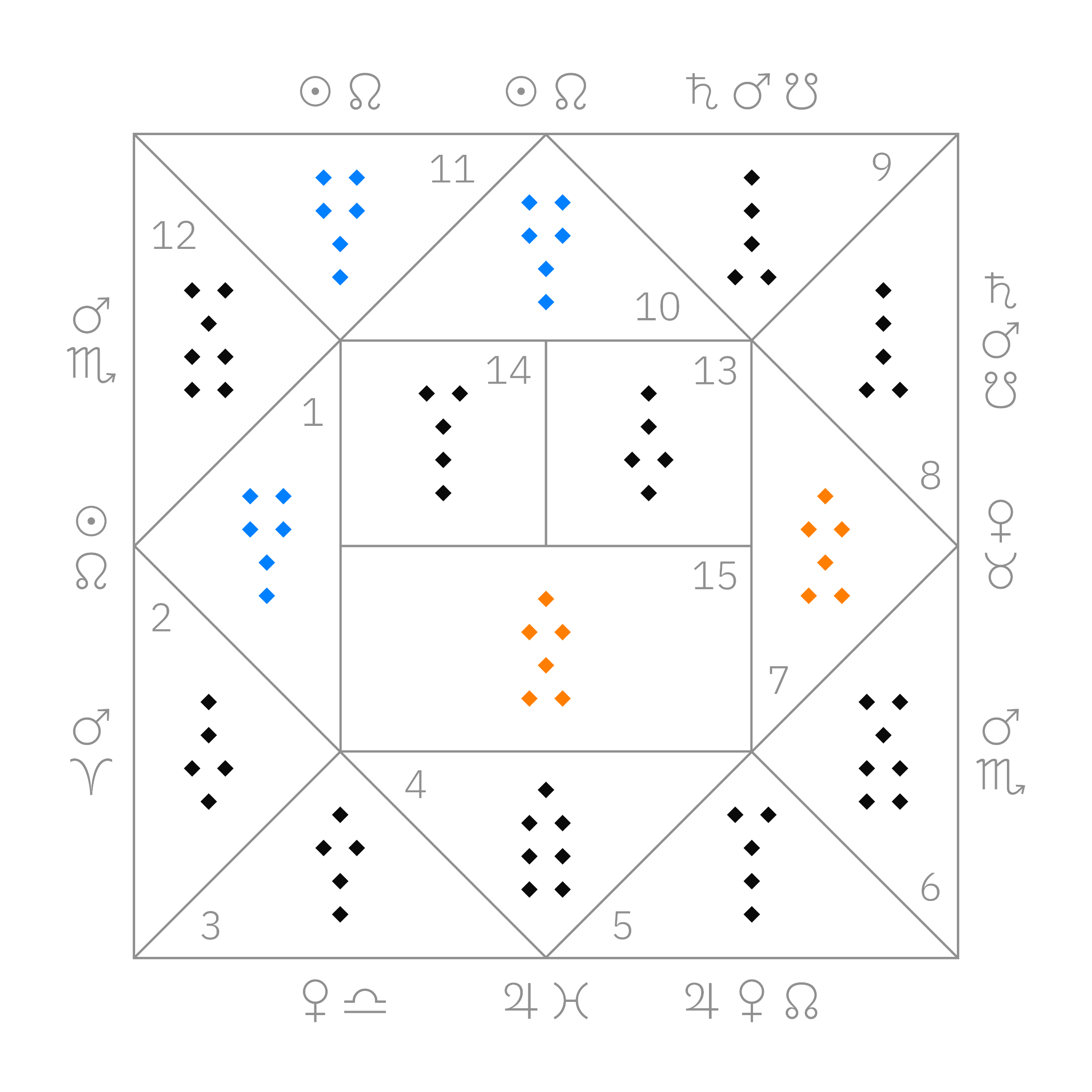
Combining Puella with Puella gives:
- Puella + Puella = Populus
Populus is the figure of multitude, of the crowd. To combine Puella with Puella is to gather them together and multiply them. And since Puella signifies growth, their gathering multiplies that growth. In the language of the market, these are long green candles—the very ones traders call god candles.
Benefaction of the Sixth House
Puella in H6 falls under the rule of benefaction. She has Venusian figures on both sides, Puella in H5 and Puella in H7, and with her neighbor in H5 she also forms a perfect company, as the rule requires. To stand between two benefics is to lie between a cushion and a featherbed. The growth only becomes more secure for it.
C Venus or K Jupiter?
Some may object: C Venus is the Lesser Benefic, while the Greater Benefic is K Jupiter, with its figures Lætitia and Acquisitio. From experience, I can say that they do indeed show strong growth. But the house of joy of K Jupiter is H11, while H5, on the contrary, is its house of sorrow.
That is why I place more trust in Puella here. First, the color of C Venus is the color of a rising chart. Second, for C Venus H5 is more than the house of her joy. Games, gambling, and the pleasure they bring are her own significations. K Jupiter is by no means bad in such a question; it is simply out of place in this part of the chart, while C Venus is right where she belongs.
Other People: Puella in the Seventh House
The same picture can be viewed from another angle. H7 signifies other people, and there, too, we find Puella. She passes into H5 and H6—into the house of her joy and the one beside it. Puella also signifies love and affection. In 2027, then, people will fall in love with ₿ Bitcoin again. And g Libra is a loud-voiced sign, so they will talk about it loudly: “a promising asset,” “the money of the future.” It happens every time the price goes up.
Crowd psychology in the market is simple. People love what is rising, and they buy it. What sits at the bottom, deep in the red, they hate and avoid. So the crowd’s renewed love for Bitcoin in 2027 is in itself indirect testimony that its price will rise. Smart money, however, does the opposite: it buys the fear and sells the euphoria. Warren Buffett put this rule as follows:
We simply attempt to be fearful when others are greedy and to be greedy only when others are fearful.
Warren Buffett, Letter to Berkshire Hathaway Shareholders, 1986
In practice, this is incredibly hard to do: when panic is everywhere, one’s hand simply will not move to click “Buy.” That is why most people in the crypto market lose money, while only a small circle makes money. Some are simply lucky; others know the rules of this game and keep their mental state under control.
The Querent’s Money: Tristitia in the Second House
Now to Tristitia in H2. If ₿ Bitcoin belongs to H5 and H6, H2 once again becomes what it is meant to be: the querent’s own money. The very name Tristitia means “sorrow,” and this money is, to put it mildly, in a sorrowful state. More specifically, the querent does not have enough stablecoins to get into ₿ Bitcoin and reap the harvest of the coming rise.
Combining the querent’s figure with the figure of his money gives:
- Via + Tristitia = Cauda Draconis
Cauda Draconis is a figure of decrease, lack, and emptiness. Tristitia passes from H2 into H10 and forms a U square with the querent’s figure in H1. And when Via passes into H4, an X opposition is added to the U square. These aspects describe not an event but a state of affairs: money is tight for the querent right now.
The Burnt Way: Reception Between the Querent and ₿ Bitcoin
Combining the querent’s figure with the figure of ₿ Bitcoin and its profit gives:
- Via + Puella = Rubeus
This is the geomantic analogue of the Via Combusta, the Burnt Way of horary astrology. That is the name given to the stretch of the zodiac from 15° g Libra to 15° h Scorpio, dangerous above all for the E Moon. Lilly mentions it among the considerations before judgment:
…or as some say, when she is in Via Combusta, which is, when she is in the last 15 degrees of g Libra, or the first 15 degrees of h Scorpio.
William Lilly, Christian Astrology, “Considerations before Judgement,” pp. 121–123
In geomancy, this path is formed by the figures. Via is a lunar figure; its very name means “road.” Puella is C Venus in g Libra. Rubeus is F Mars in h Scorpio, the color of blood and fire. Via leads Puella into Rubeus, just as the E Moon passes from g Libra into h Scorpio across the burnt stretch. Nothing remains of the lightness and joy of g Libra along this road; at the end of it there is only heaviness and hidden tension.
The world around him will be buzzing about ₿ Bitcoin. The chart was cast at the very peak of fear, precisely when smart money buys. The querent sees this, understands that now is the time, and cannot buy. Hence the dejection and the foul mood.
There is one more detail. Puella passes into H7 and forms an X opposition with the querent’s figure in H1—a malefic aspect of the nature of L Saturn. Together with the poor reception and the empty wallet, this means only one thing: the rise of ₿ Bitcoin will pass the querent by, and he will not be able to profit from it.
The Witnesses and the Judge
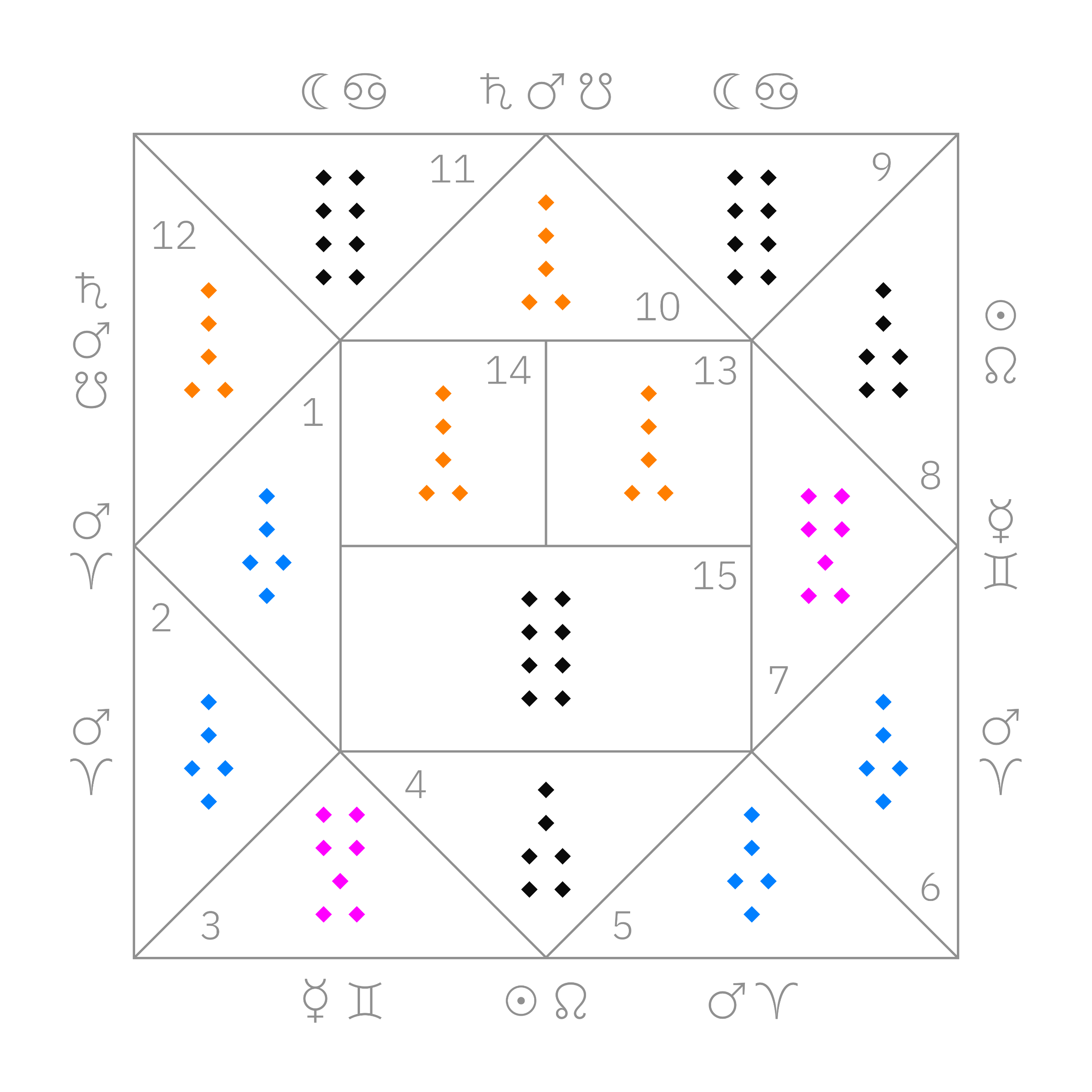
Combining the Right and Left Witnesses gives:
- Via + Conjunctio = Carcer
The Right Witness is Via, the same figure as in H1—that is, the querent himself. The Left Witness, Conjunctio, signifies a trade deal. Together they produce Carcer, the figure of prison and restriction. This combination traditionally signifies blockage. The Judge is born from the querent’s figure, so it is the querent above all whom it restricts: the door to the deal is closed to him.
Carcer is a figure of L Saturn. The querent’s money in H2 is also L Saturn, only in another figure, Tristitia. The Judge and the querent’s wallet share the same Saturnian nature, and this points once again to a lack of funds.
The chart, then, accurately describes the querent’s real situation: his finances and his attitude toward buying ₿ Bitcoin. It is therefore radical.
Judgment
The doubled Puella in H5 and H6, their perfect company and their reception into Populus, the Benefaction of H6, and Puella in H7 all speak of strong growth. Tristitia in H2, the reception into Rubeus, and Carcer as the Judge show that the querent lacks the funds to take part in it.
₿ Bitcoin will show strong growth in 2027—at any point within that year. People will fall in love with it again and speak well of it, loudly. The querent, meanwhile, will watch this rise from the sidelines.
It is important to understand what kind of growth is meant. This is strong growth for ₿ Bitcoin, and here one must remain a realist. ₿ Bitcoin is not a memecoin that can do a 100x. Many memecoins trade for pennies and have tiny market caps, so a small inflow of money and a good wave of hype are enough to make such a coin grow tens or hundreds of times. ₿ Bitcoin’s market cap is enormous: at the time of the question, it stood at around $1.3 trillion. To move its price even by a few dozen percent, colossal sums of money must enter the market. It is like getting an ocean liner up to speed rather than a motorboat. Strong growth for ₿ Bitcoin therefore means a few x at best—not tens of x, and certainly not hundreds. That is the scale on which the forecast of this chart should be understood.
Outcome
The outcome will be added at the end of 2027.
Lesson
A house is chosen by the essence of the matter, not by its name. Formally, cryptocurrency is an investment and belongs to H2; in essence, it is a game and belongs to H5. A mistake at this step turns the entire answer upside down: here, three formally correct approaches would have given a “no.”
Relying on authorities is useful. But no one should be trusted blindly—not even me. If you want to truly understand the subject, cast many charts, study the matter of the question, and test everything in practice. All the more so when money is involved.