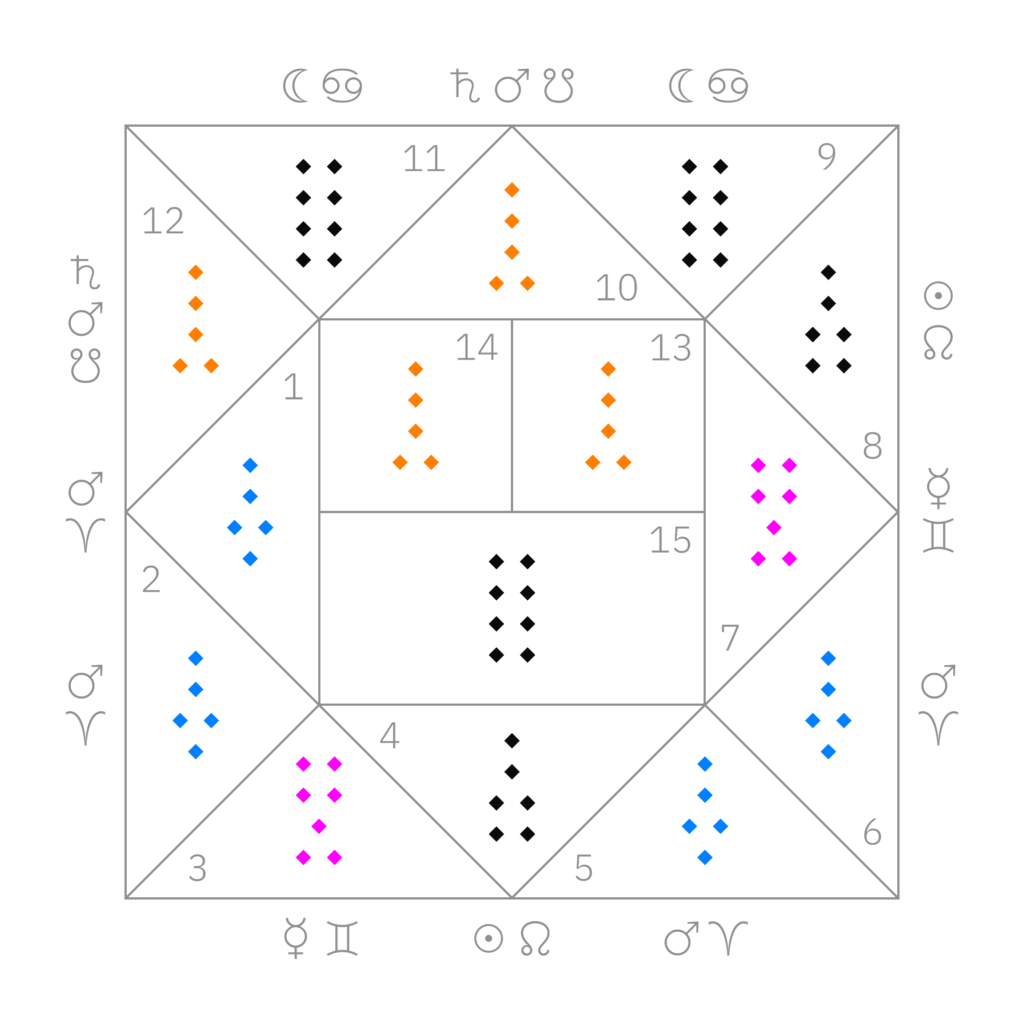
Chart Information
Cast By: The Querent.
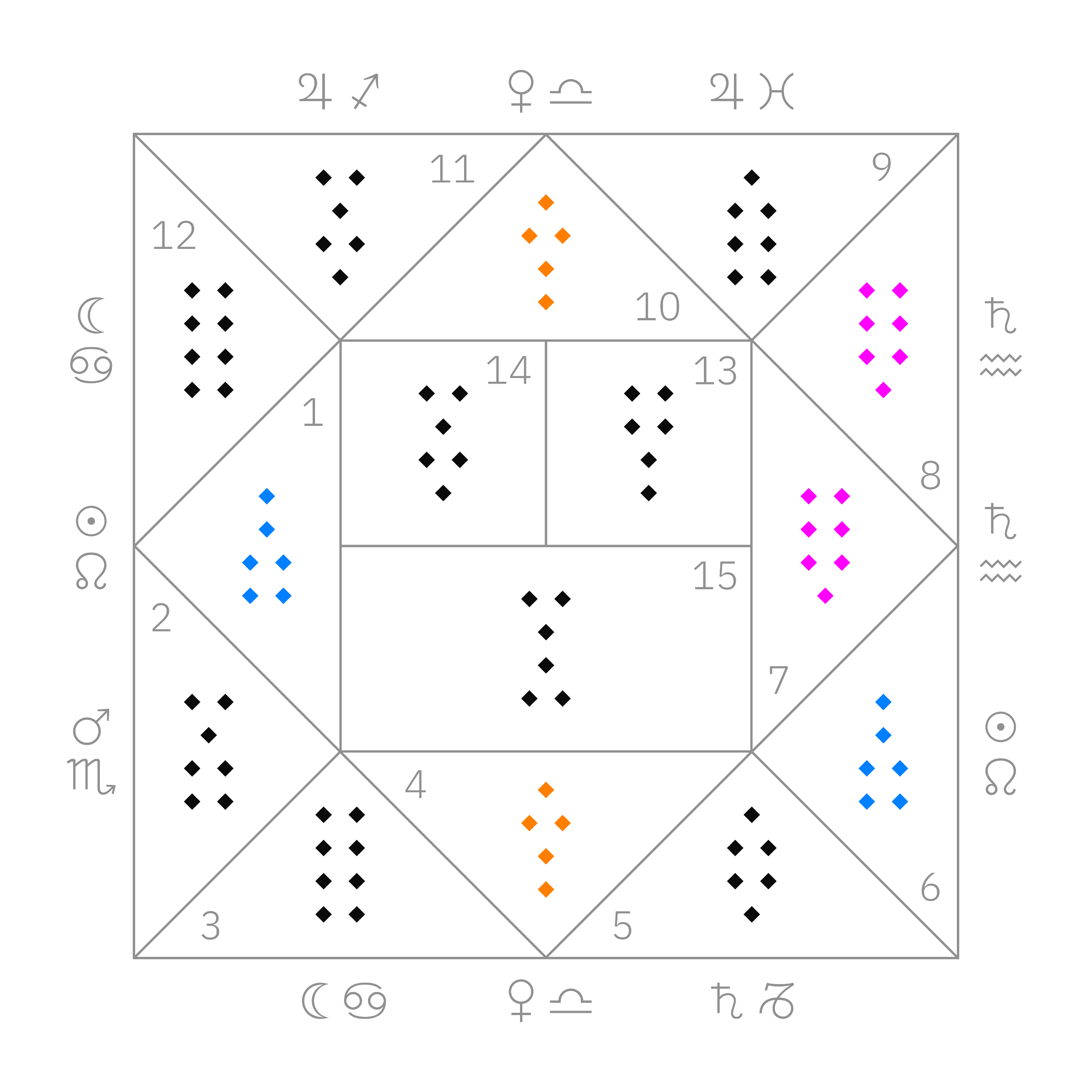
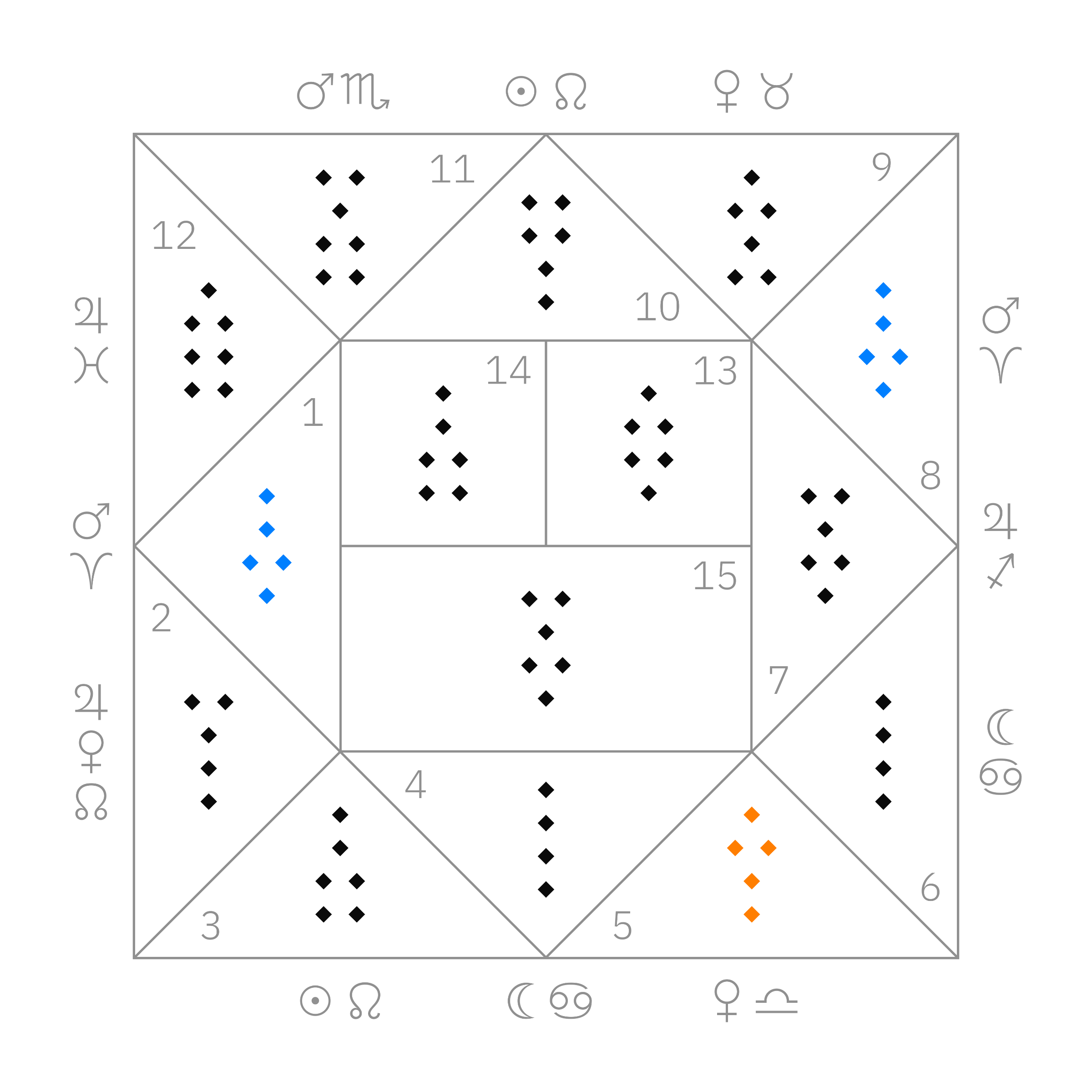
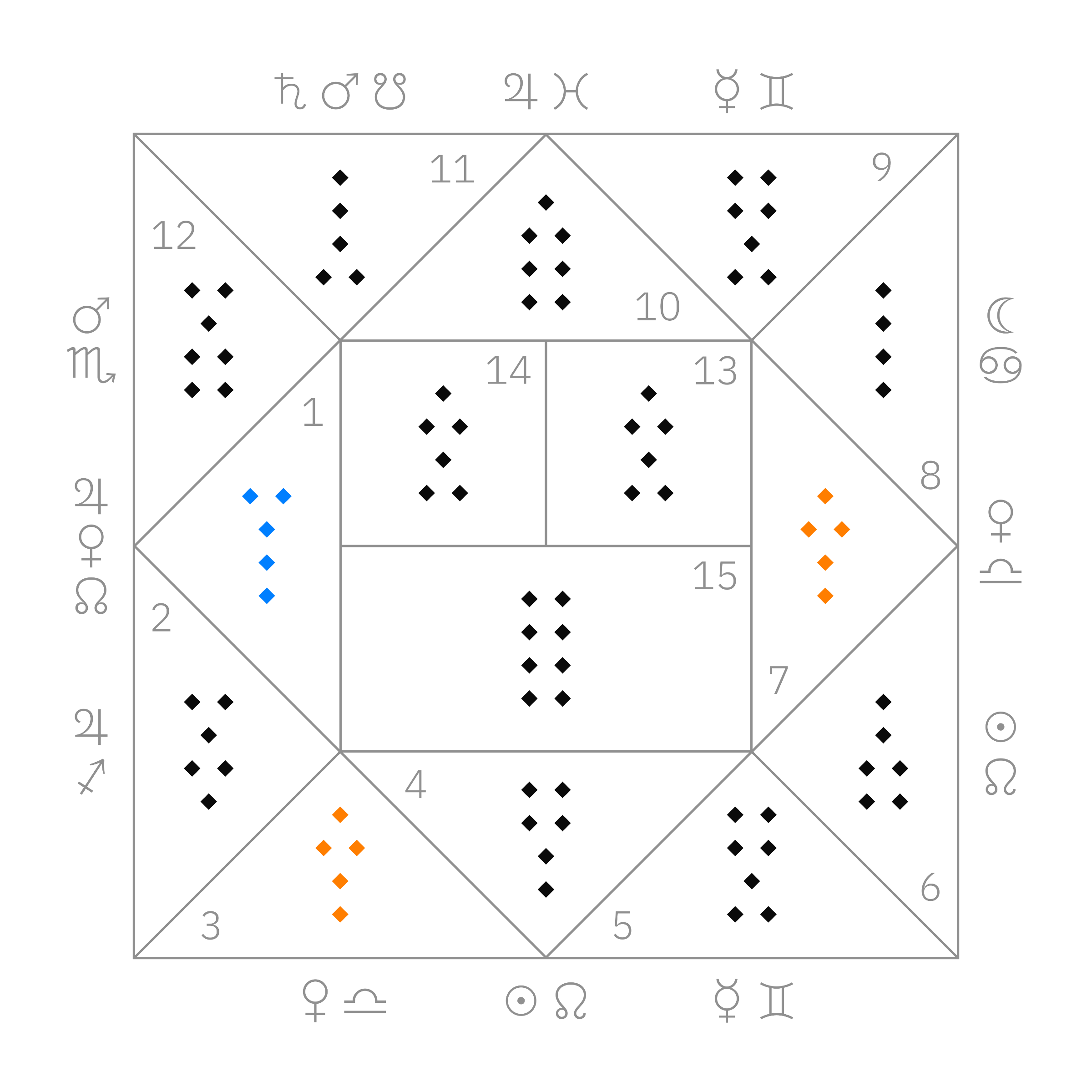
The Four Mothers: Puer · Puer · Albus · Fortuna Minor.
Permalink: View This Chart on Geomancy.Tools.
Preface
The querent is my student and an avid football fan. He had already appeared as the querent in the previously discussed chart for the Barcelona–Alavés match played on November 29, 2025.
The following day, Real Madrid was due to play Girona. Since the student supported Real Madrid, he cast a geomantic chart asking which team would win. He interpreted the chart himself, placed a bet, and only then brought the chart to me—without mentioning the bet.
After examining the chart, I told him that I could clearly see that he had placed a bet and that, beneath the stated question about the match, the chart was speaking principally about something else—his attempt to make money from football. He then admitted that he had indeed placed a bet and that the prospect of winning money mattered to him more than the result itself.
That was my only judgment before the event. We analyzed the match and the outcome of the bet together only after the result of the match and the outcome of the wager were known.
The match ended in a 1–1 draw, and the student lost his bet.
The Querent and the Quesited
Because the querent supported Real Madrid, the team is assigned to the first house and signified by Puer.
Girona, as Real Madrid’s open opponent, is assigned to the opposite seventh house and signified by Albus.
The victory for which both teams were competing belongs to the tenth house, occupied by Cauda Draconis.
The chart, however, unfolds on three connected levels: the football match itself, the querent’s sports bet, and his communication with the geomancer.
Analysis
First Layer: The Match
Two Teams, Two Styles
In retrospect, Puer—F Mars in a Aries—describes Real Madrid’s play with striking accuracy: active, direct, aggressive, persistent, and driven by continual outward pressure.
Albus—B Mercury in c Gemini—corresponds to Girona’s more measured approach: compact, patient, tactically cautious, and unwilling to meet the favorite in a prolonged contest of raw force.
The match therefore became an encounter between two complementary principles. Puer acts quickly and directly, expending great force. Albus watches, chooses its moment, and avoids unnecessary confrontation.
The Territory of the Match
Puer is repeated in the fifth and sixth houses, crossing into Girona’s side of the chart. In the spatial reading of a sports chart, this suggests that most of the action will take place on the opponent’s half under pressure from Real Madrid.
The statistics confirm the overall pattern. Real Madrid held 59.6% of possession, completed 611 passes to Girona’s 426, and took 25 shots to Girona’s 10. Yet both teams finished with four shots on target. Madrid produced far more attacking volume, while Girona’s fewer attempts were more selective.
Albus moves from the seventh house into the third—onto Real Madrid’s side of the chart. This shows Girona making occasional incursions into opposing territory. Those attacks were less frequent but genuinely dangerous: Girona scored first, and Real Madrid equalized from the penalty spot in the second half.
The two occurrences of Puer on Girona’s side describe the main territorial current of the match. The single Albus on Real Madrid’s side describes Girona’s rarer but intelligent counterthrusts.
A Victory That Did Not Exist
Cauda Draconis occupies the tenth house—the house of victory. Its principal action is to weaken a matter, deprive it of retention, and carry it out of possession. Placed here, it shows victory slipping away before either team can establish or hold it.
Cauda Draconis is also both the Right and Left Witness. The two identical Witnesses produce the Judge:
- Cauda Draconis + Cauda Draconis = Populus
Cauda Draconis corresponds to the Q South Lunar Node. The lunar nodes are not physical celestial bodies but calculated points where the E Moon’s orbit crosses the ecliptic.
The symbolism is unusually precise. Victory is represented by a figure associated with a point that possesses no independent physical body—and in the match, victory likewise had no independent existence for either side.
Real Madrid did not win, but neither did Girona. The two Cauda Draconis Witnesses may therefore be read symbolically as two "non-victories"—one for each team.
The numerous perfections between the teams’ significators and Cauda Draconis show both sides attempting to seize the victory. Each scored a goal, yet neither could turn that success into a full win.
Second Layer: The Bet
Although the stated question concerned the match, the repeated transitions of Puer show that the chart was organized more strongly around the querent and his financial interest.
Puer in the first house represents the querent himself. Puer in the second shows his own money. Puer in the fifth signifies football, gaming, and the bet. Puer in the sixth, as the derived second house from the fifth, shows the gain he expected to obtain from sport.
The sixth house is also the house of F Mars’s joy. Puer there does more than signify hoped-for profit: it emphasizes what truly excited and pleased the querent. His real enthusiasm lay not simply in watching Real Madrid win, but in making money from the match.
The sixth house does not signify the winnings themselves. It shows the expected gain arising from sport.
The actual money the querent hoped to receive belonged to the other party in the transaction. The bookmaker or the people paying out the winnings are signified by Albus in the seventh house. Their money belongs to the derived second house from the seventh—the eighth house—where Fortuna Minor is placed.
The chart’s underlying question was therefore not merely, “Who will win?”
It was, “Will I receive other people’s money through a bet on this match?”
The querent is Puer, while the money of the other party is Fortuna Minor in the eighth house. Their reception produces Tristitia:
- Puer + Fortuna Minor = Tristitia
Retrospectively, the interaction between the querent and the money he hoped to win did not produce acquisition. It produced Tristitia—sorrow, disappointment, and the loss of the stake.
Albus acquires another precise meaning here. In the seventh house, it signifies the bookmaker’s side. Its transition into the third house signifies the website or application through which the querent entered into contact with that side and placed the bet.
Third Layer: Communication With the Geomancer
Puer and Albus simultaneously signify the student and the teacher.
Puer represents the student—a person who acts quickly, tests his judgment in practice, and learns through the consequences of his mistake.
Albus represents me as the consulting geomancer and teacher. Its position in the seventh house places me opposite the querent as his partner in establishing the truth, while its transition into the third shows the exchange between us—his sending me the chart and our discussion of its meaning.
This reading is reinforced by the natural complementarity of Puer and Albus—student and teacher, action and reflection, rash experience and measured judgment.
The same transition of Albus into the third house works coherently on all three levels. In the match, it shows Girona entering Real Madrid’s territory. In the betting question, it shows the website used to place the bet. In the consultation, it shows the student’s communication with the geomancer.
The Chart Reveals the Querent
Puer occupies the first, second, fifth, and sixth houses and also becomes the Reconciler. Four further positions are occupied by Cauda Draconis, whose nature is both Saturnian and Martial.
Nine positions in the chart therefore contain Martial testimony. The chart is concentrated around the querent himself—his excitement, his money, his interest in football, and his hasty decision to act.
The fourfold repetition of Cauda Draconis is especially significant. An old and reliable rule from a traditional geomantic treatise states:
When Cauda Draconis is found several times, then we should judge that many lies are being said.
Lectura Geomantiæ
This need not indicate a deliberate lie. It may signify an omission, self-deception, unreliable wording, or a discrepancy between the question spoken aloud and the motive operating beneath it.
The querent asked who would win but did not initially disclose that he had already placed a bet and hoped to receive money. The chart itself exposed the discrepancy.
Judgment
Before the result became known, I did not predict the winner of the match or the outcome of the bet.
My judgment was limited to one point: the chart was not non-radical, but its subject was blurred. The stated question about the match remained present, yet the main testimonies were organized around the querent’s money, football, and his desire to profit from a bet.
In other words, the chart showed not so much a desire to know the winner as a desire to make money from the result.
The student then admitted that he had already placed a bet.
Outcome
Real Madrid and Girona drew 1–1, and the student lost his bet.
Once the results were known, we returned to the chart and examined its three levels retrospectively.
The football layer described the contrasting styles of the teams, Real Madrid’s territorial pressure, Girona’s selective attacks, and the absence of a winner. The financial layer revealed the querent’s own money, the expected gain from sport, the bookmaker’s funds, and the lost stake. The third layer described the student’s approach to the geomancer and the communication through which the chart was finally understood.
Lesson
A Blurred, Not a Non-Radical, Chart
A chart may answer the spoken question accurately while being organized around a different and more powerful motive.
That is what happened here. The chart revealed the querent’s desire to make money, showed the structure of the bet and the funds of the other party, described the play of both teams, and accounted for the absence of a winner. It cannot be said that the chart failed to show something essential. On the contrary, it represented the entire situation with considerable precision.
I call such a chart “blurred” not because its testimonies are vague or incorrect, but because the querent’s intention was not unified. The stated question remained visible, yet it was neither the only nor the principal center around which the chart was organized.
In this case, we were fortunate: all three layers remain clearly legible in the chart and can be assigned with confidence to their proper houses and figures. That degree of clarity will not be present in every case.
Human motives are rarely as uniform or straightforward as many astrologers and geomancers assume. A querent may consciously ask about one thing while hoping for another, fearing a third, and concealing a fourth. Some of these motives may be fully conscious; others may remain unclear even to the querent himself.
A blurred chart may therefore describe several connected questions with equal accuracy. It may emphasize a hidden motive more strongly than the spoken wording. It may answer the stated question while arranging its principal testimonies around what matters most deeply to the querent. At other times, several intentions may be woven together so tightly that they cannot be separated with confidence.
The proper response is not to reject such a chart automatically as “non-radical,” but to determine what inner question gave birth to its structure. This often requires closer communication with the querent, careful questioning, and the collection of as many relevant details as possible, since the true motive may not be contained in the initial wording of the question.
What Is Within Appears Without
The Emerald Tablet, traditionally attributed to Hermes Trismegistus, states that “that which is below is like that which is above, and that which is above is like that which is below,” so that the wonder of the One may be accomplished.
The corresponding principle of geomancy may be expressed in this way:
What exists within the querent appears without—in the figures of the chart and in reality itself.
At the birth of the question, the querent’s inner condition—his intention, hope, fear, concealed motive, and already-formed decision—takes an outward form in the geomantic figures. The same inner condition directs his actions and manifests again in the events that follow.
In this chart, the inner Puer appeared within the querent as excitement, haste, and the desire to act. In the chart, it became the repeated figure of his person, his money, football, and the gain he expected from it. In reality, it appeared as the bet itself and its consequences.
Calculating radicality, then, is not a formal test of whether a chart may be judged. It is the work of identifying the true question and the motives that generated the chart’s structure. The ability to see beyond the spoken wording to what actually moves the querent—and to understand what the testimonies are truly organized around—is precisely what separates a superficial judgment from a masterful one.