Chart Information
Cast By: The Querent.
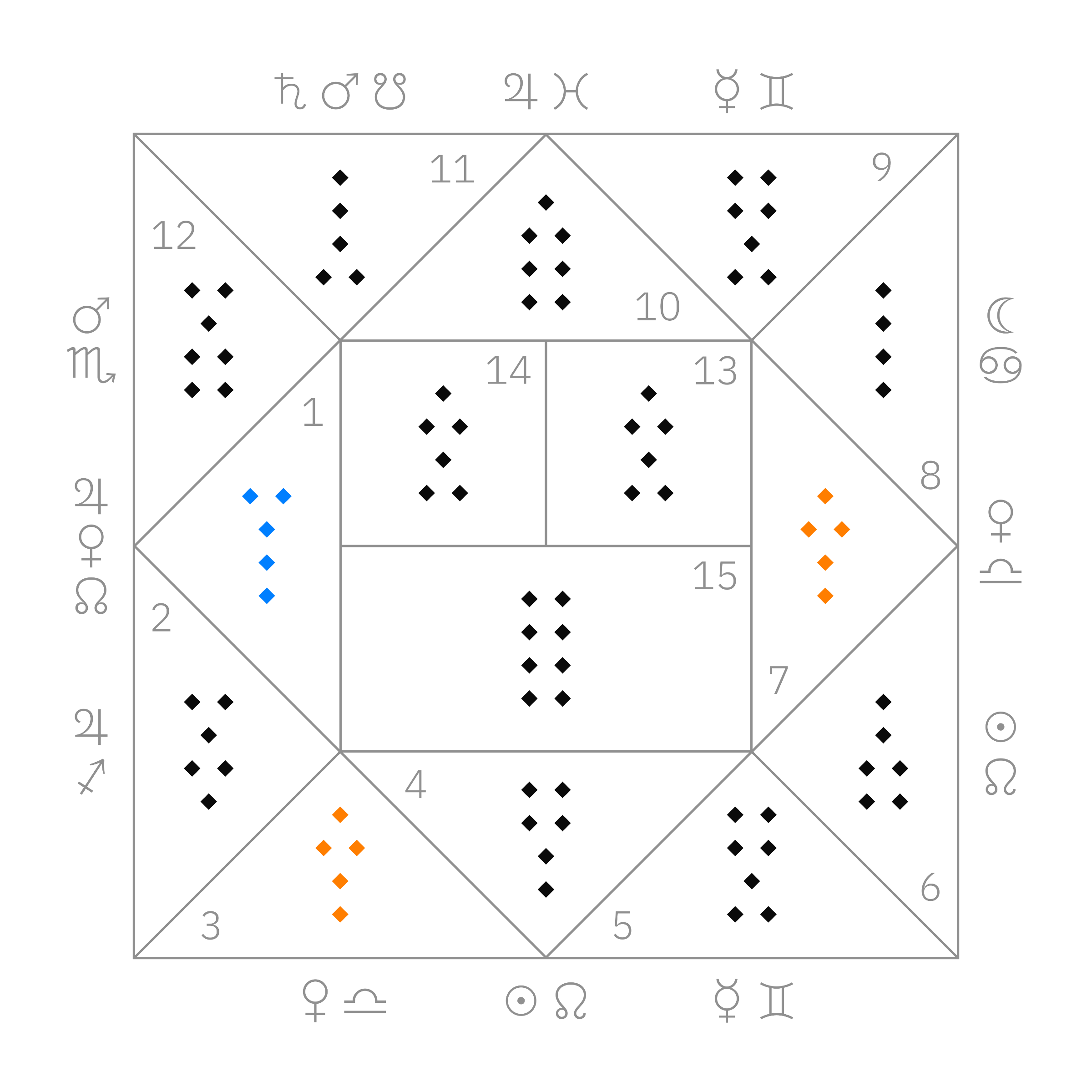
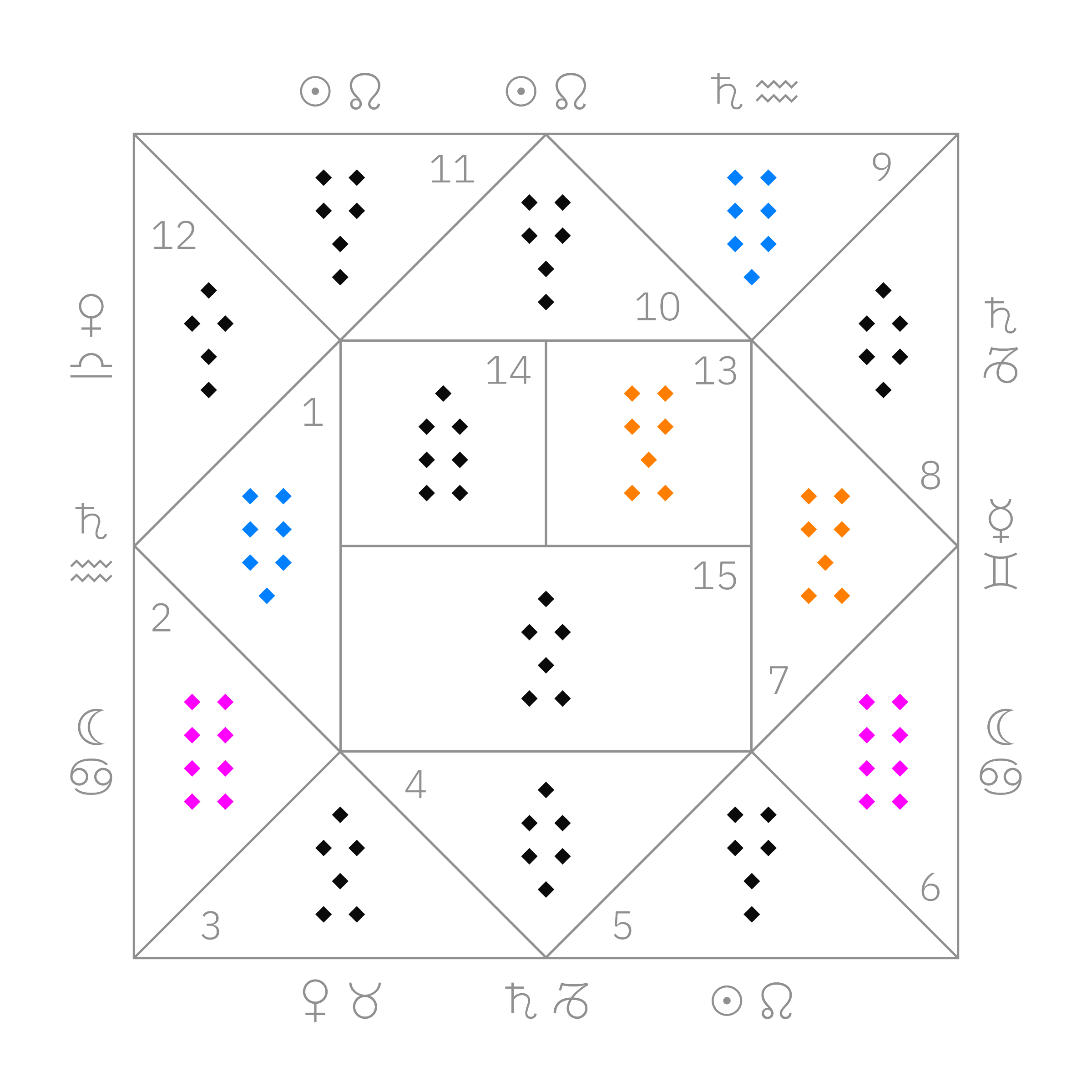
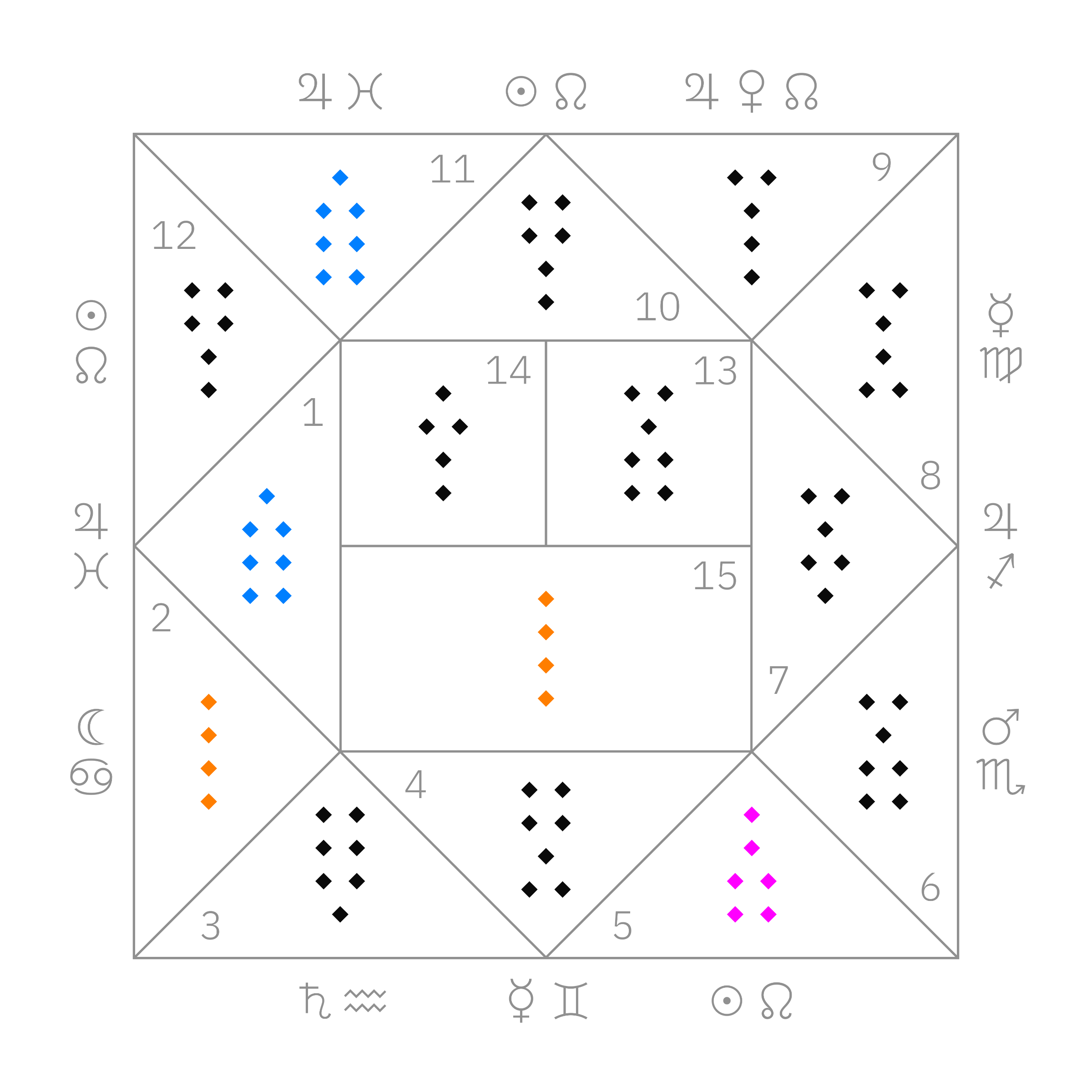
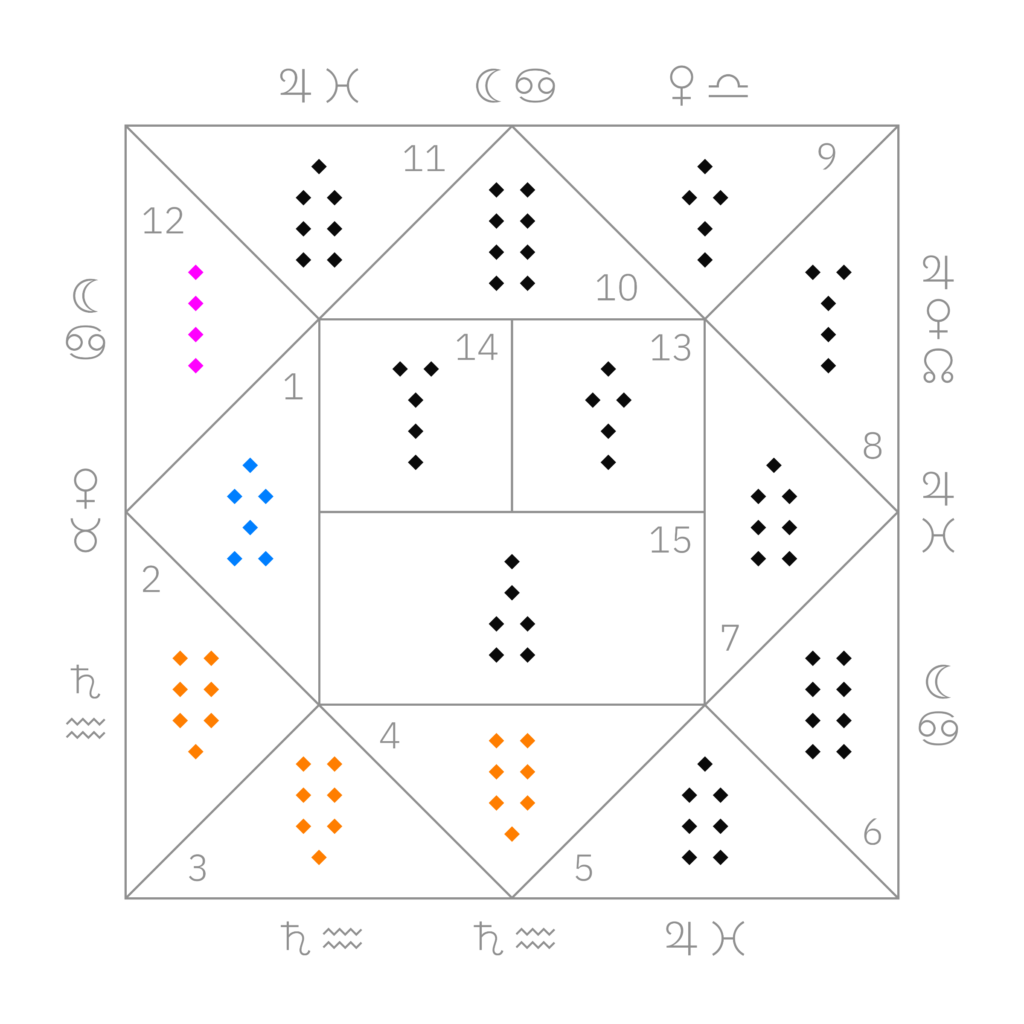
The Four Mothers: Amissio · Tristitia · Tristitia · Tristitia.
Permalink: View This Chart on Geomancy.Tools.
Preface
The querent was a man who wanted to understand the cause of his lifelong financial misfortune. Throughout his adult life, money either passed him by or slipped away almost as soon as it arrived, no matter how hard he tried to improve his circumstances.
The same pattern had followed his parents. For as long as he could remember, they never seemed to have enough money, and their attempts to improve their situation rarely produced lasting results.
The querent suspected that some kind of curse rested upon him and his family—or, in modern terms, that a destructive subconscious program had been passed down from one generation to the next.
The Querent and the Quesited
The Querent and His Money
The querent is represented by Amissio in the first house—a figure of C Venus in b Taurus. Amissio signifies loss and surrender, but also giving and sacrifice.
In financial questions, it is unfavorable. A person represented by Amissio parts with money more readily than he acquires or keeps it. Here it describes not only the querent’s repeated losses, but also his tendency to give, yield, and sacrifice his own material interests.
The second house represents the querent’s money and his financial condition as a whole. It contains Tristitia—a powerful and stable malefic figure of L Saturn in k Aquarius. In traditional astrology and geomancy, L Saturn is the Greater Malefic. Taken together, the four Latin names of Tristitia describe the querent’s financial life with remarkable precision:
- Tristitia (Sorrow)—money brought him anxiety and disappointment far more often than joy.
- Damnatus (Cursed)—his money seemed cursed: either it failed to arrive or disappeared soon afterward.
- Transversus (Crooked)—his relationship with money had become distorted.
- Diminutum (Diminished)—there was never enough money.
The first two houses already state the case. The querent is represented by a figure of Loss and Sacrifice, while his finances are governed by a powerful figure of the Greater Malefic—one that traditionally signifies Poverty and Destitution. The chart describes the circumstances of the question accurately and is therefore radical.
A Personal Curse
The twelfth house signifies secret enemies and concealed harm of which a person may remain unaware. Since a curse is a hidden and harmful influence, a personal curse upon the querent must be sought in this house.
The twelfth house contains Via—the figure of the waning E Moon. In questions of imprisonment, Via in the twelfth house traditionally signifies release from prison. In questions concerning secret enemies, it signifies their departure. They withdraw just as the E Moon wanes.
The chart therefore shows no active personal curse. If such an influence once existed, it has already departed.
The source of the querent’s financial difficulties, however, may not lie in his personal fate. It may belong to his family line.
An Ancestral Curse
The fourth house represents parents, ancestors, family roots, and the lineage as a whole. Symbolically, it is the lowest point of the chart—Imum Coeli, or the Lowest Point of the Heavens.
To find a possible curse upon the querent’s family, we count the derived twelfth house from the fourth. This brings us to the radical third house.
The third house contains Tristitia, which forms perfect company with another Tristitia in the fourth. The quesited is therefore shown by a doubled Tristitia.
The same figure also occupies the second house of money. In the third house, Tristitia shows the hidden ancestral evil; in the fourth, its roots within the family; and in the second, its financial manifestation in the querent’s life.
Analysis
A Question of Condition
This is a question of condition, not of a future event. No perfection between the first and third houses is therefore required to confirm the existence of the curse.
Perfection is used to judge whether an event will come to pass. Here, the chart describes an influence that already existed when the question was asked.
Its presence is established by the essential nature of the quesited itself. The derived twelfth house contains Tristitia—a powerful and stable malefic figure of L Saturn. In a question about a curse, it acts precisely as a figure of cursing.
Any perfections found elsewhere in the chart do not show the curse coming into existence. They show how an already existing ancestral evil is connected with the querent and how it has manifested in his life.
The Nature of the Influence
The reception of the two Tristitia figures produces:
- Tristitia + Tristitia = Populus
Populus is the figure of multitude. This was not an isolated misfortune affecting one person, but a collective family program shared by several members of the lineage. The same attitudes had appeared in different generations and repeatedly produced similar consequences.
Tristitia belongs to L Saturn in k Aquarius, a fixed sign of 🜁 air. Fixity signifies duration and deep entrenchment. The influence had existed for many years and had become part of an established worldview.
🜁 Air is traditionally opposed to 🜃 earth—the element of money, property, material values, and practical stability.
The Querent’s Parents
The father’s natural co-significator is Caput Draconis in the eighth house. The first and eighth houses are in aversion, or inconjunction: they do not behold one another.
This describes their relationship literally. The father abandoned the family while the querent was still a boy, and the child scarcely saw him afterward.
With the father gone, the mother had to become the family’s provider. Her natural co-significator, Lætitia, stands in the seventh house, opposite Amissio in the first.
The X opposition shows separation between mother and child. To support the family, she worked in trade and was frequently away on business. She provided for her son materially, but could not be consistently present in his daily life.
Lætitia and Caput Draconis are in planetary company, confirming their connection as the querent’s parents. Their positions also explain why neither took a constant part in his upbringing: the father had left the family, while the mother was forced to work.
The Two Grandmothers
Lætitia is the natural significator of a mother. When its pattern is inverted, it becomes Tristitia—the natural significator of a grandmother. A grandmother is the mother of the previous generation, and the relationship between them is reflected literally in the shapes of the two figures.
The doubled Tristitia in the third and fourth houses represents the querent’s two grandmothers—one maternal and one paternal.
The maternal grandmother cared for the querent whenever his mother was away and effectively took her place.
The querent frequently visited his paternal grandmother and helped her around the house. Since her own son—the querent’s father—had abandoned his family, she treated her grandson almost as a son.
The second house signifies not only money, but also a person’s closest helpers and material supports. Tristitia in this house therefore reveals both sides of the matter: the grandmothers were the querent’s chief helpers, yet they were also the people from whom he absorbed the attitudes that later damaged his financial life.
The Financial Program
Both grandmothers were deeply religious. They taught their grandson to think less about money and more about “eternal life.”
Poverty was presented as a religious virtue: “We may be poor, but we are believers, and therefore God loves us.” Both women also gave a considerable portion of their own money to religious causes.
They genuinely loved the querent and meant him no harm. Yet together with their care, they passed on contempt for money and the belief that poverty was a mark of “spiritual purity.”
This is where Transversus in the second house becomes clear: the querent’s relationship with money had been distorted by his upbringing. Receiving, accumulating, and seeking prosperity seemed spiritually suspect, while material renunciation, giving, and sacrifice were treated as virtues.
Amissio in the first house now becomes equally clear. The querent had been taught to give rather than receive, and to sacrifice rather than preserve and increase what he possessed. What the family regarded as moral virtue became a pattern of continual loss in his financial life.
The symbolic opposition between 🜁 air and 🜃 earth also becomes concrete here. Abstract religious ideals were repeatedly placed above practical material needs.
The same outlook had first been passed on to the querent’s parents, which explains why they suffered from similar financial difficulties. The querent received the program in two ways: as part of the family’s general worldview and directly through the upbringing provided by his grandmothers.
Love as the Conduit
To determine the querent’s relationship with his grandmothers, we combine his figure with theirs:
- Amissio + Tristitia = Puella
Puella is the good and stable figure of C Venus in g Libra, signifying love, tenderness, and deep affection.
The repetition of C Venus is especially important. The querent himself is represented by Amissio—C Venus in b Taurus. Its reception with Tristitia produces Puella—the other figure of C Venus. The Right Witness is also Puella.
Love for the grandmothers is therefore not a secondary detail. It stands at the center of the judgment.
Puella does not change the evil nature of Tristitia, nor does it make the program they transmitted beneficial. It explains why their influence reached so deeply into the querent’s mind.
He loved his grandmothers, trusted them, and did not dare oppose their teachings. His ideas about money came not from enemies, but from the women who fed him, protected him, and took the place of his parents. Their beliefs therefore became inseparable from love, faith, and family security.
C Venus appears in the chart from two sides. Puella signifies the querent’s love for his grandmothers; Amissio signifies his willingness to give and sacrifice. His affection made him receptive to their teachings, while the habit of sacrifice turned those teachings into a lasting pattern of financial behavior.
The Witnesses and the Judge
The Right Witness is Puella. It repeats the figure produced by the reception of Amissio and Tristitia and once again points to the querent’s love for his grandmothers.
The Left Witness is Caput Draconis. This figure corresponds to the P North Node, which in astrology increases and magnifies whatever it joins. Caput Draconis therefore strengthens Puella and shows the extraordinary depth of the querent’s attachment.
The Judge is Fortuna Minor—the figure of the A Sun obscured by clouds. One of its principal meanings is secrecy and things concealed from view.
Together, the Witnesses and the Judge give an exact answer: a powerful but hidden love for the grandmothers.
That hidden love lies at the heart of the question. The querent might consciously reject the glorification of poverty, yet he remained inwardly loyal to the women he loved. On an unconscious level, rejecting their beliefs about money felt almost like rejecting the grandmothers themselves.
Judgment
There is no active personal curse upon the querent. Via in the twelfth house indicates the departure of a hidden harmful influence.
The chart does, however, confirm a powerful ancestral program. The doubled Tristitia represents the curse upon the family, while the same figure in the second house shows that its chief manifestation lay in the querent’s money and overall financial condition.
The two grandmothers who had taken the place of his parents became the conduits through which the program reached him. They passed their religious contempt for money and idealization of poverty first to their own children and later to their grandson.
Amissio shows the result of that upbringing. The querent learned to give and sacrifice, but he never learned to receive without guilt, preserve what he had, or increase it with confidence.
The grandmothers’ love does not turn Tristitia into a good figure, nor does it erase the harm that was done. On the contrary, love allowed their beliefs to enter especially deeply. The querent remained loyal not only to the grandmothers themselves, but also to their attitude toward material life.
In the language of geomancy, this was an ancestral curse. In the language of psychology, it was an entrenched financial program transmitted through upbringing, affection, and family loyalty.
Outcome
The Reconciler shows how the situation described by the chart will conclude. It is formed through the reception of the querent’s figure with the Judge and therefore represents the outcome of their interaction:
Amissio + Fortuna Minor = Conjunctio
Conjunctio signifies the joining of things that had previously seemed unrelated.
That is exactly what occurred. The querent connected his financial misfortune with his grandmothers’ upbringing, the religious glorification of poverty, his habit of sacrificing his own interests, and his hidden love for the women who had given him those beliefs.
The decisive realization was simple: loving his grandmothers did not oblige him to preserve their relationship with money. He could remain grateful for their care without repeating their convictions or their way of life.
He understood that he had to release them inwardly, and that gratitude did not require him to sacrifice his own well-being in order to remain faithful to their values.
Afterward, the querent listened every day for thirty days to a course of Ericksonian hypnosis intended to free him from negative financial programs inherited from family members.
His financial circumstances gradually began to improve and settle into order.
Lesson
A question about a curse does not always reveal an external supernatural attack.
Sometimes the language of geomancy describes as a curse what psychology calls a family program—an attitude learned in childhood, reinforced by experience, and passed from one generation to the next.
This chart revealed the source of the problem, the people through whom it was transmitted, the means by which it entered the querent’s life, and the reason he had been unable to resist it for so long.
Harm does not always arrive through hostility. Sometimes it is carried by love, care, and unquestioning trust. And sacrifice, when taught as a virtue, can quietly become a lifelong habit of surrendering one’s own prosperity.