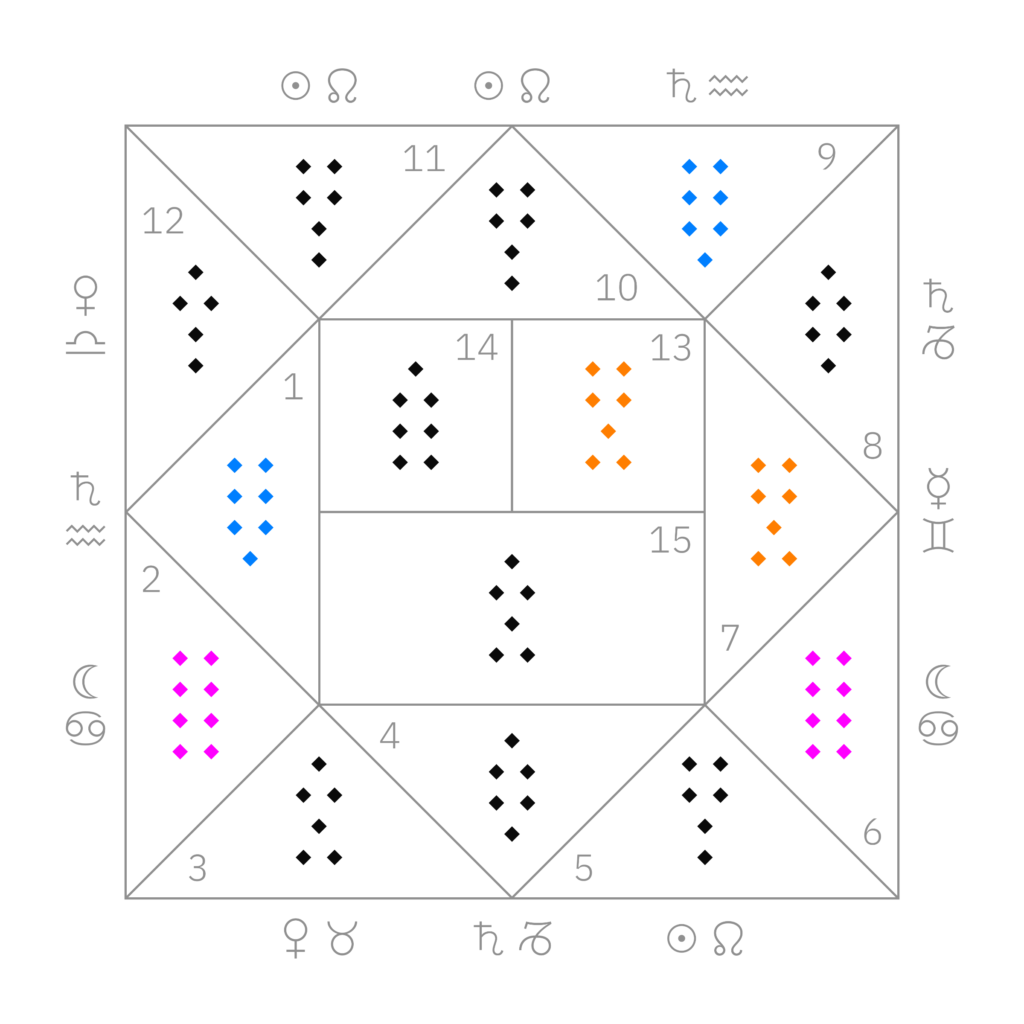
Chart Information
Cast By: The Querent.
The Four Mothers: Tristitia · Populus · Amissio · Carcer.
Permalink: View This Chart on Geomancy.Tools.
Preface
The querent was a young attorney in active practice. He had found himself in serious difficulty: an important document entrusted to him by his clients had gone missing.
He searched his office and his own car thoroughly, but could not find it.
The querent asked where the missing document was.
The Querent and the Quesited
The querent is signified by Tristitia in the first house.
Tristitia, the figure of L Saturn in k Aquarius, signifies sorrow, dejection, and a heavy state of mind. Its meaning is intensified by the head company it forms with Populus in the second house.
Populus, the figure of the full E Moon in d Cancer, acts like a mirror: it reflects and magnifies the qualities of the figure with which it forms company. Tristitia therefore shows more than ordinary concern. It describes the querent’s deep anxiety over the disappearance of an important document.
The same Tristitia passes into the ninth house—the house of dreams. The querent was indeed under severe strain and unable to sleep peacefully because of what had happened.
The chart thus describes his condition and the circumstances of the question with precision, confirming its radicality.
We must now identify the figure signifying the missing document.
Since the document belonged not to the attorney himself but to his clients, the formal rules of judgment direct us to the clients’ derived second house—the radical eighth. There we find Carcer.
The same figure also occupies the fourth house, which is traditionally considered in questions concerning lost property.
Carcer can signify an enclosed or confined space—a drawer, cabinet, container, or another place in which something is shut away. The document had originally been kept inside the desk. The thin, flimsy folder that held it hardly corresponds to the nature of Carcer.
Carcer therefore appears to describe the document’s ordinary place and manner of storage—the enclosed space inside the desk from which it disappeared—rather than the document itself.
The most natural significator of the missing paper is Albus in the seventh house.
Albus corresponds to the lost document for several reasons:
- Albus is the figure of B Mercury in c Gemini, and B Mercury is the natural ruler of documents, papers, records, messages, and business correspondence.
- The word Albus means “white.” The figure may therefore signify paper, a white sheet, or another pale object in a very literal sense.
- c Gemini is a double-bodied sign. Albus may therefore signify not only one object, but a pair or several related objects. It was later discovered that two documents had gone missing, although the querent believed at the time of the question that he was searching for only one.
- The first house is traditionally the joy of B Mercury. Albus stands in the opposite seventh house, giving us a fitting image of a Mercurial object displaced from its proper place and found where it ought not to be.
Albus is neither besieged nor combust. The documents were therefore not destroyed or damaged, but merely moved elsewhere.
The principal significators are therefore:
- the querent— Tristitia;
- the lost documents— Albus.
Analysis
The Employee and the Lost Documents
Some time after the chart was cast, I contacted the querent again. He told me that he had reviewed footage from the building’s surveillance cameras.
The recording showed an employee removing the documents from the desk and leaving the building with them.
The employee said that he might have taken the documents for some work-related purpose, but could no longer remember where he had put them afterward. His actions were therefore not necessarily an act of theft. Nevertheless, the documents were still missing.
This new information made the structure of the chart much clearer.
Employees and hired workers traditionally belong to the sixth house. The sixth house is occupied by Populus, which in this case signifies the employee.
The following seventh house is his derived second house. It therefore signifies his possessions, personal effects, and anything that had passed into his keeping.
It is precisely here that we find Albus, the significator of the lost documents.
The chart thus showed their location in the simplest and most direct manner:
- Populus in the sixth house—the employee;
- Albus in the seventh house—the documents among his belongings or in a place to which he had carried them.
No company is formed between Populus in the sixth and Albus in the seventh. This may be taken as a secondary symbolic indication that the employee no longer retained a clear, conscious connection with the documents: he had taken them, but could not remember where he had subsequently left them.
The Surveillance Cameras
Once the surveillance footage became known, another striking symbol in the chart became apparent.
Particular attention should be given to the company formed by Fortuna Major in the fifth house and Populus in the sixth.
Populus is a lunar figure, while Fortuna Major is solar. In traditional bodily correspondences, the E Moon and the A Sun govern opposite eyes. Together they symbolically represent both eyes—sight as a whole.
Here this does not describe the eyesight of any particular person, but the broader image of observation: the employee was in view, and his actions were captured by surveillance cameras.
Will the Documents Be Found?
The principal question concerns the location of the lost documents. Once their connection with the employee had been established, however, a second practical question remained: would they ultimately be recovered?
The recovery of lost property is an event. We must therefore look for perfection between the querent’s significator— Tristitia in the first house—and the significator of the documents— Albus in the seventh.
Their reception produces:
- Tristitia + Albus = Fortuna Major
Fortuna Major is the figure of great fortune, light, success, and a favorable conclusion.
Fortuna Major also appears twice above the horizon, in the tenth and eleventh houses. This provides further testimony that the lost documents would be found.
Two perfections are formed between Tristitia and Albus.
The T Sextile
Tristitia passes from the first house into the ninth and from there forms a T sextile with Albus in the seventh.
Their reception produces Fortuna Major. The T sextile therefore gives favorable testimony for the recovery of the missing documents.
Tristitia in the ninth also forms company with Fortuna Major in the tenth, further strengthening this testimony. Moreover, the reception of Tristitia and Fortuna Major produces Albus—the figure of documents.
The Translation
The second perfection is formed by translation through Populus.
Populus in the second house stands beside Tristitia in the first. The same Populus appears again in the sixth house beside Albus in the seventh.
Populus therefore acts as an intermediary between the querent and the missing documents.
Since Populus in the sixth signifies the employee, the translation shows that the documents would be recovered through his participation.
The Witnesses and the Judge
The Right Witness is Albus, which is also the significator of the lost documents. It is B Mercury in c Gemini—the natural image of papers, records, and information.
The Left Witness is Lætitia, the figure of K Jupiter in l Pisces.
Their reception produces the Judge, Amissio, whose name literally means Loss:
- Albus + Lætitia = Amissio
B Mercury and K Jupiter stand across the two mutable sign axes: c Gemini and i Sagittarius, f Virgo and l Pisces. In the context of this chart, their symbolic discord describes an error or mismatch in action that resulted in the loss of the documents.
The Witnesses and the Judge therefore describe the subject of the question with precision:
- Albus—the documents;
- the discord between B Mercury and K Jupiter—the error;
- Amissio—the resulting loss.
The Court thus provides further confirmation of the chart’s radicality by plainly describing the matter under judgment.
The Reconciler
The sixteenth figure is Puella.
The Reconciler is formed by adding the figure in the first house to the Judge:
- Tristitia + Amissio = Puella
It describes the manner in which the situation will finally be resolved.
Puella signifies peace, agreement, reconciliation, and the quiet settlement of a dispute without open conflict.
It indicates that the matter would end without accusations, quarrels, or serious confrontation.
Judgment
The lost documents are among the employee’s belongings or in a place to which he carried them.
The employee is signified by Populus in the sixth house, while Albus—the significator of the documents—occupies the following seventh house, which is his derived second.
The search should therefore proceed through the employee himself and through a careful reconstruction of his movements and actions after he removed the documents.
The perfections further indicate that the documents will be recovered through his participation.
I advised the querent to remain in communication with the employee and to retrace, together with him, everything he had done after leaving with the documents.
Outcome
The attorney recovered the lost documents with the employee’s help.
This corresponds directly to the translation through Populus in the sixth house.
It was also discovered that not one but two documents had gone missing, as suggested by the double-bodied nature of Albus as the figure of B Mercury in c Gemini.
The querent and the employee traveled together to another city, and the documents were found there.
Only after the event did the second perfection reveal its additional meaning. Tristitia—the querent’s figure—had passed from the first house into the ninth, the house of long journeys and movement over a considerable distance, and from there formed a T sextile with Albus, the significator of the documents.
The chart therefore described not only their recovery, but the action that led to it: the querent traveled to another city with the employee and found the documents there.
Both perfections were fulfilled literally:
- the translation through Populus showed the employee’s direct involvement;
- the passage of Tristitia into the ninth house and its T sextile with Albus described the querent’s journey to another city, where the documents were found.
The company of Populus and Fortuna Major was likewise fulfilled: the employee was in view, and his actions had been captured by surveillance cameras.
The matter ended peacefully and without conflict, in keeping with Puella as the Reconciler.
Lesson
The chief lesson of this chart is that a geomancer needs flexibility of mind. Rules provide the structure of judgment, but they must not be applied blindly or mechanically.
The clients’ derived second house and the fourth house both gave Carcer. Yet Carcer described not the documents themselves, but their ordinary place of storage—the enclosed space inside the desk from which they disappeared. Albus, their natural significator, described the papers far more precisely.
Flexibility does not mean arbitrary interpretation. It means recognizing the particular role that each figure performs within the chart.
A geomantic chart answers the question no more elaborately than necessary. It shows the object, the person, the place, and the path to the outcome so naturally that, once events have unfolded, every symbol falls into its proper place. The same is true of horary astrology.