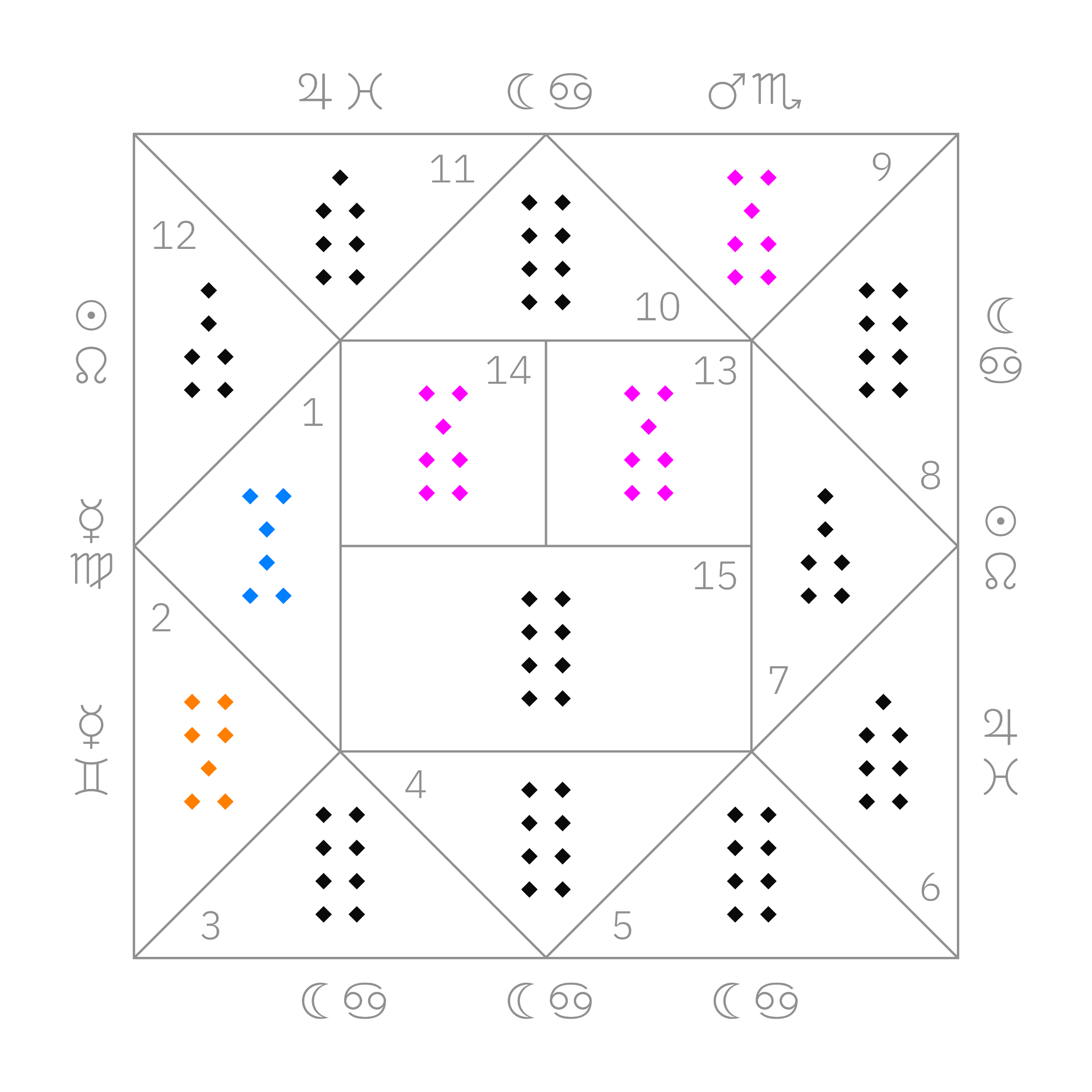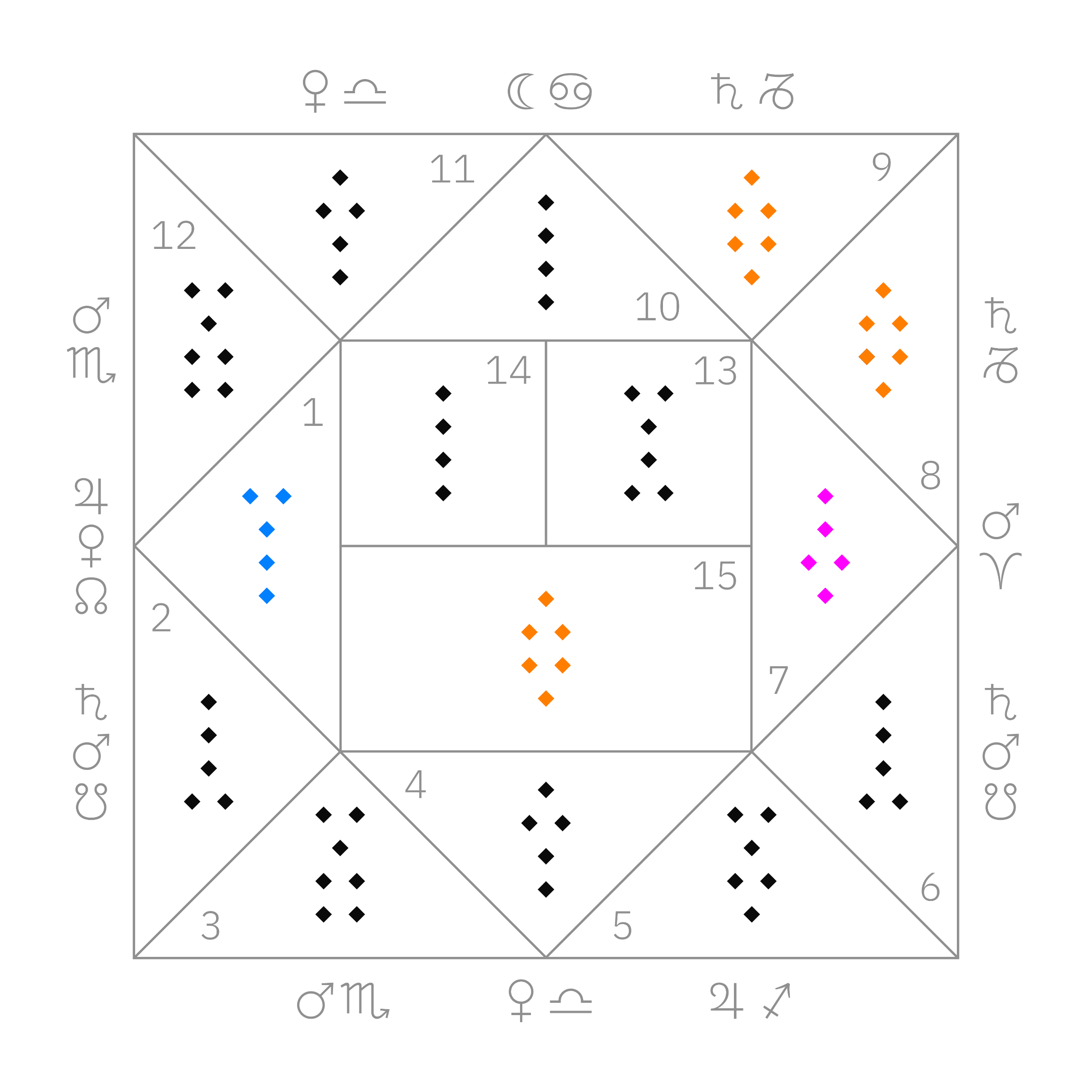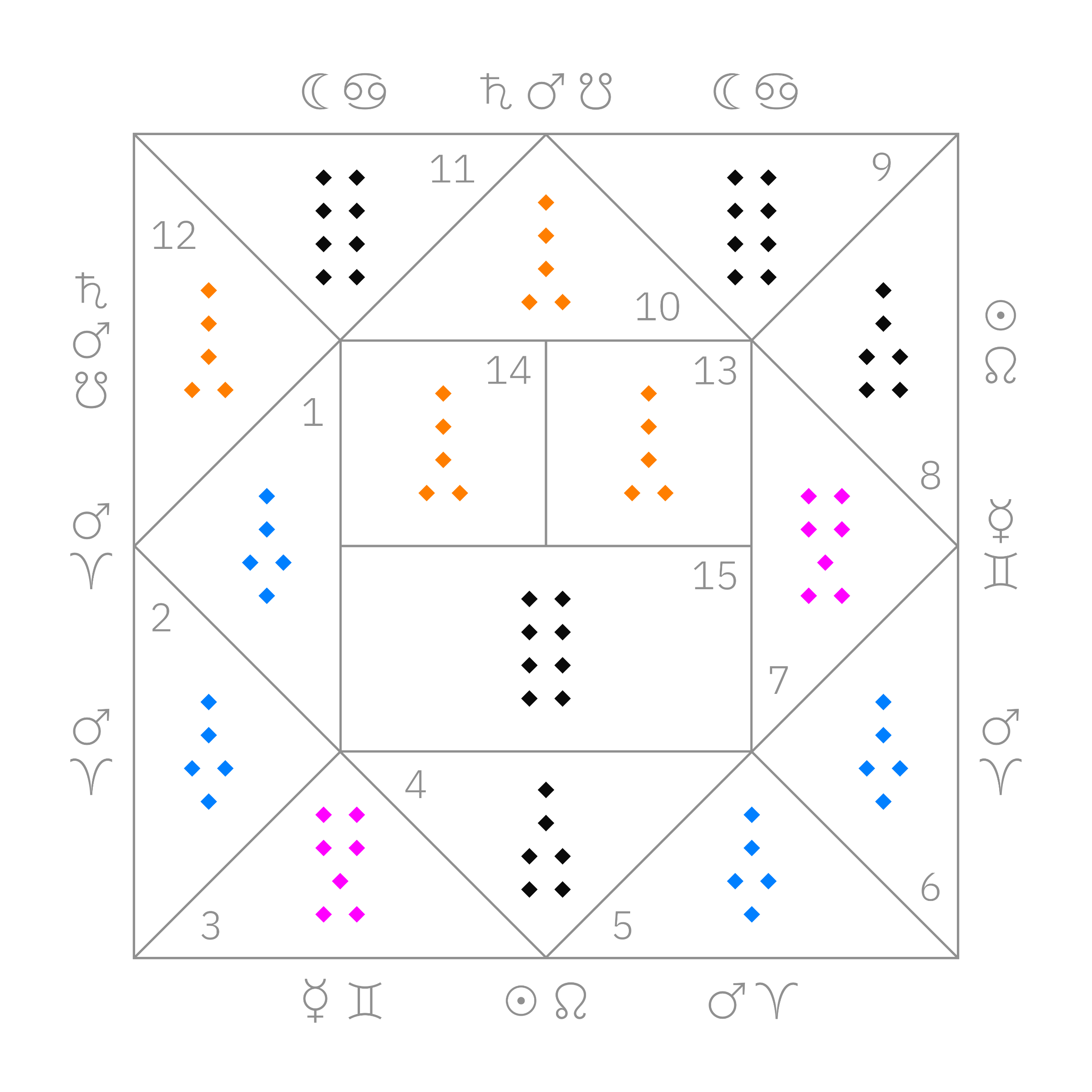

Chart Information
Cast By: The Querent.
The Four Mothers: Amissio · Fortuna Major · Conjunctio · Populus.
Permalink: View This Chart on Geomancy.Tools.
Preface
The querent was a young woman. One day, a friend called to tell her that she was taking her driving test the following day. She was learning to drive because she planned to buy a car for family use.
Her friend was extremely nervous about the test and had called the querent for moral support. The querent decided to consult geomancy and ask whether her friend would pass the test and receive her driver’s license.
The Querent and the Quesited
The young woman who asked the question automatically receives the first house, where we find Amissio. The querent herself, however, does not matter in this question—the matter concerns her friend alone.
Friends are signified by the eleventh house. There we find the same figure, Amissio, in perfect company with Amissio in the twelfth house. The friend is therefore represented by a doubled Amissio. Moreover, Amissio passes from the eleventh house into the twelfth and then appears again in the first.
Driving belongs to basic practical knowledge and skill, so it is judged from the third house. To determine the friend’s own driving ability, we count the third derived house from the eleventh. This brings us to the first house of the radical chart, where we again find Amissio.
The friend and her driving ability are therefore represented by the same figure.
Because the question concerns receiving a driver’s license as the result of the test, the license must be judged as the profit or benefit gained from her driving ability. The profit or benefit arising from anything is shown by its second derived house.
If the first house of the radical chart represents the friend’s driving ability, then the radical second house is the second derived house from that ability and therefore signifies the driver’s license. There we find Fortuna Major—the figure of Greater Fortune.
Analysis
Traditionally, the fifth house is the house of C Venus’s joy, while the opposite eleventh house is considered the house of her sorrow. Amissio, a C Venus figure belonging to the cold and dry sign of b Taurus, is therefore saddened and distressed in the eleventh house.
This accurately describes the friend’s condition. She was deeply worried about the approaching test and called the querent for reassurance and moral support. This is the first confirmation of the chart’s radicality.
Now let us turn to the Witnesses and the Judge:
- the Right Witness is Via.
- the Left Witness is Populus.
- the Judge is Via.
All three figures are lunar. Via signifies a road, a path, and movement, while Populus signifies a crowd, a multitude, and a busy public setting.
Together, Via and Populus can depict a solitary person— Via as a figure of the waning E Moon—moving among a crowd represented by Populus, a figure of the waxing or full E Moon. The same combination also gives a clear symbolic picture of movement through busy streets among other road users.
The Witnesses and Judge therefore describe the subject of the chart with remarkable precision: one person must drive through public streets among many others and demonstrate her ability to control a vehicle. This is the second confirmation of the chart’s radicality.
There is another important point concerning the Judge. When Populus appears as Judge, it traditionally indicates that the result depends upon a group, a collective, or several people rather than upon one individual.
Via as Judge indicates the opposite—the result depends upon one person. In this case, the outcome depended upon the friend herself and her own ability to pass the test.
Receiving a driver’s license is an event, so we must look for perfection between the friend’s figure— Amissio in the eleventh house—and the figure of the driver’s license— Fortuna Major in the second.
There are no fewer than four perfections: three major perfections and one through an astrological aspect.
1. Conjunction
Amissio from the eleventh house passes into the first house, where it stands directly beside Fortuna Major in the second.
2. First Translation
Conjunctio in the tenth house stands beside Amissio in the eleventh. The same Conjunctio appears in the third house, where it stands beside Fortuna Major in the second.
Conjunctio therefore acts as the first intermediary figure, connecting Amissio with Fortuna Major.
3. Second Translation
Amissio in the twelfth house stands beside Amissio in the eleventh. The same figure appears in the first house, where it stands beside Fortuna Major in the second.
Amissio therefore acts as the second translating figure, even though it also signifies the friend. This is a compound perfection: its appearance in the first house forms Conjunction with Fortuna Major, while its appearances in the twelfth and first houses form Translation between the original significators. Both modes remain valid.
The twelfth house is also the second house from the eleventh and therefore signifies the friend’s money. The translating Amissio may thus represent the payment required to enter the examination. This is a possible meaning of the mediation, rather than a certain identification based on the repeated figure alone.
Conjunction describes the friend’s personal participation: she must attend and demonstrate her driving ability. Translation through Amissio can describe the means enabling that attempt—her payment, signified by the twelfth house, and her own performance, signified by the first. The same figure thus represents the person, her expenditure, and her skill in different houses. Both perfections remain meaningful: one shows direct involvement, the other how that involvement is made possible.
4. T Sextile
Amissio passes from the eleventh house into the twelfth, where it stands with one intervening house between itself and Fortuna Major in the second, forming a T sextile aspect.
At first glance, so many perfections might seem to guarantee that the friend would receive her driver’s license. They do not.
The cookbook rule—"find a perfection and give a positive answer"—fails here. Geomancy requires more than knowledge of techniques and rules. It also requires judgment, context, and logical interpretation.
The four configurations show several technical paths connecting the friend with the object of her question. Their presence must be judged together with the figures and Reception before concluding that she will obtain her license.
The precise question concerns passing the test and receiving the license—not merely attending the examination. Participation is a necessary stage, but it is not the requested outcome. Here, the connections show engagement with the examination process, while the repeated Amissio and the Reception of Carcer argue against successful acquisition. The judgment is therefore that she will make the attempt but will not obtain the license on this occasion.
First
The friend is represented by a doubled Amissio.
In questions concerning victory, success in a trial, or obtaining something desired, Amissio is the figure of the loser. Its reversed counterpart, Acquisitio, signifies acquisition, gain, and victory.
The friend’s own figure therefore points directly toward defeat.
Second
The friend’s driving ability is also represented by Amissio in her derived third house—the first house of the radical chart.
This plainly shows that her driving skills were poor.
b Taurus is both a mutilated and a fixed sign. In traditional astrological imagery, b Taurus is depicted as only the front half of a bull—the hindquarters and legs are absent. b Taurus is therefore mutilated specifically in the legs.
Since the legs are needed to operate a car’s pedals, Amissio in a b Taurus mutilated in the legs can indicate that the friend handled the pedals poorly or without confidence.
b Taurus is also a fixed sign. Fixedness signifies immobility, rigidity, remaining in one place, and difficulty adapting quickly to changing circumstances. These are poor qualities for a driving test, where the driver must respond promptly to changing traffic conditions and continuously coordinate her actions.
Third
Because both the friend and her driving ability are represented by Amissio, we must examine the interaction between Amissio and Fortuna Major, the figure of the driver’s license.
This is their reception—the result produced by the interaction of the two figures. When Amissio and Fortuna Major are added together, they produce Carcer.
Carcer signifies restriction, obstruction, and a barrier. The result of the friend’s interaction with the driver’s license is therefore negative: an obstacle stands between her and the thing she seeks.
The several configurations establish connections with the object sought, but do not by themselves establish its acquisition. The reception of Carcer shows how that event will end.
Fourth
Amissio is extremely unfavorable in material matters. The friend’s personal money is judged from the second derived house from the eleventh—the twelfth house of the radical chart.
The twelfth house contains Amissio, and it stands in perfect company with Amissio in the eleventh. The friend and her money are therefore both represented by a doubled Amissio.
The primary meaning of Amissio is loss. The fee paid for the attempt would not be returned if she failed the test. The loss of that money therefore indirectly confirms the negative result: within the context of the question, the examination fee becomes a loss precisely because she does not pass and does not receive her driver’s license.
Judgment
The friend will not pass the driving test the following day, will not receive her driver’s license, and will lose the money paid for the attempt.
In other words, Fortuna Major—Greater Fortune—will not be hers that day.
Outcome
That is exactly what happened.
When the querent spoke with her friend the following day, she learned that the friend had failed the test and had not received her driver’s license.
The friend later passed the test and obtained her license on her second attempt. That, however, was a separate event and lay outside the scope of the original question. The chart had been cast for one specific matter—whether she would pass the test scheduled for the following day.
Lesson
The principal lesson of this chart is that several technical paths of Perfection must be interpreted together with the figures, Reception, and the precise outcome asked about.
Conjunction and both Translations remain valid configurations. In particular, the Translation through Amissio combines with Conjunction to form a compound perfection. Neither mode cancels the other, but their coexistence does not override the obstructive Reception of Carcer.
The friend’s attendance at the examination and her acquisition of the license are distinct events. The chart was judged to show an unsuccessful attempt: the connections described her engagement with the process, while Amissio and Carcer indicated failure to obtain the desired result on that occasion.