Chart Information
Cast By: The Querent.
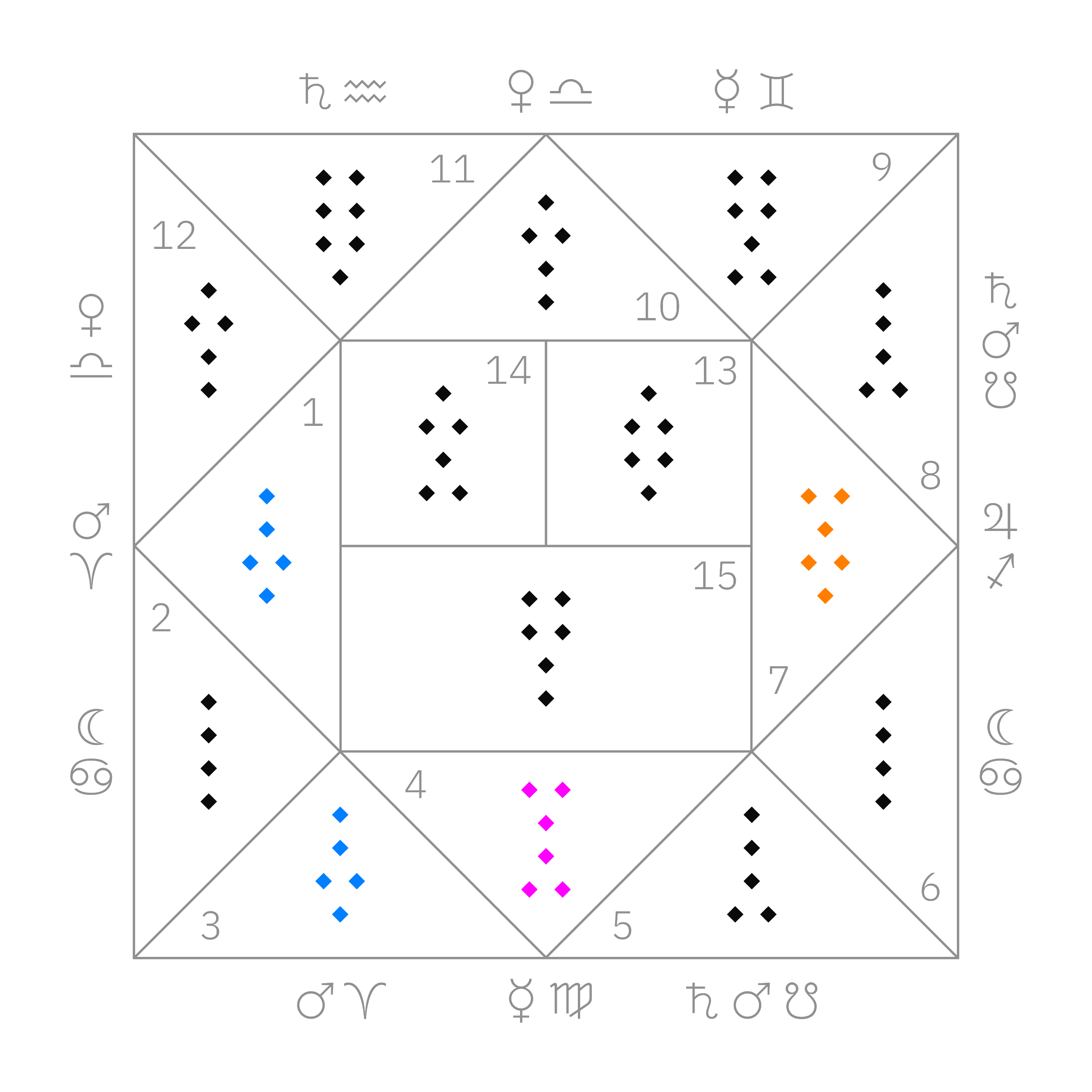
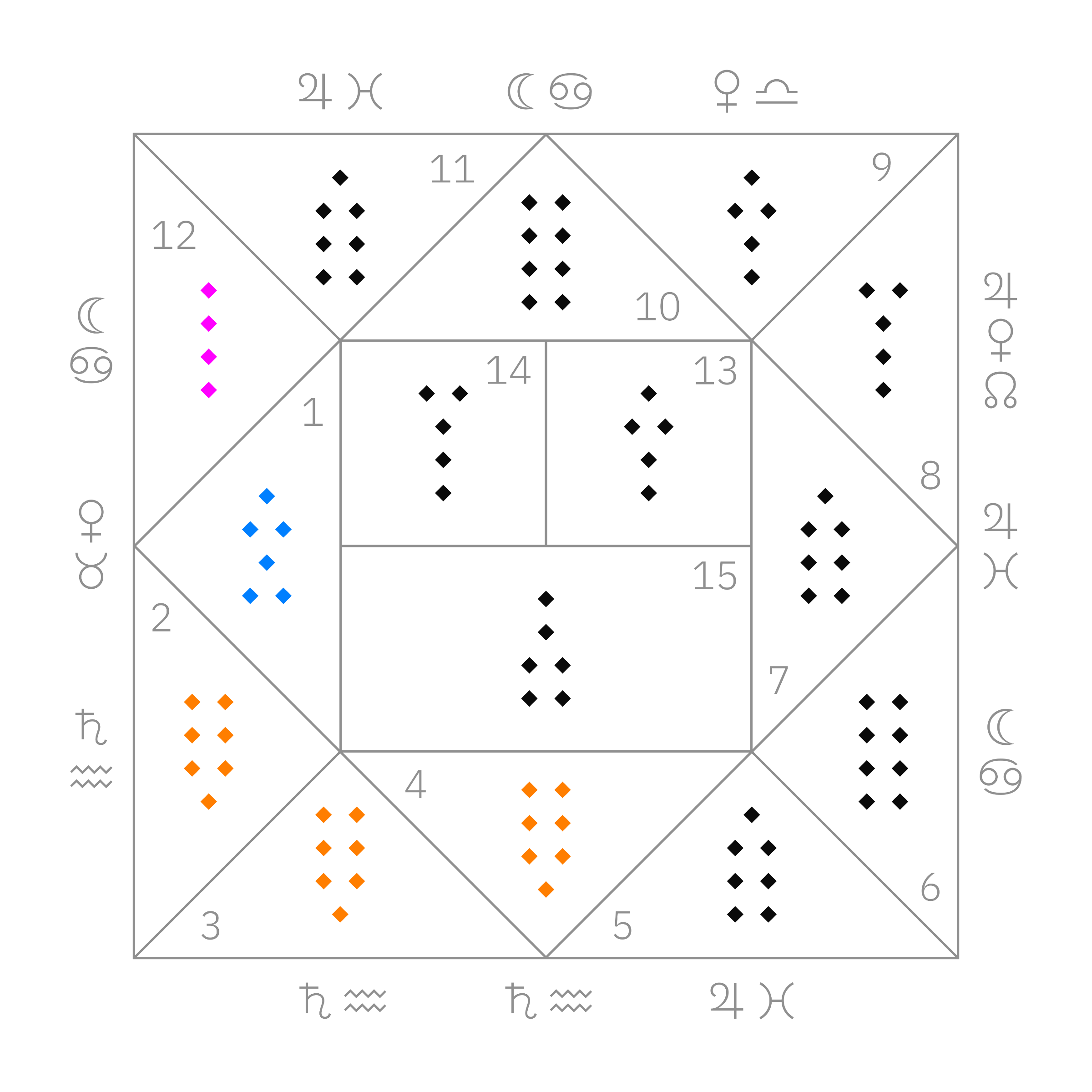
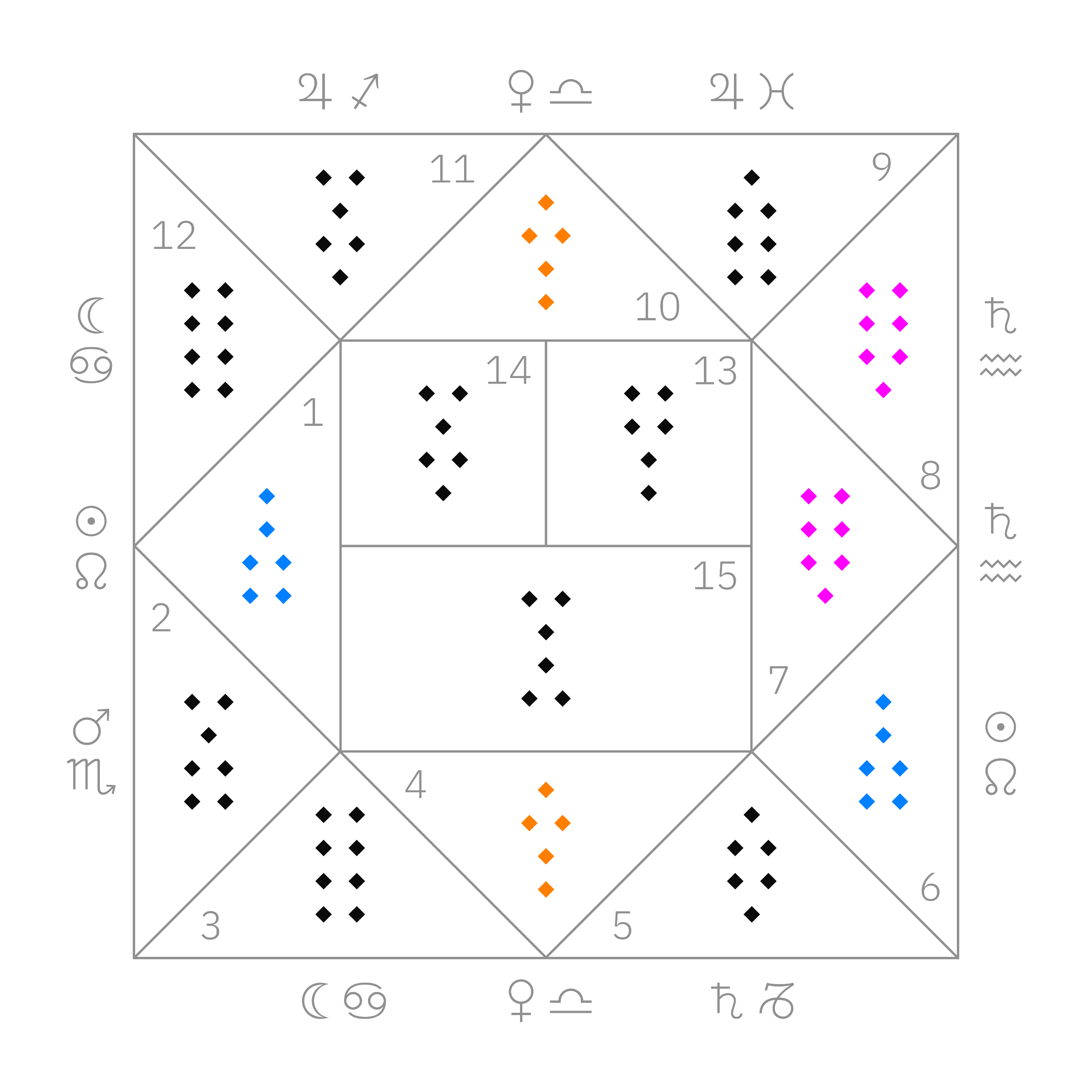
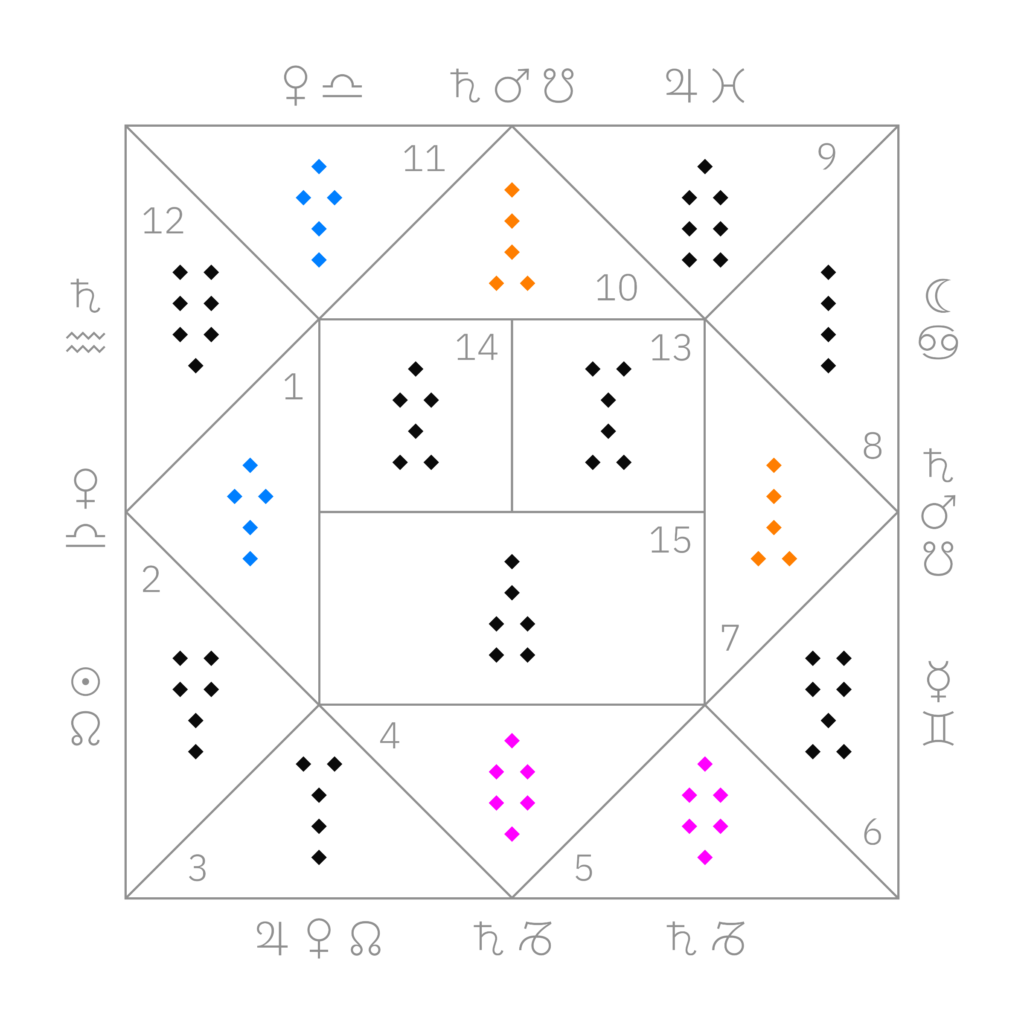
The Four Mothers: Puella · Fortuna Major · Caput Draconis · Carcer.
Permalink: View This Chart on Geomancy.Tools.
Preface
The querent was an adult woman with a family of her own. She had begun studying psychology in an effort to understand her difficult relationship with her parents. She grew up poor in a war-torn country, in a household that was both deeply religious and extremely demanding. From childhood onward, she tended to assume that she was the one at fault. Even as an adult, much of her attention remained fixed on how to please her parents and win their approval.
At one point, someone told her bluntly that her parents had been abusive and had never given her the kind of love a child should receive from her parents. She strongly rejected that idea. At the same time, what little psychology she had studied made the claim increasingly difficult to dismiss. She therefore turned to geomancy and asked whether her parents had loved her when she was a child.
The Querent and the Quesited
The woman is signified by Puella in the first house—C Venus in g Libra and a natural significator of women and girls. Since the question concerns the querent’s childhood, the appearance of the figure of a girl in the first house is itself a strong confirmation of the chart’s radicality.
Her mother is signified by Cauda Draconis in the tenth house, and her father by Carcer in the fourth.
Analysis
The Girl
Puella signifies beauty and purity, as several of its traditional names in different languages make clear. The fifth house is traditionally the house of C Venus’s joy. It governs play, amusement, pleasure, and the kinds of things children naturally enjoy.
Yet Puella does not pass into the fifth. It appears instead in the opposite eleventh house, which is the house of sorrow for C Venus. This alone describes an unhappy girl whose natural Venusian needs for affection, pleasure, warmth, and companionship were not being met.
If we read the eleventh in its ordinary meaning as the house of friends, another detail of her childhood emerges. The querent had almost no close female friends. Puella in the eleventh is besieged by malefic figures: Cauda Draconis in the tenth house stands on one side, while Tristitia in the twelfth stands on the other. The girl is quite literally enclosed between two malefic figures.
The mother’s figure, Cauda Draconis, corresponds to the Q South or Descending Lunar Node and carries the combined nature of L Saturn and F Mars. The father’s figure, Carcer, corresponds to L Saturn in j Capricorn. Both parents are therefore marked, in different ways, by the nature of L Saturn—the Greater Malefic.
There is another important astrological detail. Puella corresponds to C Venus in g Libra, and g Libra is the exaltation of L Saturn. In the context of this chart, the girl quite literally exalts the Saturnian parents. She gives them disproportionate importance, treats their judgments as carrying more weight than they deserve, and continues to place them above herself even after becoming an adult.
That pattern remained with the querent for decades. Even after building a family of her own, she continued to assume that she was somehow at fault, tried to please her parents, and treated their approval as something of enormous importance.
The Mother
We begin with the mother because her influence on the daughter is central to the chart.
Motherhood itself is naturally associated with the E Moon in traditional astrology and geomancy. Yet the only lunar figure in this chart is Via in the eighth house. Via represents not a waxing or full E Moon, but the waning E Moon. It is also in aversion—or non-beholding—to Puella in the first house.
The maternal function is, in a sense, turned away from the child. The girl does not receive the maternal care, affection, and bodily warmth she needs.
The mother herself is represented by Cauda Draconis, one of the most malefic figures. It combines the natures of L Saturn and F Mars. L Saturn is cold and dry; F Mars is hot and dry. Their common quality is dryness. In the context of this question, Cauda Draconis describes an emotionally dry and callous mother with remarkable precision.
Still, the condition of the figure cannot be ignored. Cauda Draconis in the tenth house is benefacted, standing between the Greater and Lesser Benefics: Lætitia, K Jupiter in l Pisces, in the ninth house, and Puella, C Venus in g Libra, in the eleventh. This benefaction softens the harmful nature of Cauda Draconis to some degree.
The involvement of the querent’s own figure is particularly important. The eleventh house is the mother’s derived second house and therefore signifies her resources, support, and closest helpers. Puella there shows that the daughter tried to help her mother. Yet that help came at an emotional cost to the child. Puella remains under siege and occupies the house of C Venus’s sorrow.
This is a recognizable psychological pattern known as parentification. The normal family roles become inverted: instead of the mother providing emotional security to the child, the child gradually begins to function as a source of support for the mother.
Cauda Draconis signifies departure, severance, and deprivation. The mother’s figure passes into the seventh house and forms an X opposition with Puella in the first. X Opposition is the strongest malefic aspect and is of the nature of L Saturn. It signifies complete hostility, confrontation, estrangement, and separation.
The mother literally abandons the daughter.
As Cauda Draconis passes into the seventh house, it forms Head Company with Via in the eighth. Their Reception gives:
- Cauda Draconis + Via = Tristitia
This describes movement in a harmful direction that ends in sorrow. The meaning of Via now becomes clear. It occupies the eighth house—the house of death. It is movement toward death.
In real life, the mother repeatedly attempted suicide. Her attention was directed toward death and escape from her own suffering rather than toward caring for her daughter.
Since the mother was still alive when the question was asked, those attempts had failed. The chart shows this as well. The eighth house is fully combust by Fortuna Major in the second house. Under Combustion, a house cannot properly produce what it signifies. In this case, the eighth house should produce death—but does not. The attempts occurred, yet death did not.
Now consider the Reception between the querent and her mother:
- Puella + Cauda Draconis = Acquisitio
Acquisitio is the figure of Acquisition, corresponding to K Jupiter in i Sagittarius. One of its alternative Latin names is Comprehensum Intus—"Inward Grasping."
Here the image is strikingly physical. It describes a little girl with an intense need for close bodily contact with her mother—almost a hunger for touch, affection, hugs, and kisses. Acquisitio carries meanings of absorbing, taking in, receiving inwardly, grasping, and holding. All of them point once again to a profound lack of maternal affection.
But the same Reception also reveals a deeper psychological mechanism. Cauda Draconis is the mother who withdraws and leaves; the result of her interaction with the daughter is Acquisitio—the figure of inward grasping and holding. The more emotionally unavailable the mother becomes, the harder the child tries to obtain and hold onto her.
A child does not simply stop needing an emotionally unavailable mother. On the contrary, the threat of losing the parent may intensify the drive to preserve the attachment. Attachment theory describes a related pattern as compulsive caregiving: rather than receiving care, the child begins caring for the parent and tries to preserve the bond through that care.
The girl’s need for maternal affection therefore joins naturally with Puella’s position in the mother’s derived second house. She not only longs to hold onto her mother—she also becomes her helper and, eventually, her constant rescuer.
The Father
The father is represented by Carcer in the fourth house.
Carcer is a Saturnian figure of restriction, prohibition, alienation, confinement, and loss of freedom. L Saturn is cold and dry, as is j Capricorn, the sign corresponding to this figure. In this case, the image is very literal: an emotionally cold and insensitive father—hard and unyielding like stone.
But the symbolism goes further. Carcer does not merely signify rules or restrictions imposed by the father. The father himself is represented by a figure whose very meaning is prison and confinement. For the girl, he becomes a source of restriction, control, and the inability to live freely as a child.
Carcer passes into the fifth house, which is the father’s derived second and therefore signifies his personal resources. This shows his constant preoccupation with money—or, more precisely, with its scarcity. That fits the querent’s memories exactly. The family was so poor that the parents could not even afford ordinary toys for their children.
The fifth house also governs play, amusement, and pleasure and is the traditional house of C Venus’s joy. Carcer therefore does more than describe the father’s limited finances. The figure of imprisonment enters the very sphere of childhood enjoyment and blocks it. The father forbade her from playing freely and simply enjoying herself.
As with the mother, an X opposition appears. Puella passes into the eleventh house and stands opposite Carcer in the fifth. The girl is once again placed in the strongest Saturnian confrontation with a parental figure.
Now consider the Reception between the querent and her father:
- Puella + Carcer = Albus
Albus is B Mercury in c Gemini, a figure associated with speech, writing, paper, letters, and instruction. Here it manifested literally.
Albus occupies the sixth house, which is the derived third from the father’s fourth house and therefore signifies the father’s letters. He had a habit of writing out instructions for his children and listing the mistakes they had made. He preferred to put these things in writing rather than say them aloud.
Albus in the sixth house is besieged, reducing its manifestation. The letters did exist, but there were fewer of them than we might otherwise expect from an unafflicted Albus.
The daughter tried to ignore them. When Puella passes into the eleventh house, it falls into non-beholding with Albus in the sixth. She quite literally did not want to see the letters.
The Parents’ Relationship
When Cauda Draconis passes into the seventh house, it forms a U square with Carcer in the fourth. By itself, this describes a highly tense, exhausting, and emotionally draining relationship between the parents.
There is another revealing configuration. For Carcer in the fifth house, Cauda Draconis in the tenth becomes a blind spot. There are exactly four intervening houses between the fifth and the tenth, creating another instance of non-beholding.
In the real situation, this manifested very plainly. The father did not want to see what was happening with the mother and largely ignored her condition, absorbed instead in his own problems—especially money.
Now consider the Reception between the parents:
- Cauda Draconis + Carcer = Caput Draconis
The result is a figure that points toward continuation of the existing state. Despite all their problems, the parents continued living together.
This did not make the marriage healthy. On the contrary, their relationship was deeply toxic and destructive, yet its form remained intact. They lived like cats and dogs, spending much of their life together fighting and arguing.
According to the querent, some of these conflicts escalated into direct threats of violence. There were occasions when the father grabbed a knife and threatened to kill the mother, while the girl stepped between them in an attempt to stop him. This provides a stark confirmation of the father’s Saturnian signification and of the distinctly malefic nature of Carcer in this chart.
The same conclusion appears independently through the natural significators of the parents. The natural geomantic significator of the father is Caput Draconis, which occupies the third house. The natural significator of the mother is Lætitia, which occupies the ninth.
The third and ninth houses stand in X opposition, and neither figure appears elsewhere in the Wheel Chart. The natural co-significators therefore independently confirm the main reading: the parents existed in a state of persistent conflict with one another.
The Witnesses and the Judge
Now consider the Witnesses and the Judge:
- Conjunctio + Amissio = Fortuna Minor
The Right Witness is Conjunctio, the figure of joining, contact, and connections—in the context of this question, family ties. The family existed in a formal sense. Both parents were physically present in the girl’s life, continued living together, and remained her parents. The problem was not the absence of a bond, but the quality of that bond.
The Left Witness is Amissio, the figure of loss. Significantly, Amissio shares the same planetary nature as the querent’s own figure: Puella is C Venus in g Libra, while Amissio is C Venus in b Taurus. Amissio can therefore be read not merely as an abstract loss, but as the querent herself in another condition—the lost girl within an existing family relationship.
Psychology has a useful concept for something similar: ambiguous loss. A parent may be physically present while failing to fulfill the psychological role the child needs. Mother and father are there; the family formally exists; yet affection, safety, acceptance, and emotional warmth are missing.
This kind of loss can be especially difficult to recognize. When someone dies or leaves, the loss is obvious. Here, the parents are still physically present, so the child may spend years continuing to search for the missing love while assuming that the failure lies within herself.
Amissio becomes even more significant when compared with Acquisitio, produced earlier by the Reception between the girl and her mother. The two figures are direct inversions of one another. Acquisitio takes inward, grasps, and holds; Amissio gives outward, releases, and loses.
As a child, the girl tries to obtain and hold onto her mother’s love. In adulthood, that struggle for connection turns into continual self-giving. She helps, rescues, spends her own energy, and organizes her life around the needs of her parents—especially her mother—hoping to preserve closeness and obtain the love and approval she still seeks.
The childhood pattern of “I have to hold onto my mother” gradually becomes the adult pattern of “I have to keep giving something if I want to be loved.”
The Judge is Fortuna Minor, the figure of the A Sun hidden by clouds or moving toward sunset. Unlike the stable solar strength of Fortuna Major, here the light remains present but is diminishing, and the setting A Sun gives progressively less warmth.
In the context of the question, the image is almost literal. Conjunctio shows the continuing family bond. Amissio shows the Venusian girl lost within it. Fortuna Minor shows the diminishing warmth available inside that bond. The girl remains within a family that exists outwardly, yet does not receive the emotional warmth that family should provide.
Fortuna Minor as the hidden A Sun also helps explain why the true nature of the situation remained unclear to the querent for so long. She remembered many individual events from childhood: the poverty, her father’s restrictions and letters, her mother’s condition and suicide attempts, the threats, and the constant fighting between her parents.
Yet painful experience is often stored and recalled in a fragmented way. Psychological defenses such as avoidance, emotional distancing, suppression, and compartmentalization can keep related experiences separated from one another. A person may remember each incident while failing to experience them as parts of one coherent story. This fragmentation can reduce the immediate emotional burden: each memory may remain an isolated episode rather than becoming part of a larger and more painful pattern.
What remained hidden, then, was not necessarily the factual content of the memories, but the connections between them and their overall meaning. The woman remembered what had happened, yet did not organize those memories into a single causal structure. Instead of concluding, “I was treated badly,” she spent decades arriving at a very different conclusion: “The problem must be me. I need to become better and earn their approval.”
In this case, the geomantic chart performs an unusual psychological function. It brings the scattered pieces of experience into a single gestalt, allowing the querent to see not a series of unrelated incidents but an entire system of relationships—and to understand how one part of that system connects with another.
And against the heaviness of the entire chart, the purest figure in it remains the figure of the girl herself— Puella.
Judgment
The answer is no—not in any meaningful sense of parental love that the child could actually receive and experience. Whatever the parents may have believed or felt about themselves as parents, their behavior did not amount to a loving parental relationship from the child’s side of the bond. What reached the girl was not dependable care and warmth, but emotional absence, control, fear, and the burden of adapting herself to the adults around her.
The woman did not receive from her parents what a child should normally receive from a family: safety, acceptance, affection, emotional warmth, and the freedom simply to be a child.
Her mother was so consumed by her own suffering and thoughts of death that the daughter gradually began caring for her and trying to keep her close. The normal relationship was reversed. Instead of the mother serving as a source of security for the child, the girl increasingly became a source of support for the mother. The more she feared losing her mother, the harder she tried to make herself needed.
Her father created a different kind of pressure. He was emotionally cold, excessively strict, and controlling. He restricted his daughter’s enjoyment and repeatedly drew her attention to what she was supposedly doing wrong. The girl therefore learned to look for the cause of family problems within herself and to assume that she was the one who needed to change, improve, and earn better treatment.
But the chart shows the opposite very clearly: the girl was not to blame. The responsibility lay with the adults, not the child. She was a child forced to adapt to emotionally immature and harsh parents and to circumstances she neither created nor had the power to change. The guilt she carried into adulthood was, in effect, reversed: the person who felt responsible was the very person who should have been protected and cared for.
At the same time, she did not see her parents simply as flawed people. Their judgment carried enormous authority in her inner world. She learned that she was the one who had to please, justify herself, help, and earn good treatment.
That pattern survived into adulthood. She continued rescuing her mother, seeking her father’s approval, and spending a considerable part of her own life trying to obtain from both parents the love she had lacked as a child.
Outwardly, the family remained intact. Both parents were alive, continued living together, and remained in contact with their daughter. That made the truth especially difficult for her to recognize. She had not physically lost her parents, yet emotionally she remained the same lost girl inside a family in which love and warmth had always been painfully scarce.
Outcome
Eventually, the querent realized that throughout most of her adult life, her attempt to earn her parents’ approval—especially her father’s—had really been an attempt to obtain the love she had been denied as a child. As long as she continued organizing her life around their demands and judgments, she was barely living a life of her own.
She made the difficult decision to end contact with her now-elderly parents and to stop depending on them both psychologically and materially. The time and energy she had previously spent on them began to go instead toward her own family and children.
The decision was not easy, but she followed through with it. Her life gradually began to improve, and she has never regretted the choice.
The sixteenth figure, the Reconciler, is Caput Draconis—the natural significator of the father and also the Reception figure produced by the interaction between the parents:
- Cauda Draconis + Carcer = Caput Draconis
The parents never divorced. They remained together into old age while continuing to resent and fight with one another. Their basic patterns also changed very little: the mother still thinks of death as a form of release, while the father still writes down the mistakes made by the people around him.
Caput Draconis therefore gives one final confirmation that their relationship would continue in essentially the same form.
Lesson
This case points to a largely unexplored possibility offered by combining geomancy and psychology. A geomantic chart can serve as a powerful practical tool for psychologists and psychotherapists, as well as for people with a basic grounding in psychology who are trying to understand their own inner patterns.
The value lies not in replacing psychology with geomancy, but in using the two together. Psychology provides the concepts and models needed to understand inner processes; geomancy can help reveal connections between experiences, relationships, and recurring patterns that the person has not yet recognized as parts of the same structure. This application of geomancy remains remarkably underappreciated.
Acknowledgments
I would like to thank the woman who asked this question for allowing me to present her case. Despite the deeply personal, painful, and at times sensitive nature of the subject, she was willing to revisit difficult memories and generously answered my follow-up questions.
Her openness made it possible to compare the symbolism of the chart in detail with the actual circumstances of her childhood and later adult life.