Chart Information
Cast By: The Querent.
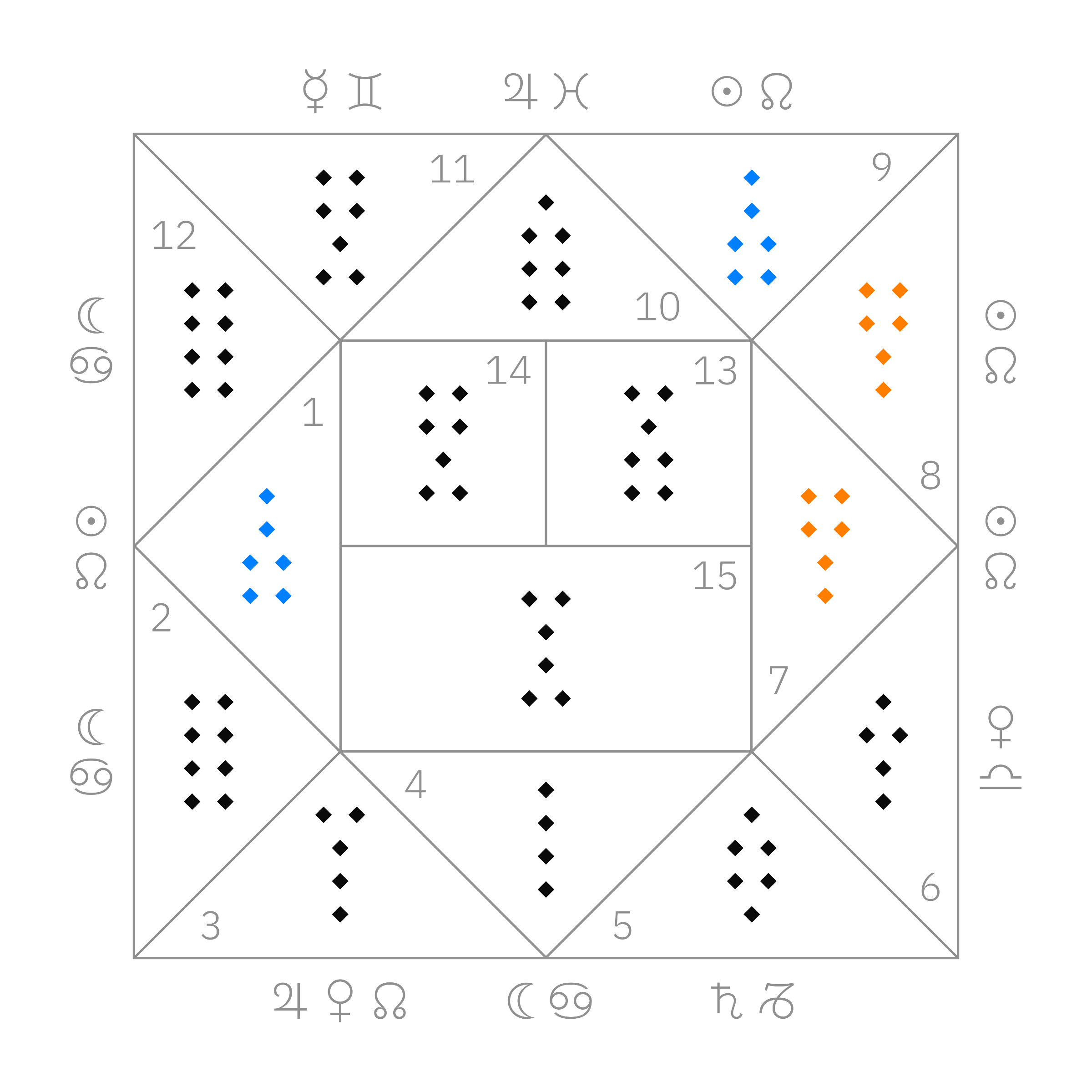
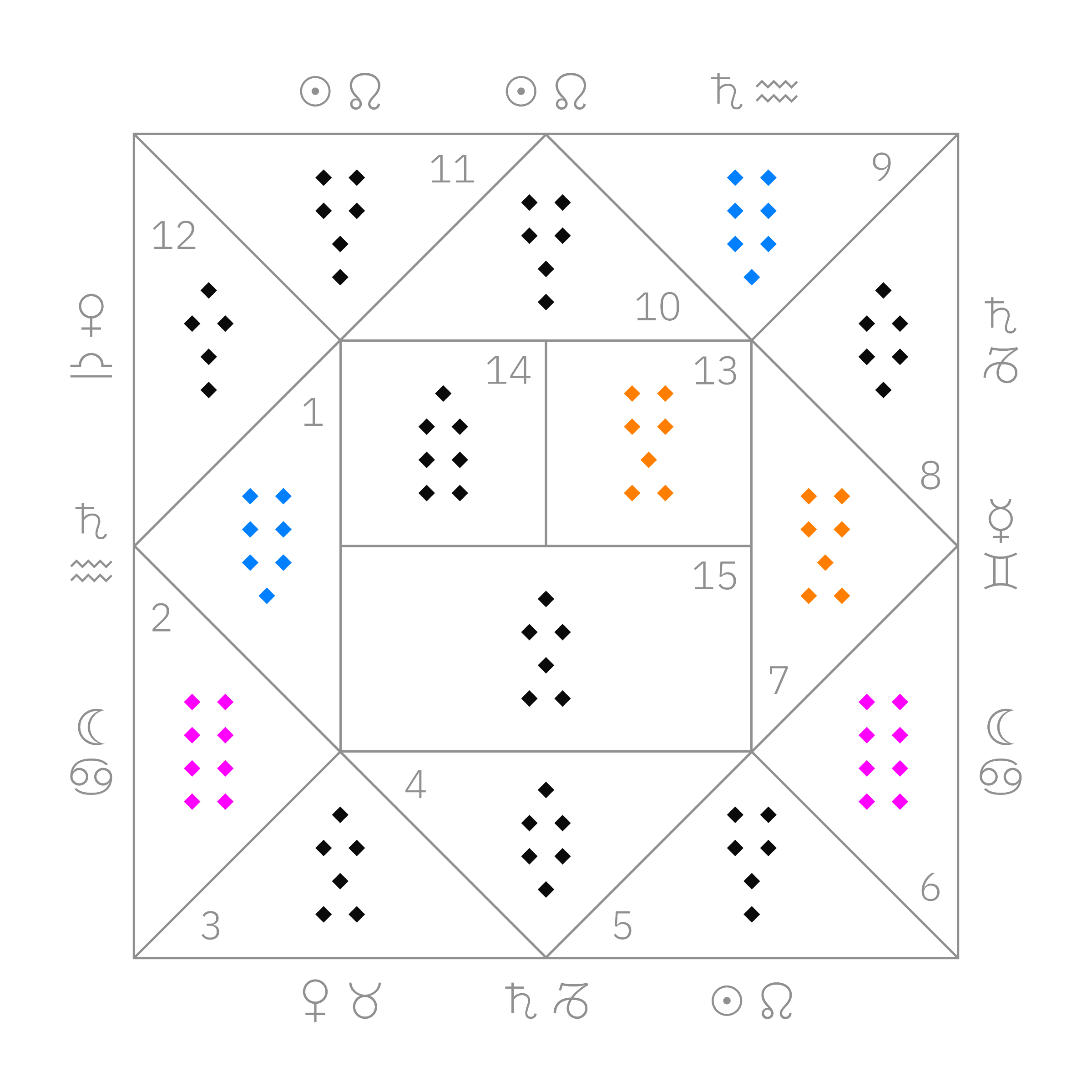
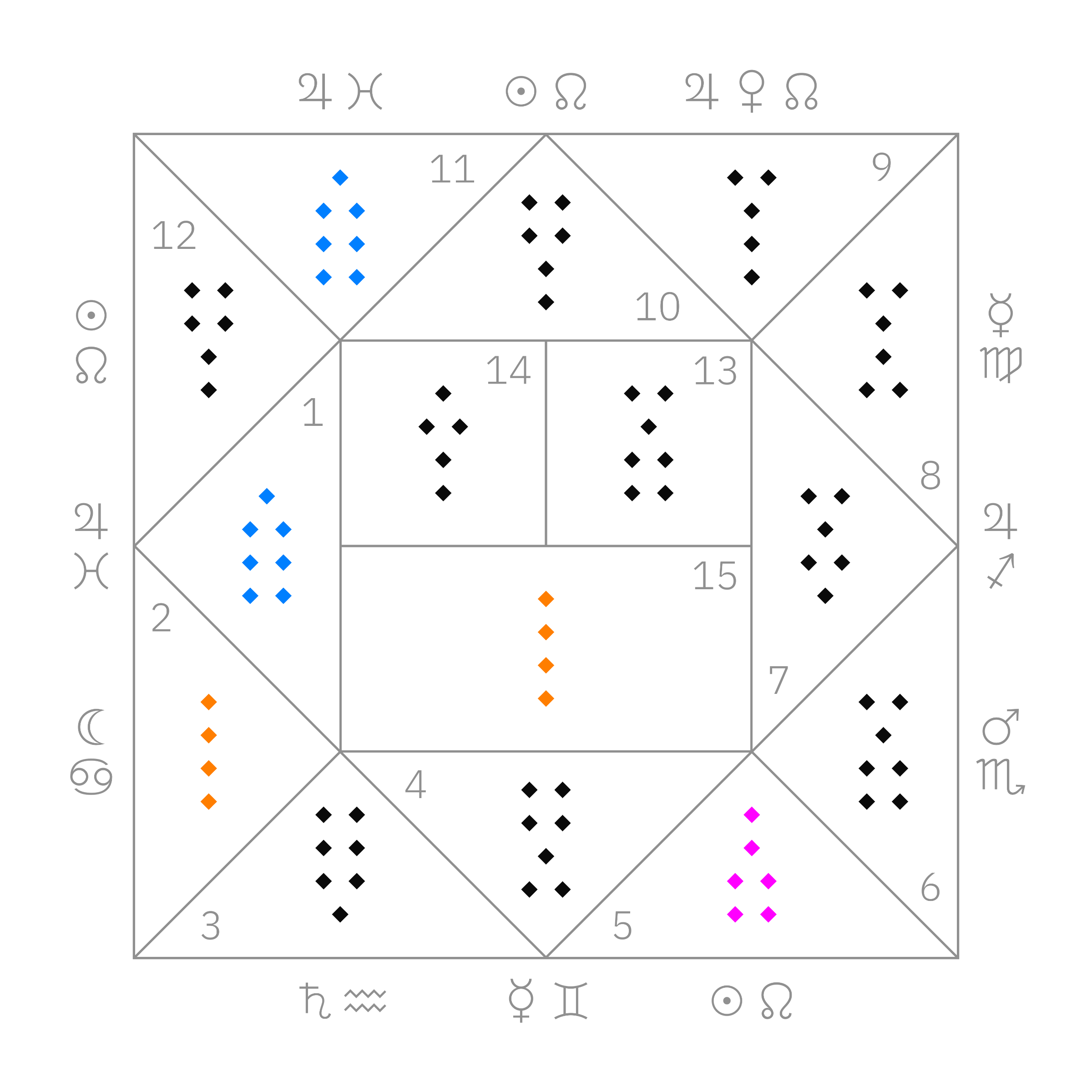
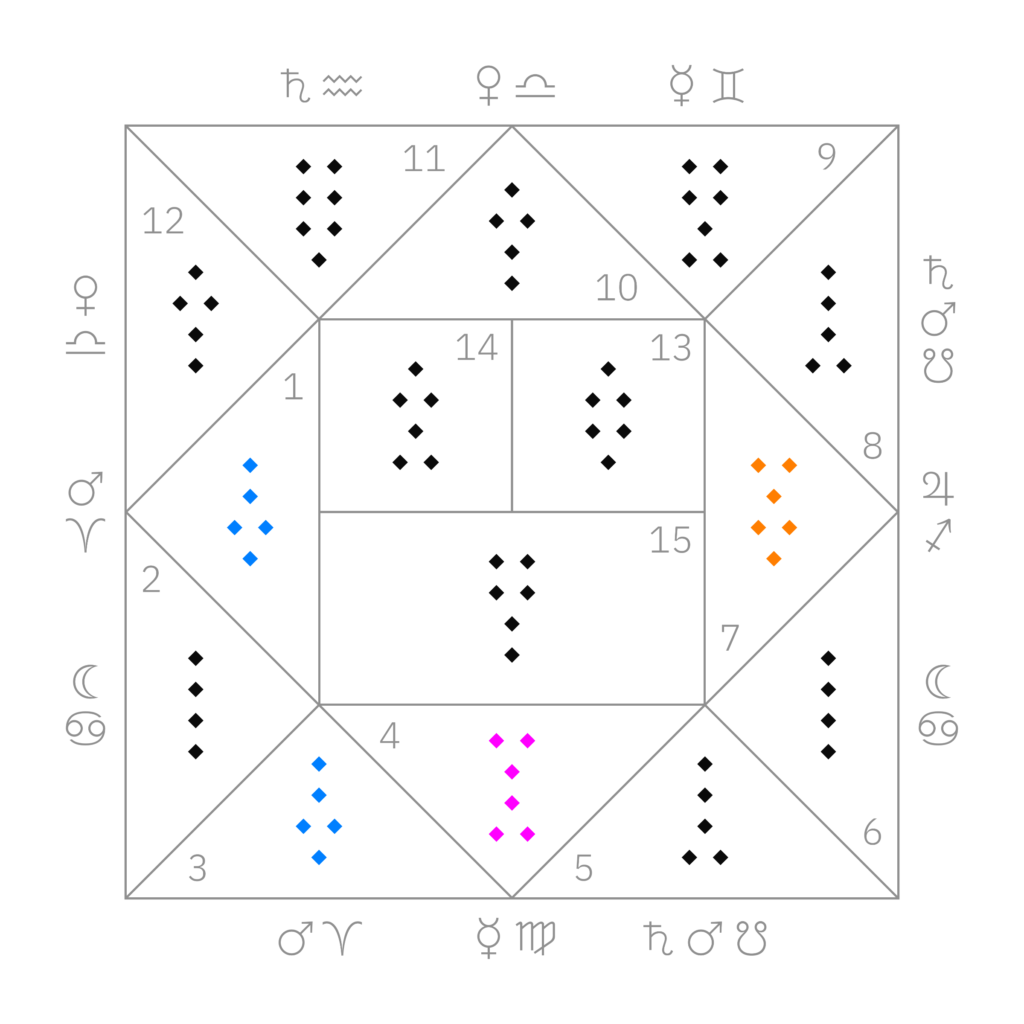
The Four Mothers: Puer · Via · Puer · Conjunctio.
Permalink: View This Chart on Geomancy.Tools.
Preface
The querent was a middle-aged man working for a large retail chain. He asked about a fellow administrator, also middle-aged and extremely overweight, weighing roughly 120–130 kilograms. The colleague was chronically short of money and constantly complained about his low pay and lack of funds.
Not long before the question was asked, he had made a serious mistake. The store manager, a woman, transferred him to another store instead of firing him. Once there, however, he continued making mistakes.
The querent wanted to know whether his colleague would eventually be fired from the company.
The Querent and the Quesited
The querent is signified by Puer in the first house.
The first quesited is the querent’s colleague. As another person, he belongs to the seventh house and is signified by Acquisitio there—K Jupiter in i Sagittarius. I will refer to him as Mr. Acquisitio.
The figure fits the man well. K Jupiter signifies increase and expansion and can describe a large or corpulent person, which corresponds closely to his extreme obesity.
i Sagittarius is a common, or mutable, sign. Such signs indicate a change of state or a transition from one condition to another. By the time the question was asked, Mr. Acquisitio’s working situation had already changed: after his earlier mistake, he had been transferred from one store to another.
His financial circumstances are also described with remarkable accuracy. A person’s money and personal finances belong to his second house. The second house turned from the seventh falls in the radical eighth house, where Cauda Draconis is found.
Lectura Geomantiæ says of this figure in the second house:
In the second house, it signifies that one spends more than is earned.
Lectura Geomantiæ
That is exactly consistent with Mr. Acquisitio’s persistent financial problems and his repeated complaints that he never had enough money.
The second quesited is the colleague’s position. A person’s employment and office belong to his tenth house. The tenth turned from the seventh falls in the radical fourth house, occupied by Conjunctio—B Mercury in f Virgo.
This figure describes the position exceptionally well.
Mr. Acquisitio’s duties included receiving merchandise and checking invoices; correcting discrepancies, making adjustments, and sorting misplaced goods; working the register and preparing daily cash reports; and covering for absent employees in different parts of the store—for example, making coffee when the cafeteria worker was absent.
Conjunctio is a figure of connection. As B Mercury in f Virgo, it corresponds well to work that requires many separate processes to be brought together and kept functioning as a whole—merchandise, paperwork, accounting, cash handling, employees, and customers.
f Virgo is also a double-bodied sign. Here this is reflected quite literally in the multiplicity of duties. Mr. Acquisitio did not have one narrow task. He had to move constantly between different responsibilities and step into other employees’ roles whenever necessary.
Conjunctio as B Mercury in f Virgo therefore describes his position with striking precision, both through its planetary nature and through the nature of its sign.
A further testimony of radicality appears in Puella in the tenth house—C Venus in g Libra and a natural significator of a woman. The tenth house signifies authority and management, and the store manager was in fact a woman. I will refer to her as Miss Puella.
The principal significators are therefore clear:
- Puer in the first house signifies the querent;
- Acquisitio in the seventh house signifies the querent’s colleague;
- Conjunctio in the fourth house signifies the colleague’s position.
Analysis
Mismatch Between the Man and His Job
There is a pronounced mismatch between Mr. Acquisitio and his position, confirmed by mutual negative reception.
The colleague is represented by Acquisitio—K Jupiter in i Sagittarius—while his position is represented by Conjunctio—B Mercury in f Virgo.
B Mercury rules f Virgo and is exalted there, while K Jupiter is in detriment in f Virgo. In i Sagittarius the situation is reversed: K Jupiter is in its own sign, while B Mercury is in detriment.
In other words, K Jupiter occupies a sign of B Mercury’s detriment, while B Mercury occupies a sign of K Jupiter’s detriment.
This mutual negative reception shows that the man and the job are fundamentally ill-suited to one another. He is a poor fit for the position, and the position is a poor fit for him.
The Rival Colleague
Puer repeats in the first and third houses. I will refer to the person represented by this figure as Mr. Puer.
Radically, Puer in the first house signifies the querent. But the first house is also the seventh turned from Mr. Acquisitio’s seventh house. From that perspective, it signifies another person standing opposite him—his opponent and colleague.
Puer in the third house identifies this person more precisely.
Miss Puella is represented by the tenth house. Her sixth turned house—the house of her employees and hired workers—falls in the radical third house.
Puer in the first house therefore signifies an opponent and colleague of Mr. Acquisitio.
Puer in the third house signifies an employee of Miss Puella.
Both positions describe the same man.
Only after establishing his identity does the nature of Puer become especially significant. Puer is F Mars in a Aries—the sword. Puer in the first house stands in direct X opposition to Acquisitio in the seventh house.
The sword is literally pointed at Mr. Acquisitio.
The configuration therefore describes hostility and active opposition between Mr. Puer and Mr. Acquisitio.
The querent himself does not participate in the events. The actual actors in the chart are Mr. Acquisitio, Mr. Puer, and Miss Puella.
The Store Manager’s Attitude Toward the Two Employees
In a question about dismissal, the attitude of management toward the employee is crucial. Here the receptions describe Miss Puella’s attitude toward both men with unusual clarity.
The reception between Mr. Puer and Miss Puella gives:
- Puer + Puella = Conjunctio
Conjunctio is itself a figure of connection and union. In this chart, Conjunctio in the fourth house also signifies Mr. Acquisitio’s position.
There is therefore a connection between Miss Puella and Mr. Puer that concerns Mr. Acquisitio’s position specifically.
Her attitude toward Mr. Acquisitio is entirely different.
The reception between Miss Puella and Mr. Acquisitio gives:
- Puella + Acquisitio = Cauda Draconis
Here the result is a figure of rejection, removal, and termination. Miss Puella wants to break her connection with Mr. Acquisitio and get rid of him as an employee.
This is reinforced by Puella in the twelfth house. The twelfth and seventh houses are in aversion and do not see one another.
In the language of the chart, Miss Puella literally does not want to see Mr. Acquisitio and runs away from him.
Her attitude toward the two employees is therefore opposite. She wants to break her existing connection with Mr. Acquisitio, while with Mr. Puer she forms Conjunctio—a connection directly involving the position held by Mr. Acquisitio.
The Siege of the Position
Conjunctio in the fourth house is besieged by two malefic figures: Puer in the third house and Cauda Draconis in the fifth house.
Puer signifies the colleague who opposed Mr. Acquisitio and whom the store manager wanted to put in his place.
Cauda Draconis has already appeared as the result of the reception between Miss Puella and Mr. Acquisitio. It therefore represents not only termination and removal, but also Miss Puella’s rejection of Mr. Acquisitio—her hatred of him and her desire to be rid of him.
The position is therefore caught between two hostile forces: the store manager’s rejection of Mr. Acquisitio and the opposition of Mr. Puer, whom she wants in his place.
Perfection
There is only one perfection between Acquisitio in the seventh house and Conjunctio in the fourth house—a translation through Cauda Draconis.
Cauda Draconis in the fifth house stands next to Conjunctio, while Cauda Draconis in the eighth house stands next to Acquisitio.
The same figure therefore connects Mr. Acquisitio with his position.
Perfection shows that an event comes to pass, while the translating figure describes the means by which it happens. Here that means is Cauda Draconis—termination, separation, departure, and removal.
The connection between Mr. Acquisitio and his position must therefore be completed through dismissal.
The same figure has already appeared in the store manager’s reception with him:
- Puella + Acquisitio = Cauda Draconis
Miss Puella’s desire to end the relationship and the actual mechanism by which that relationship ends are expressed by the same figure.
Financial Consequences
Cauda Draconis in the eighth house occupies Mr. Acquisitio’s turned second house and therefore signifies his personal finances.
Cauda Draconis in the fifth house occupies Mr. Acquisitio’s turned eleventh house and, as the second house from his position, signifies the money he receives from his job—his salary and bonuses.
The loss of the job should therefore be accompanied by financial loss—specifically the loss of his bonus and his regular source of income.
The Judge
The reception between Mr. Acquisitio and his position gives:
- Acquisitio + Conjunctio = Fortuna Major
Fortuna Major is also the Judge of the chart.
Fortuna Major is a figure of the A Sun in e Leo and is associated with sight and vision. In the context of an administrator’s job, this has a very practical meaning: Mr. Acquisitio was supposed to watch, supervise, monitor, and keep an eye on what was happening around him.
Yet Fortuna Major is produced by the two Witnesses:
- Carcer + Amissio = Fortuna Major
Together, the Judge and the Witnesses point to a problem with the very function Mr. Acquisitio is supposed to perform: watching, supervising, and keeping track of what happens under his responsibility.
Judgment
Mr. Acquisitio will be fired.
He is not doing his job well, and the store manager already wants to get rid of him. More than that, she has a specific employee whom she would rather see in his position—Mr. Puer.
The dismissal will also hurt him financially. He will lose his bonus and his regular source of income, which will be particularly difficult given his existing money problems.
Considering the circumstances, the decision to fire him is both logical and fair. He has repeatedly made mistakes, has failed to perform his responsibilities properly, and was already given another chance when he was transferred to a different store instead of being dismissed the first time.
Outcome
The judgment was correct.
Mr. Acquisitio was fired from the company and lost his bonus. Mr. Puer took his position.
The querent also confirmed that even before the dismissal, Miss Puella had openly told other employees that she wanted Mr. Puer in Mr. Acquisitio’s place.
After I learned that Mr. Acquisitio had been fired, the querent told me the immediate reason for the dismissal.
During Mr. Acquisitio’s shift, a box of return merchandise worth a substantial amount of money went missing. A supplier arrived to collect it, but the box was gone.
After learning this, I returned to the original chart and examined it again to determine what had actually happened to the missing merchandise.
Retrospective Reading: What Happened to the Merchandise?
The Store and Its Merchandise
The fourth house can signify a building. In this second reading, Conjunctio in the fourth house therefore signifies the store itself.
The store’s merchandise belongs to the second house from the fourth—the radical fifth house—where Cauda Draconis is found.
Cauda Draconis in the fifth house therefore signifies the missing merchandise.
The same figure repeats in the eighth house, which in this context signifies trash and refuse.
The same figure makes a literal transition:
- the store’s merchandise → the trash.
Who Threw the Merchandise Away?
Via—E Moon in d Cancer—is found in the sixth house.
The sixth house signifies servants, employees, and subordinate workers. In this context, Via in the sixth house signifies the stock handler.
This must be distinguished from Mr. Puer. Via signifies an ordinary hired worker in a general occupational sense, while the repeated Puer identifies a specific colleague and opponent of Mr. Acquisitio.
Via in the sixth house forms head company with Cauda Draconis in the fifth house, directly connecting the worker with the store’s merchandise.
Their reception gives:
- Via + Cauda Draconis = Tristitia
The worker’s interaction with the merchandise therefore leads to a literally sad result.
In reality, the stock handler mistakenly took the return box for something that was supposed to be discarded and threw it in the trash.
Via is the E Moon in d Cancer, a mute sign. The worker said nothing to Mr. Acquisitio. He simply took the box and silently threw it away.
Via also repeats in the second house, where it forms an X opposition aspect with Cauda Draconis in the eighth house—the merchandise that has ended up in the trash.
This again connects the worker directly with the final fate of the missing box.
Why Was It Missed?
The colleague is signified by Acquisitio in the seventh house, while the stock handler is signified by Via in the sixth house.
The sixth and seventh houses are in aversion. They do not see one another.
Via also repeats in the second house, but the second and seventh houses are again in aversion.
The chart therefore shows twice that Mr. Acquisitio does not see the worker.
That is exactly what happened. He did not see the stock handler take the box and throw it away.
At this point, the Judge becomes completely clear.
Fortuna Major signifies sight, observation, and the duty to keep watch.
Its paternity is:
- Carcer + Amissio = Fortuna Major
Once the actual circumstances are known, the combination becomes almost literal:
- Carcer is the box.
- Amissio is its loss.
- Fortuna Major is the duty to watch over it—a duty Mr. Acquisitio failed to fulfill.
Mr. Acquisitio was supposed to keep an eye on what was happening during his shift, but he failed to notice the moment when the box was taken away.
The merchandise was not stolen. The stock handler threw it in the trash by mistake, and Mr. Acquisitio failed to see it happen.
That failure of supervision was the immediate cause of his dismissal.
Reconciler
The final figure of the chart is Cauda Draconis.
It appears in the relationship between Miss Puella and Mr. Acquisitio, expressing her rejection of him and her desire to end their working relationship.
The same figure then brings about the perfection between Mr. Acquisitio and his position, signifying his dismissal and the financial losses that follow.
It also appears in the event that directly caused the dismissal. Cauda Draconis in the fifth house signifies the store’s merchandise, while its repetition in the eighth house shows that merchandise ending up in the trash.
As the Reconciler, Cauda Draconis therefore brings the entire case together: the store manager’s rejection of Mr. Acquisitio, the incident that led to his dismissal, the termination of his employment, and the resulting financial loss.
Lesson
This case demonstrates several important principles.
First, significators should be checked against known facts and the actual characteristics of the people, jobs, and circumstances they are supposed to represent.
Second, turned houses can reveal additional people involved in an event and define their roles with considerable precision.
Third, in employment questions, the attitude of management toward the employee is extremely important. The reception between their significators should therefore be examined carefully. It may show whether the employer wants to keep the employee, replace him, or get rid of him altogether.
Fourth, receptions can reveal not only relationships between people, but also their motives and preferences.
Finally, it is useful to ask the querent for concrete facts and details whenever they are available. The better the real circumstances are understood, the easier it becomes to identify what the figures and houses actually signify instead of guessing among several possible meanings.
Acknowledgments
I would like to thank the querent for his detailed account of the situation and, especially, for the additional information he provided after the dismissal.
His follow-up explanations made it possible to return to the original chart and understand it far more deeply. Thanks to those details, the chart could be decoded on two distinct levels—not only as a judgment about the dismissal itself, but also as a remarkably detailed description of the incident that ultimately caused it.