Chart Information
Cast By: The Querent.
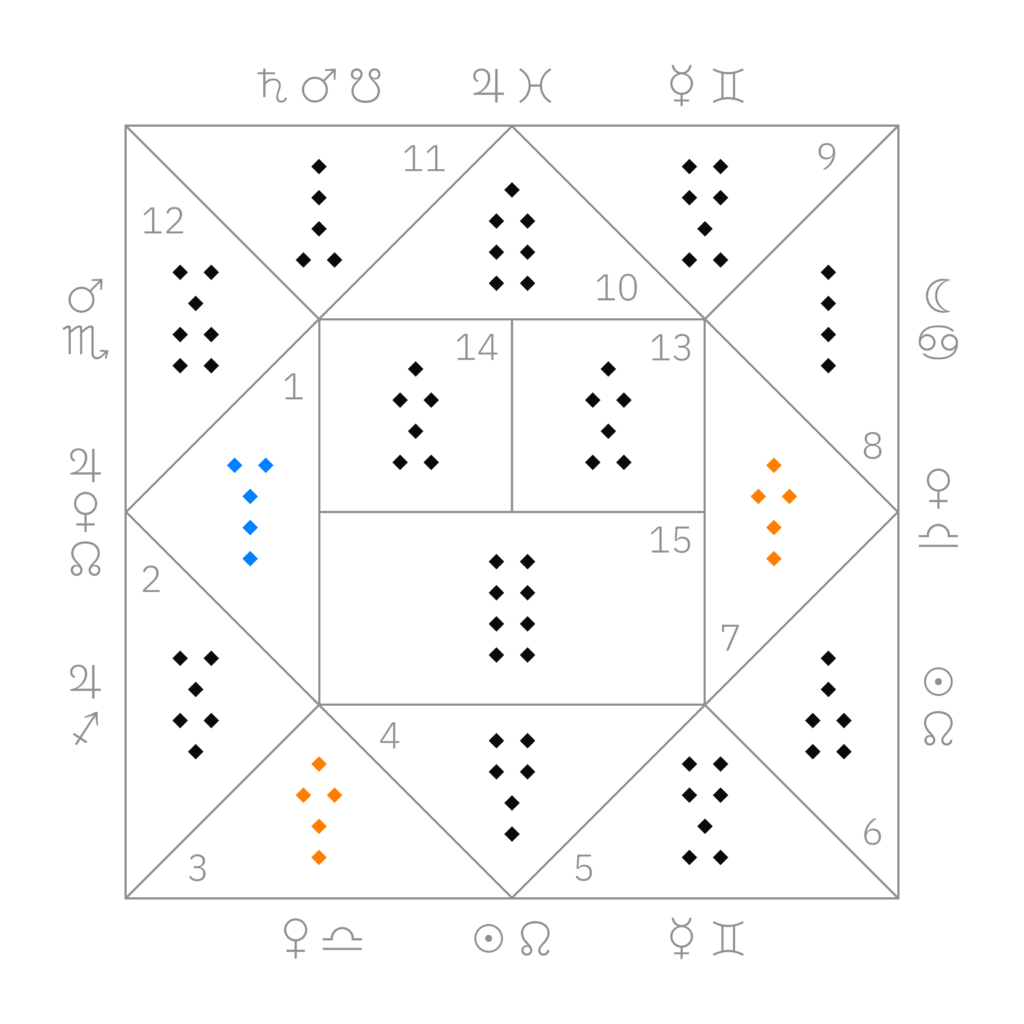
The Four Mothers: Caput Draconis · Acquisitio · Puella · Fortuna Major.
Permalink: View This Chart on Geomancy.Tools.
Preface
A male querent asked whether he and his family would move to another country by the end of that year.
The Querent and the Quesited
Because the proposed destination was another country, it may at first seem that it should be assigned to the ninth house.
The ninth house does indeed signify foreign countries simply as foreign territory—the ninth place. But that is not what the querent was asking about. He was not asking about the country itself, its qualities, or what might happen there. He was asking whether he would leave his present location and move to another place.
Questions of relocation are therefore judged through the axis of the first and seventh houses. The first house signifies the place where the querent is at the time of the question—"here." The opposite seventh house signifies any other place to which he is considering moving—"there."
The distance involved makes no difference. The destination may be another country, another city, the house next door, or an apartment across the street. The principle remains the same because the question concerns the transition from one place of residence to another, not the distance of the journey.
The querent’s present location is therefore signified by Caput Draconis in the first house. This figure forms a company with Acquisitio in the second house.
The other place—the country to which the querent was considering moving—is signified by Puella in the seventh house. Puella also passes into the third house.
The principal significators are therefore Caput Draconis for the querent’s present location and Puella for the proposed destination.
Analysis
The Witnesses and the Judge
The first thing that draws attention in this chart is the Court.
Both the Right Witness and the Left Witness are Amissio, while the Judge is Populus.
This combination is a traditional indication of relocation. The Court therefore reflects the subject of the question with remarkable precision and confirms the radicality of the chart.
This alone, however, is not enough to promise that the move will actually take place. The Witnesses and the Judge may describe what the question is about without guaranteeing that the event under consideration will occur.
Because relocation is an event, it must be confirmed by a perfection between the significator of the present place and the significator of the proposed destination.
The Only Perfection
There is only one perfection between the two significators.
Puella passes from the seventh house into the third and, from there, forms a T sextile with Caput Draconis in the first house.
The T sextile is a weak benefic aspect of the nature of C Venus. It establishes a connection between the querent’s present location and the place to which he is considering moving, but it is not strong enough by itself to guarantee that the relocation will occur.
The third house signifies nearby places and neighboring territories. In a question about moving abroad, Puella in the third may therefore indicate a neighboring country—peaceful, pleasant, and beautiful, in keeping with the nature of Puella as C Venus in g Libra.
Testing the Aspect Through Reception
Although both principal significators are Venusian, the aspect must still be tested through reception. The two figures are added together, and the resulting third figure shows whether the perfection is confirmed or denied.
The reception gives:
- Caput Draconis + Puella = Fortuna Minor
Fortuna Minor signifies what is temporary, fleeting, obscure, and uncertain.
It is the figure of the weak or setting A Sun—the A Sun at night or hidden behind clouds. The light is present, but it cannot be seen clearly. The figure may also signify weak eyesight or an inability to perceive the situation distinctly.
In the context of this question, Fortuna Minor shows that the querent had no clear view of the proposed move. He could not see a definite path by which it would happen, had no firmly established plan, and did not fully understand what the relocation would actually require.
The idea existed, but it remained vague, indistinct, and temporary.
Fortuna Minor therefore does not confirm the T sextile. The possibility of relocation appears in the chart, but it lacks the clarity, stability, and duration required to come to pass.
The Direct Testimony of the Figures
We must now consider the direct meanings of the figures themselves—an essential part of judgment that many geomancers overlook in their haste to search for perfections.
Caput Draconis, the geomantic analogue of the P North Node of the E Moon, traditionally signifies the continuation of an existing condition. It also increases and strengthens whatever it joins. Here, in the first house, it shows that the querent will continue to remain where he already is.
Caput Draconis forms both a head company and a planetary company with Acquisitio in the second house. Caput Draconis is of the nature of K Jupiter and C Venus, while Acquisitio corresponds to K Jupiter in i Sagittarius.
The principal meanings of Acquisitio include acquisition, gain, increase, addition, obtaining, accumulation, possession, and absorption.
Another traditional name for the figure is Comprehensum Intus—Inward Grasping or Holding Within. This name expands its meaning to include holding within, absorbing, assimilating, internalizing, and taking root within.
In a question about relocation, this symbolism runs directly against the idea of leaving the present place. Acquisitio shows the querent becoming more firmly established in his existing environment—holding it, assimilating it, and putting down roots.
Because Caput Draconis increases and strengthens whatever it joins, its company with Acquisitio intensifies precisely these meanings of inward possession, consolidation, and taking root.
Together, the two figures show not a departure from the querent’s present location, but a deeper and more lasting attachment to it. Acquisitio signifies the process of becoming rooted in the existing environment, while Caput Draconis strengthens and continues that process.
It is especially significant that Acquisitio is the inverted counterpart of Amissio, the figure occupying both Witnesses.
Amissio signifies loss, relinquishment, and departure, while Acquisitio signifies acquisition, retention, and taking root. This contrast makes the distinction between the neutral testimony of the Witnesses and the actual judgment of the chart even sharper.
The Witnesses accurately describe what the chart is about: leaving one place and moving elsewhere. The figures associated with the querent’s present location, however, point in the opposite direction—not toward leaving his present place, but toward remaining there, strengthening his position, and becoming more firmly established.
The reception between Caput Draconis and Acquisitio gives:
- Caput Draconis + Acquisitio = Albus
Albus is a benefic and stable figure of peace, clarity, reason, and sound judgment.
It shows that remaining where he is will ultimately bring the querent peace of mind. The decision to stay will prove reasonable, calm, and personally satisfying.
The only perfection in the chart therefore fails to receive the necessary confirmation, while the direct meanings of the figures associated with the querent’s present location clearly indicate the continuation of the existing condition.
Judgment
The idea of moving did exist, but it was temporary, uncertain, and insufficiently formed. This is shown by Fortuna Minor, the reception between the querent’s present location and the proposed destination.
The only perfection is formed through a weak T sextile, but the figure produced by reception does not confirm it. The querent lacks a clear vision of the move, cannot see a definite path toward its accomplishment, and is dealing with a possibility that is vague, unstable, and short-lived.
At the same time, Caput Draconis in the first house signifies the continuation of the present condition. Its company with Acquisitio—Comprehensum Intus—shows the querent becoming increasingly rooted in the place where he already lives.
Caput Draconis strengthens Acquisitio and intensifies its meanings of inward possession, consolidation, and taking root.
Their reception produces Albus, showing that the preservation of the existing situation will ultimately bring the querent peace and prove to be the more reasonable course.
The querent will not move to another country with his family by the end of the year in question. Instead, he will become more firmly established in his present location and will eventually be content that matters remained as they were.
Outcome
The move did not take place. The querent remained where he was and, as Albus had indicated, was ultimately glad that everything had been left as it was.
The outcome is further confirmed by the sixteenth and final figure of the chart—the Reconciler.
The Reconciler is calculated by adding the figure occupying the first house to the Judge. It shows how the situation ultimately concludes for the querent himself.
In this chart:
- Caput Draconis + Populus = Caput Draconis
The Reconciler therefore repeats the original figure of the first house.
Nothing changes in the final operation. The chart ends with the same Caput Draconis with which it began.
Because Caput Draconis signifies the continuation of an existing state, the final result shows that everything will remain as it was. The querent does not pass into the place signified by Puella in the seventh house. He remains in his present location, and the existing condition continues unchanged.
Lesson
The Witnesses and the Judge do not always show an event that will necessarily occur. They may instead describe the subject of the question with great accuracy and thereby confirm the radicality of the chart.
The event itself must still be tested through perfection, reception, and the direct meanings of the figures involved.
In this chart, the Witnesses and the Judge clearly reflected the theme of relocation, but the only perfection failed to receive confirmation. At the same time, the figures in the first and second houses showed the continuation of the querent’s present condition and his increasing attachment to the place where he already lived.
Finally, the Reconciler produced Caput Draconis once again, confirming that the situation would end with the preservation and continuation of the existing state.