Chart Information
Cast By: The Querent.
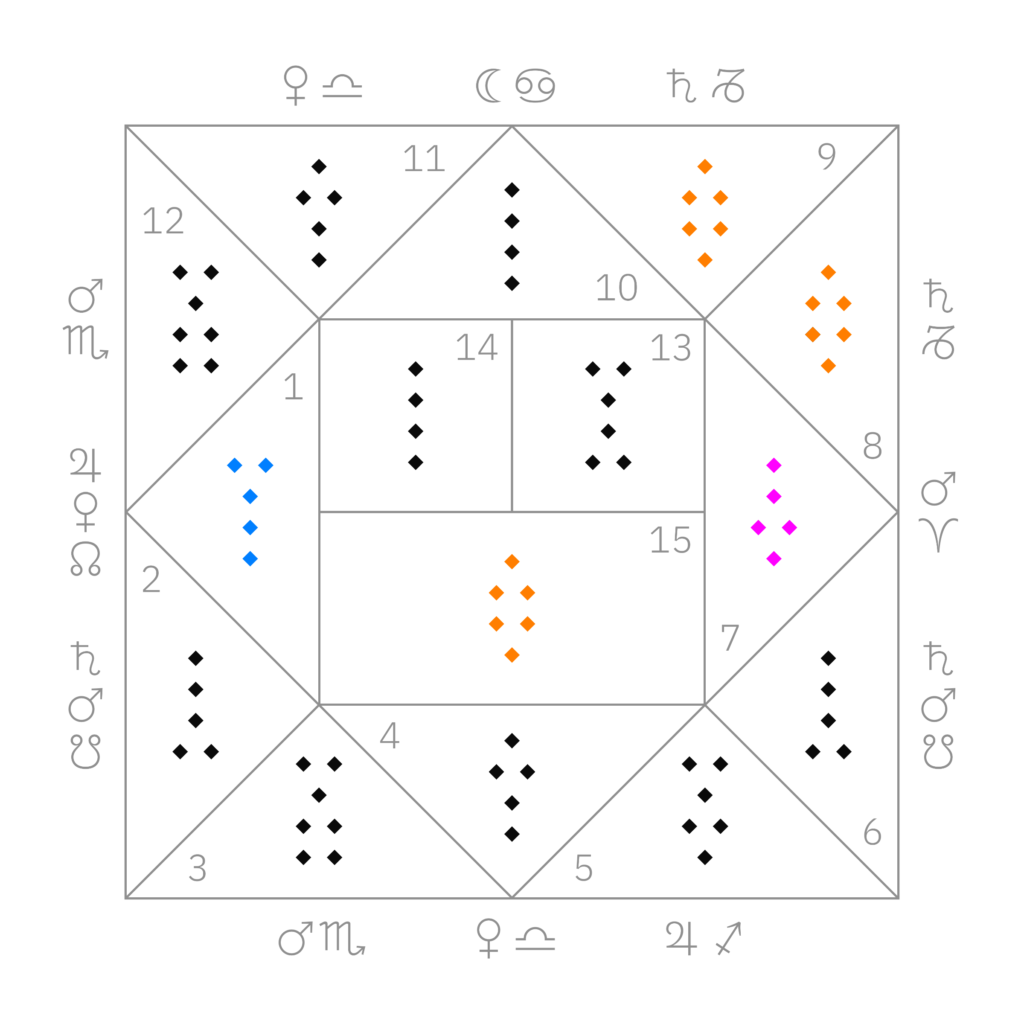
The Four Mothers: Caput Draconis · Cauda Draconis · Rubeus · Puella.
Permalink: View This Chart on Geomancy.Tools.
Preface
The querent was a man who had ordered clothing from a well-known German multinational brand through a popular and reputable online marketplace in his country. The seller on the platform was the brand’s official representative.
The identity of the seller mattered greatly to the querent. Products from this brand are frequently counterfeited in his country, so he had deliberately ordered from the official representative to ensure that he received authentic merchandise rather than counterfeit goods.
According to the marketplace, the seller was expected to hand the order over to the carrier within two weeks. That period had already expired, yet the order status had still not changed to “shipped.”
The querent was therefore not asking whether he might eventually obtain similar items from some other source. He wanted to know whether the official seller he had deliberately chosen would fulfill the order already placed with it.
The Querent and the Quesited
The querent—the customer—receives the first house and Caput Draconis within it.
The seller is assigned to the seventh house and signified by Puer.
The ordered goods are the seller’s property and inventory. They are therefore judged from the seller’s derived second house—the radical eighth—where we find Carcer.
The principal significators are therefore:
- the querent— Caput Draconis in the first house;
- the seller— Puer in the seventh house;
- the ordered goods— Carcer in the eighth house.
Analysis
The Querent’s Condition
Caput Draconis in the first house shows that the querent is still waiting for the order to be fulfilled. The transaction has been initiated, the order accepted, and its next natural stage should be delivery to the carrier.
Caput Draconis, however, forms inversion company with Cauda Draconis in the second house.
Caput Draconis signifies entry and beginning, while Cauda Draconis signifies departure, termination, and conclusion. Their company shows that the querent’s initial expectation has begun to turn into a sense that the process has been interrupted. The stated period has expired, the status has not changed, and his patience is running out.
The Seller and the Goods
The seller is represented by Puer in the seventh house, while the goods belonging to it are represented by Carcer in the eighth.
Puer and Carcer form head company. This emphasizes the seller’s direct connection with the goods: they remain under its control and have not yet passed out of its possession.
In questions concerning parcels and ordered merchandise, Carcer frequently appears as a strikingly literal significator. A parcel consists of items gathered together, enclosed, sealed, and held within a package for shipment.
The presence of Carcer alone, however, does not prove that the parcel has already been assembled and is ready to be handed over to the carrier. To determine the actual condition of the goods, we must examine the passage of Carcer into the ninth house and its company with Via in the tenth.
The Witnesses and the Judge
The Right Witness is Conjunctio.
The Left Witness is Via.
The Judge is Carcer.
Together, these figures describe the fate of the existing order.
Conjunctio signifies the established connection between buyer and seller—the order already placed and the transaction already formed.
Via signifies a change in the order’s condition, status, or course.
Carcer signifies the resulting obstruction and blockage.
The existing order changes its condition and becomes blocked.
Carcer as Judge also repeats the figure of the goods themselves. This further confirms that the chart is organized around the fate of the ordered merchandise and corresponds directly to the matter under judgment.
The Witnesses and the Judge do not, by themselves, form a final negative answer. They describe the blockage of the order and confirm the radicality of the chart. To determine whether the seller will actually ship the goods, we must examine their condition within the seller’s system and look for perfection between the querent and the merchandise.
The Goods in the Seller’s Logistics System
Carcer is repeated in the ninth house.
The radical ninth is the seller’s derived third house. It governs the seller’s communications, dispatch process, internal transportation, and logistics system.
The passage of Carcer from the eighth into the ninth shows that the ordered goods are located within the seller’s logistics hub—the part of its system where separate items should be gathered into a single order, packed, processed, and prepared for delivery to the carrier.
Carcer in the ninth, however, forms head company with Via in the tenth.
Their reception produces:
- Carcer + Via = Conjunctio
Carcer and Conjunctio are complementary figures. In each of their four lines, one point in one figure is replaced by two in the other, and two by one.
Within the context of this question, Carcer represents a gathered, enclosed, and sealed whole. Its complementary figure, Conjunctio, therefore represents the opposite condition—separate parts that have not yet been assembled into one completed package.
Via, the figure of the changeable E Moon, denies fixity and completion. In this context, it shows that the goods have not acquired the gathered, enclosed, and sealed form signified by Carcer, but remain in the separated state revealed by Conjunctio.
Thus, while the Witnesses and the Judge show an existing order that changes condition and becomes blocked, the house chart itself explains the reason for that blockage:
The goods are within the seller’s logistics hub, but the order has not yet been assembled into a single parcel or prepared for shipment.
Via does not show a completed parcel moving toward the buyer. In company with Carcer, and through their reception into Conjunctio, it shows that the separate items remain unassembled and have not been gathered into a single sealed parcel.
The Lack of Perfection
To determine whether the seller will ship the order, we must look for perfection between the figures in the first and eighth houses.
There is no major perfection between Caput Draconis and Carcer.
When Carcer passes into the ninth house, it geometrically forms a V trine with Caput Draconis in the first. At first glance, this might appear to be a minor perfection between the querent and the goods.
In this chart, however, the passage of Carcer already performs a clear descriptive function. It shows the location and condition of the merchandise within the seller’s logistics hub.
The passage does not describe an action that brings a completed parcel to the querent. On the contrary, the company of Carcer with Via and their reception into Conjunctio show that the order has not yet been assembled or prepared for shipment.
The apparent V trine should therefore not be treated as an independent operative perfection. The passage clarifies the condition of the goods rather than carrying them to the buyer.
Even if the V trine were considered formally as a possible perfection, its reception would still be unsuitable:
- Caput Draconis + Carcer = Cauda Draconis
Cauda Draconis signifies termination, severance, departure, and cancellation.
The interaction between the querent and the goods therefore ends not in shipment, but in the termination of the original order.
The elemental nature of the figures provides further confirmation.
In traditional astrology, the V trine is a strong and favorable aspect of the nature of K Jupiter. It joins signs of the same element whose qualities are fully harmonious in heat and cold, dryness and moisture.
Caput Draconis does not correspond to a particular sign of the zodiac, but it possesses a hot and moist nature—the nature of 🜁 air.
Carcer corresponds to L Saturn in j Capricorn and therefore possesses the cold and dry nature of 🜃 earth.
The figures are completely discordant in their qualities, which does not accord with the harmonious nature of a V trine. Their reception into Cauda Draconis confirms that the apparent aspect will not bring the goods to the querent.
The Marketplace’s Intervention
A major perfection arises between the querent and the seller through translation.
Cauda Draconis occupies the second house beside Caput Draconis in the first. The same figure appears in the sixth house beside Puer in the seventh.
Cauda Draconis therefore connects the querent’s figure with the seller’s figure and acts as an intermediary—a third party entering their relationship.
That third party is the online marketplace through which the order was placed.
The placement of Cauda Draconis is especially revealing. The second house can signify the querent’s helpers, while the sixth signifies his servants and those acting on his behalf. The intermediary occupies both houses, showing that the marketplace will stand entirely on the querent’s side and act in his interest.
Cauda Draconis traditionally signifies not only termination, but the ending of an unpleasant or undesirable condition. The marketplace’s intervention will therefore bring the querent’s prolonged and fruitless waiting to an end.
It will not do so by compelling the original seller to ship the goods. Instead, it will terminate that seller’s participation in the order.
The Querent’s Relationship With the Seller
The reception between the querent and the seller produces:
- Caput Draconis + Puer = Amissio
Amissio literally signifies loss, relinquishment, and release.
The querent will lose his connection with the original seller and the possibility of receiving the order from that particular source. The existing transaction between them will be dissolved.
The Reconciler
The sixteenth figure—the Reconciler—is formed by adding the figure in the first house to the Judge:
- Caput Draconis + Carcer = Cauda Draconis
The Reconciler shows how the situation represented by the chart will finally end.
Cauda Draconis gives a clear answer: the official seller’s fulfillment of the order will be terminated. At the same time, the figure will bring the querent’s unpleasant state of prolonged uncertainty to an end.
Judgment
The brand’s official representative will not ship the order.
The goods are within the seller’s logistics hub, but the separate items have not been assembled into a single parcel or prepared for delivery to the carrier.
There is no operative perfection capable of bringing the merchandise to the querent. The apparent V trine has unsuitable reception and is inconsistent with the elemental nature of the figures involved.
The online marketplace will intervene as a third party. It will act on the querent’s side, put an end to the fruitless delay, and cancel the original seller’s fulfillment of the order.
Outcome
That is exactly what happened.
After the prolonged delay, the online marketplace intervened and canceled fulfillment by the brand’s official representative. The original seller never prepared the order for delivery to the carrier.
The translation through Cauda Draconis was fulfilled literally: a third party entered the relationship between the querent and the seller and brought it to an end.
The placement of Cauda Draconis in the second and sixth houses was likewise fulfilled. The marketplace stood entirely on the querent’s side and resolved the matter in his favor.
After the cancellation, the order was transferred to another seller. During the weeks of delay, the price of the merchandise had increased, but the querent was not required to pay the difference—the marketplace preserved the original price for him.
He ultimately received the items he had ordered, but they were shipped by another seller rather than by the brand’s official representative about whom the question had been asked.
Cauda Draconis as the Reconciler was fulfilled in both of its meanings: the original seller’s order was canceled, and the querent’s prolonged state of unpleasant uncertainty came to an end.
Lesson
The principal lesson of this chart is the importance of remaining strictly within the scope of the question.
The querent did not ask:
“Will I ever obtain similar products by any means?”
He asked:
“Will the brand’s official representative ship my order?”
The choice of seller was not incidental, nor was it introduced after the outcome became known. The querent had deliberately ordered from the official representative because products from this brand are frequently counterfeited in his country. He wanted authentic merchandise from a reliable source, not merely similar-looking items from any available seller.
The chart answered that specific question correctly: the official representative did not ship the order.
The marketplace’s later decision to transfer the order to another seller belongs to the subsequent development of the situation, outside the original relationship being judged.
This chart also shows why every apparent aspect must not be treated mechanically as perfection. The passage of a figure may perform a direct descriptive function—it may reveal the location, condition, or transformation of the thing under judgment.
Suppose a person asks:
“Will the guests arrive tomorrow?”
The chart gives a negative answer, and the guests do not arrive on the specified day. If they arrive the following day, this does not make the original judgment incorrect—the question concerned a particular time.
The same principle applies here. A chart is not obliged to answer a broader question that the querent never asked.
Failure to understand this principle leads the geomancer to expand the question after the fact, invent meanings not present in the chart, and combine separate events into a single judgment. This is one of the most common ways an otherwise clear chart is misread.
Acknowledgments
I would like to thank the querent for providing a detailed account of the circumstances and the subsequent course of events, which made it possible to compare the testimonies of the chart with the actual outcome.