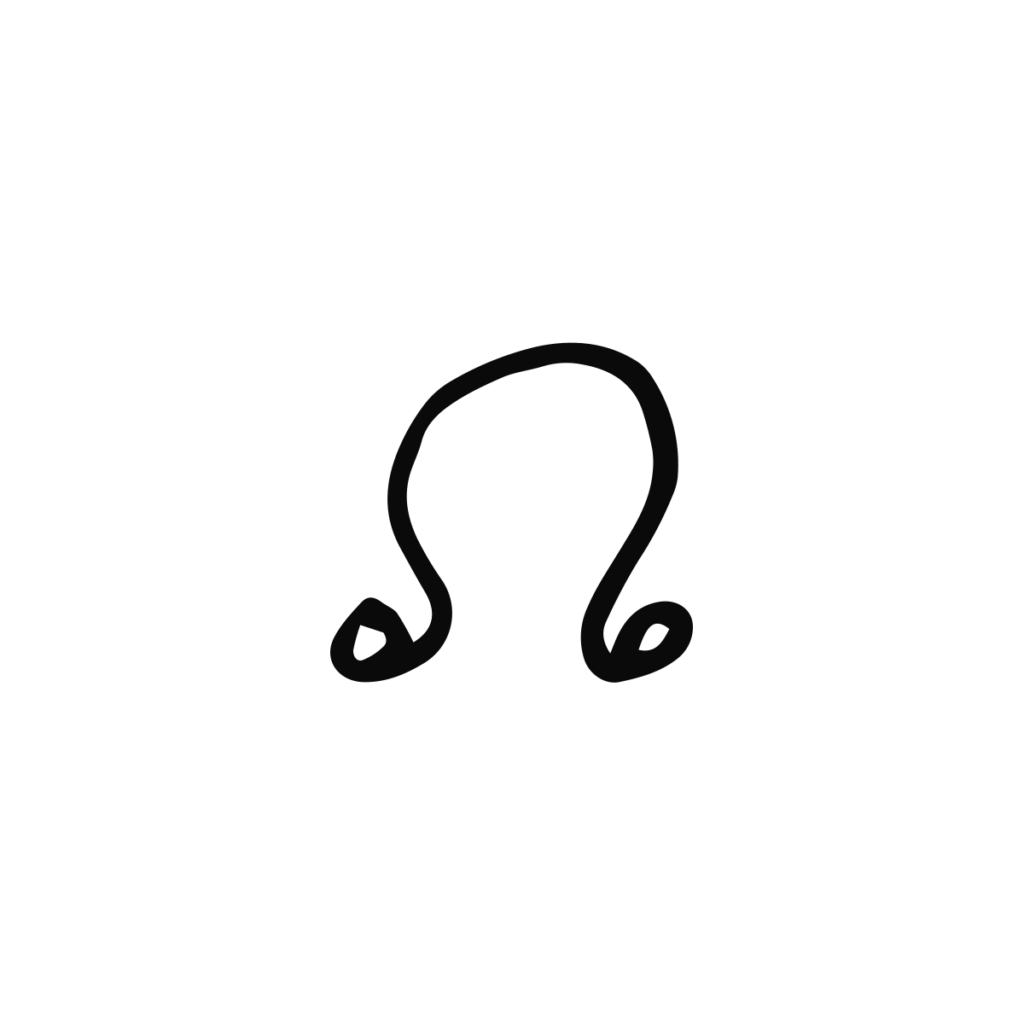
The North Lunar Node (Ascending Node) is the point where the Moon’s orbit intersects the ecliptic—the apparent annual path of the Sun across the sky as seen from Earth—and where the Moon moves from the southern celestial hemisphere to the northern one, effectively “emerging” above the ecliptic. The lunar nodes are mathematical points rather than physical celestial bodies: they have no mass, emit no light, reflect no light, and therefore cannot be directly observed in the sky.
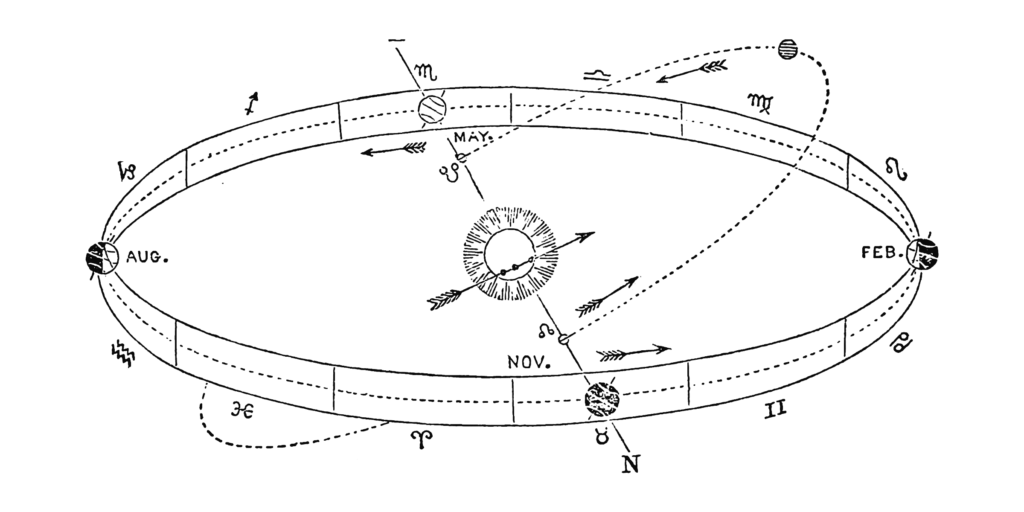
The North Node is directly involved in the formation of eclipses. Only when the Moon is near one of the nodes does it align with the Sun and the Earth within the ecliptic plane. During a full moon near the North Node, a lunar eclipse may occur as the Moon enters the Earth’s shadow. During a new moon near the North Node, a solar eclipse may occur as the Moon passes between the Sun and the Earth and casts its shadow upon the Earth’s surface.
If the Moon passes above or below the plane of the ecliptic, the geometric conditions required for an eclipse are not satisfied, and no eclipse occurs.
Geomantic Correspondence
In geomancy, the North Lunar Node corresponds to Caput Draconis (Dragon’s Head), the figure of entrance, beginning, ascent, increase, and strengthening.
Quotes on the Lunar Nodes
The ancients said that by its nature the P Dragon’s Head is increasing, while the Q Tail is diminishing. If benefic planets are with the P Head, it increases their good; if malefic planets are with it, it increases their harm. If benefic planets are with the Q Dragon’s Tail, their good is diminished; if malefic planets are with it, their harm is diminished. Therefore the Indian sage said that the P Head is benefic with benefics and malefic with malefics.
The opinion that it is harmful for planets to be with the P Dragon’s Head or Q Tail belongs to the Indians. In truth, being with the Q Tail is harmful, while being with the P Head is, on the contrary, beneficial. But what is said about a planet being with the P Head or Q Tail of the Moon’s Dragon is, according to Ptolemy, false: for how could the conjunction of the E Moon’s parecliptic circle, which resembles the zodiacal circle, with the parecliptic circle of a planet, which likewise resembles the zodiacal circle, harm that planet? This is nonsense. Likewise, the P Head of the Moon’s Dragon does not harm the E Moon, except when she is in eclipse. What the Indians said—that the P Head is benefic with benefics—is true.
Abraham Ibn Ezra, The Beginning of Wisdom, Chapter V; cf. The Book of Reasons, First Version § 5.3 and Second Version § 5.9
The P Head of the Moon’s Dragon signifies leadership and a measure of good fortune, because from this point the E Moon begins to ascend in her inclined orbit; and ascent and elevation are fortunate. The nature of the Q Tail is misfortune, because from that point the E Moon begins to descend in her inclined orbit; and descent is unfortunate. Yet the P Head may at times act with the action of the malefic planets, and the Q Tail may at times act with the action of the benefic planets.
Abu Maʿshar, The Great Introduction to the Science of the Judgments of the Stars, Book IV, Chapter IV.6
Many astrologers attribute a definite nature to the P Ascending and Q Descending Nodes: the former, they say, is hot and benefic, signifying increase in all things, while the latter is cold and malefic, bringing with it a diminution of influences. For this reason the Babylonians held that the P Ascending Node strengthens the action of both benefic and malefic planets.
al-Biruni, The Book of Instruction in the Elements of the Art of Astrology
The P Dragon’s Head is fortunate, yet with a fortunate planet it increases every good, and with an unfortunate planet every evil. The Q Tail, however, is unfortunate with a fortunate star [because it diminishes the good], and with an unfortunate star removes evil. Therefore the P Head is called fortunate with a fortunate planet, and contrary with an unfortunate one; while the Q Tail is unfortunate with a fortunate planet, and fortunate with an unfortunate one.
John of Spain, Epitome of All Astrology, Chapter XX