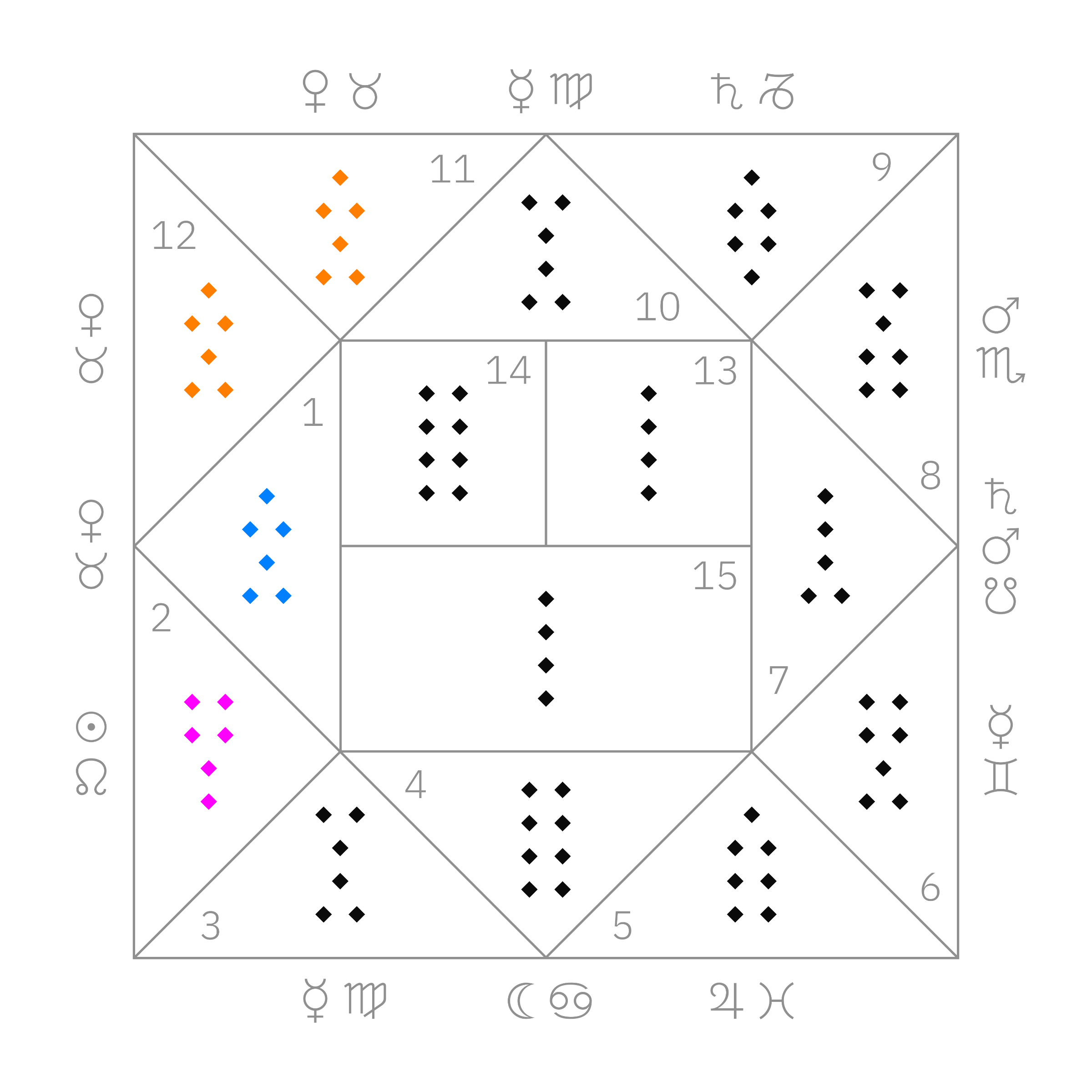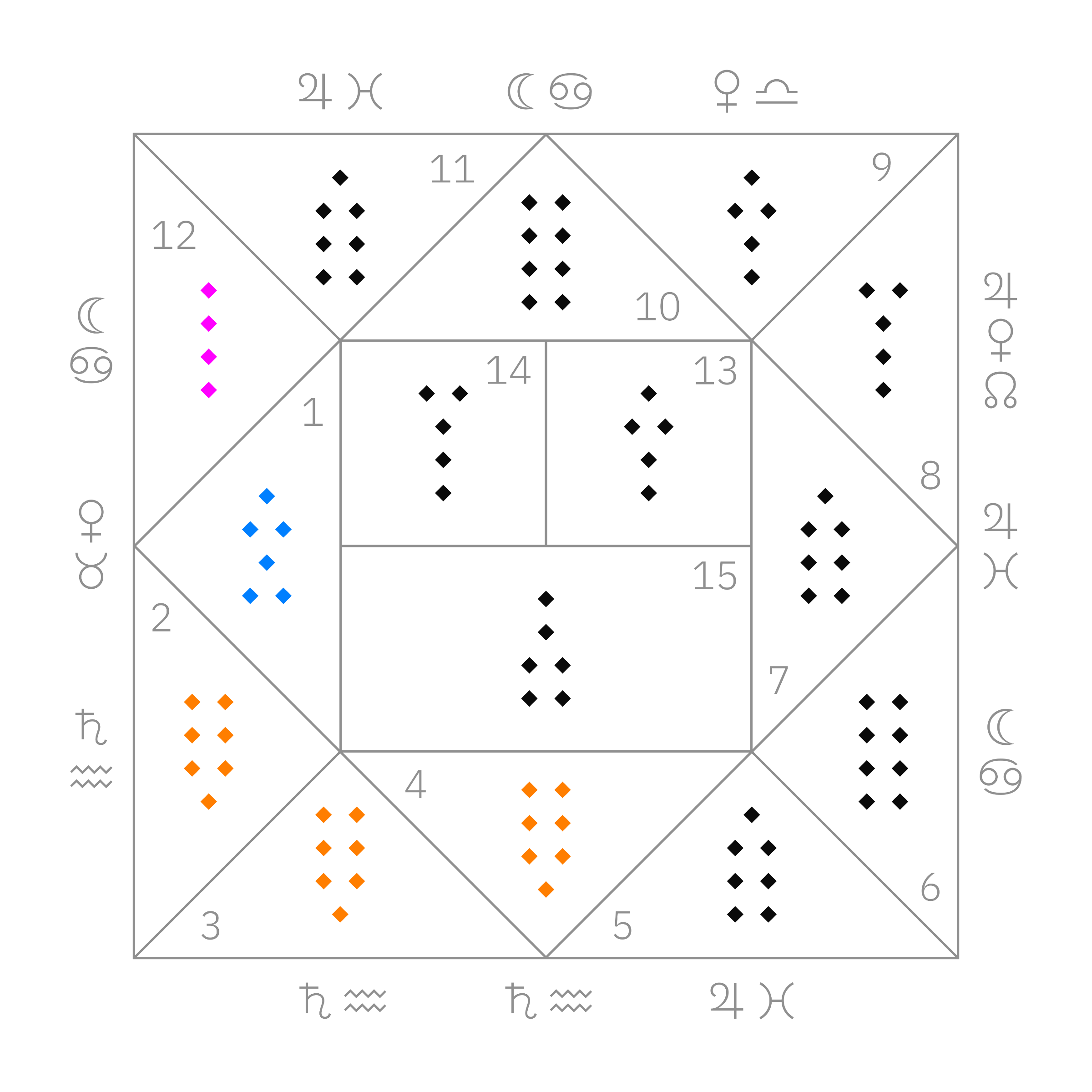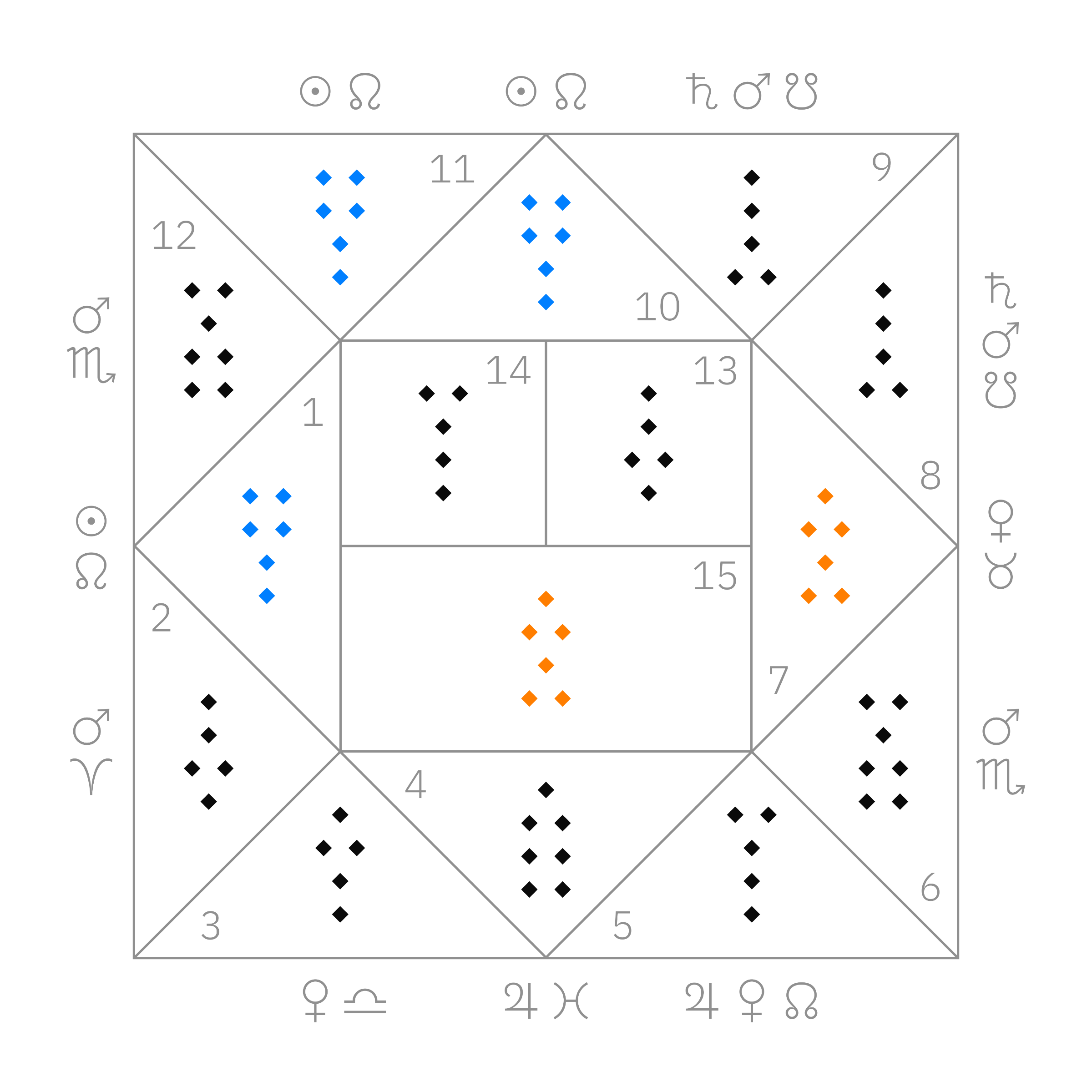
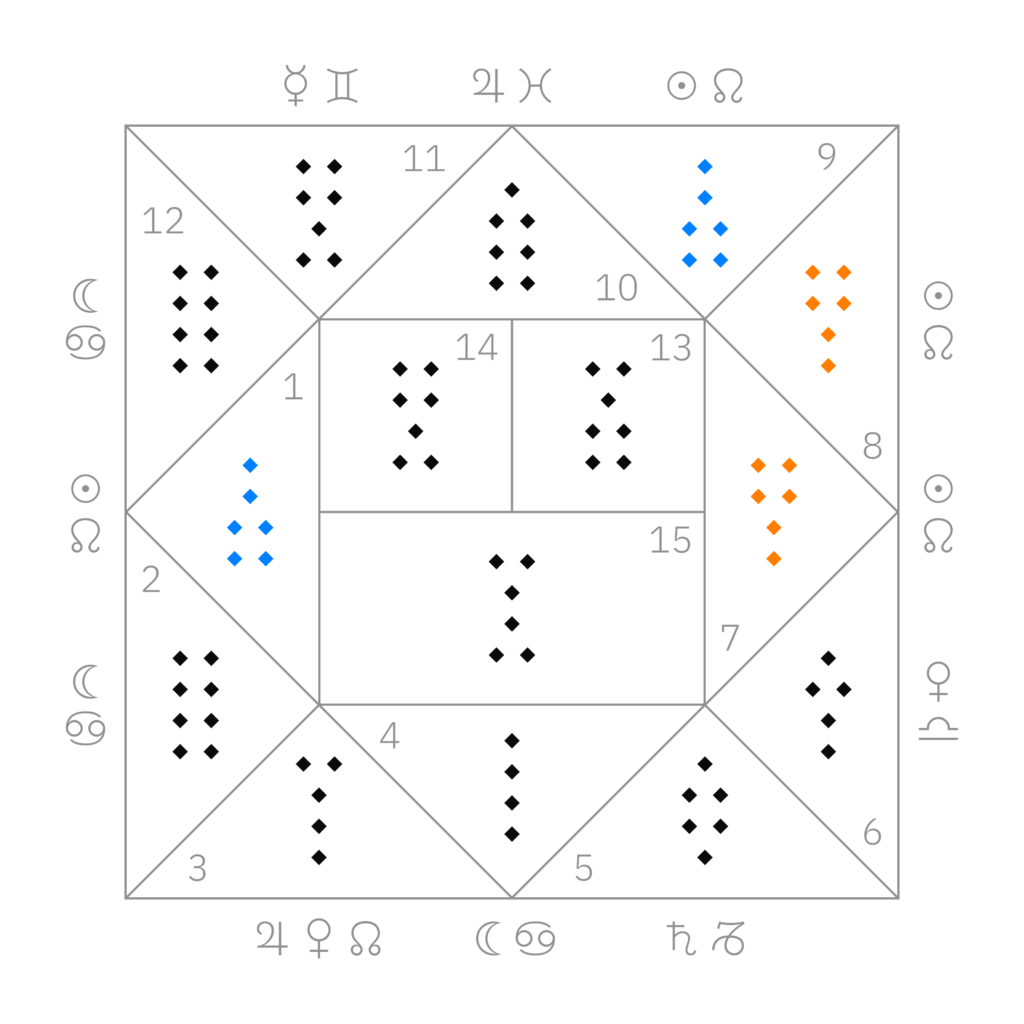
Chart Information
Cast By: The Querent.
The Four Mothers: Fortuna Minor · Populus · Caput Draconis · Via.
Permalink: View This Chart on Geomancy.Tools.
Preface
The querent wanted to know whether he would be able to move abroad with his family. The country he had chosen was Poland.
The Querent and the Quesited
The querent is represented by Fortuna Minor in the first house.
In questions about relocation, the first house traditionally signifies the querent’s present location—the place where he currently lives. The opposing seventh house signifies the place where the querent would find himself as a result of the change, should the move take place. In this chart, that place is Poland.
Poland is represented by Fortuna Major in the seventh house. Moreover, Fortuna Major forms a perfect company with itself in the eighth house. The proposed destination is therefore signified by a doubled Fortuna Major.
Analysis
The querent’s figure, Fortuna Minor, passes into the ninth house, where it forms a head company with Lætitia.
It is important to distinguish the roles of the seventh and ninth houses. The seventh shows Poland as the specific place to which the querent intends to move. The ninth shows it in a broader sense—as a foreign country, a distant territory, and a world beyond the querent’s present surroundings.
The passage of Fortuna Minor into the ninth does not give Poland a second significator. It shows that the querent’s thoughts and desires are directed toward life abroad.
As in horary astrology, when the querent’s figure (planet) passes into another house, it shows his interest in the affairs of that house. Here, the chart plainly shows that his attention is fixed on the prospect of beginning a new life in another country.
The symbolism becomes even more expressive when the nature of the figures is considered. Fortuna Minor is a figure of the A Sun, while the ninth is the house of the A Sun’s joy. It also forms a company there with Lætitia—the figure of joy. Together, these testimonies strongly emphasize the querent’s hope, enthusiasm, and excitement about the move.
This accurately described his state of mind. He spoke about moving to Poland with genuine delight and was convinced that a better life awaited him there.
The Witnesses and Judge are especially striking. The Right Witness is Rubeus—Red. The Left Witness is Albus—White. The Judge is Conjunctio—Union.
In the context of the question, these three figures symbolically reproduce the Polish flag: red joined with white. This does not answer the question of relocation by itself, but it reflects the subject of the inquiry with remarkable precision and confirms the radicality of the chart. The chart is indeed speaking about Poland.
The next question is whether the move will actually take place.
Relocation is an event, so there must be perfection between the significators of the querent and the proposed destination.
Such perfection is present.
A strong major perfection occurs between Fortuna Minor and Fortuna Major through mutation. Both figures leave their original houses and meet beside one another elsewhere in the chart: Fortuna Minor passes into the ninth house, while Fortuna Major passes into the eighth.
Their reception produces Via—the figure of the road, travel, and directed movement toward a destination.
There is also a minor perfection by T sextile between Fortuna Minor in the ninth house and Fortuna Major in the seventh.
Every initial indication appears to favor perfection. The significators perfect both by mutation and by aspect, while their reception produces Via—a figure perfectly suited to travel and relocation.
There is more. The querent’s present location is represented by a single Fortuna Minor—the Lesser Fortune—whereas Poland is represented by a doubled Fortuna Major—the Greater Fortune. Had the relocation actually taken place, life in Poland would undoubtedly have been better for him than life in his present location. Both figures are solar in nature, so the destination would also have suited the querent himself.
But this conclusion matters only if the move is genuinely possible.
Here the chart reveals its central lesson.
Combustion and Subradiation
Despite every appearance of perfection, the doubled Fortuna Major operates according to the rules of combustion and subradiation.
Fortuna Major in the seventh house burns the opposing first house—the house of the querent himself. Fortuna Major in the eighth house burns the opposing second house—the house of his money and material resources.
The doubled Greater Fortune, which at first appears to be the chart’s strongest favorable testimony, in fact afflicts both the querent and his means. The destination may be favorable in itself, but that promise cannot be realized because the possibility of reaching it is destroyed.
The affliction of the second house reveals the practical cause of failure: the querent will not have enough money to make the move.
Another testimony shows why he does not yet recognize this. After passing into the ninth house, Fortuna Minor stands in aversion to the second house, which signifies his money. The ninth and second houses do not see one another.
Absorbed in thoughts of life abroad, the querent quite literally fails to see his own wallet and the limits of his financial position.
The chart repeats the same idea symbolically.
Fortuna Minor is the A Sun hidden behind clouds. It describes someone who does not see the situation clearly because his vision is obscured by his own enthusiasm.
At the same time, he is dazzled by the brilliant light of Fortuna Major. He sees the attraction of Poland and the promise of a better life, but not the financial obstacle that prevents him from getting there.
Judgment
The querent is genuinely delighted by the prospect of moving to Poland and believes that a better life awaits him there.
The chart, however, shows that he is not assessing the situation soberly and has not properly calculated what the move would cost.
Despite major perfection through mutation, minor perfection through sextile, and an appropriate reception, the doubled Fortuna Major acts through combustion and subradiation, afflicting both the querent and the house of his money.
A lack of funds will prevent the relocation.
The move to Poland will not take place.
Outcome
This is exactly what happened.
After some time, the initial excitement surrounding the move began to fade. The querent started researching prices, calculating expenses, and preparing a realistic budget. He then discovered that he did not have enough money to relocate, and the plan had to be abandoned.
Lessons
This chart demonstrates several important principles of geomantic judgment.
- A judgment should not be made upon finding the first perfection. Even when a chart shows major perfection, minor perfection by aspect, and an appropriate reception, the final judgment must take every relevant rule into account. In this case, combustion and subradiation completely overturned the initial promise of the chart.
- A shared nature does not protect figures from affliction. Although Fortuna Minor and Fortuna Major are both solar figures, Fortuna Minor remains subject to combustion and subradiation.
- Aversion can explain the querent’s error in judgment. After passing into the ninth house, Fortuna Minor stands in aversion to the second. While the querent is wholly preoccupied with life in another country, he literally fails to see his financial limitations.
- Symbolic correspondences can confirm radicality, but they do not replace judgment. Rubeus, Albus, and Conjunctio reproduce the red and white of the Polish flag in a striking way. This confirms that the chart is speaking about Poland, but it does not mean that the relocation must occur.