Chart Information
Cast By: The Querent.
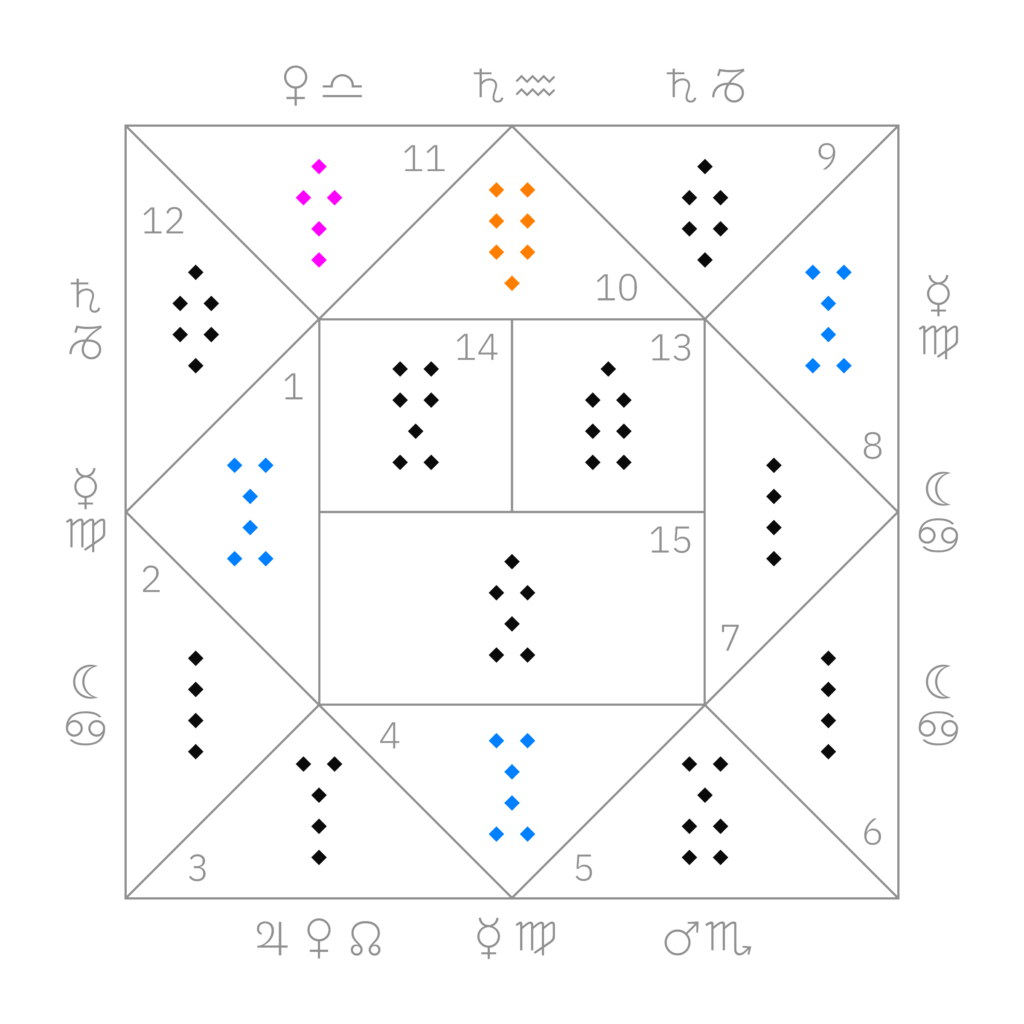
The Four Mothers: Conjunctio · Via · Caput Draconis · Conjunctio.
Permalink: View This Chart on Geomancy.Tools.
Preface
The querent was a young woman who had spent many years as a housewife and had no regular employment. One of her friends offered her a job as a caregiver for her mother-in-law, an elderly woman who lived nearby.
The woman was nearly eighty years old. Because of her age and weakness in her legs, she had difficulty walking and had already fallen several times in the bathroom. After the second fall, walking became even harder for her, so one of her sons decided to hire someone to care for his mother. The friend introduced them and recommended the querent as a suitable person for the job.
The original terms seemed reasonable enough. The querent was expected to spend the day in the house, clean, prepare and serve meals, help the elderly woman with everyday tasks, and remain close enough to steady her while she moved about and prevent further falls.
The querent wanted to know whether she would get the job.
The Querent and the Quesited
The querent is represented by Conjunctio in the first house. The same figure also passes into the fourth and eighth houses of the chart.
The proposed job is represented by Tristitia in the tenth house. Tristitia forms a planetary company with Carcer in the ninth house. The quesited is therefore represented by two figures of L Saturn.
It is important to assign the job to the proper house. A widespread modern notion places all ordinary, routine, or subordinate employment in the sixth house. This is incorrect. Office, employment, occupation, and one’s place in the working world belong to the tenth house, regardless of whether the work is prestigious, humble, or physically demanding.
The sixth house signifies services rendered to others, as well as servants and subordinates, but not the querent’s own employment. The offer of work as a caregiver must therefore be judged from the tenth house.
The financial benefit arising from the job—the querent’s wages—is a secondary quesited. It is represented by Puella in the eleventh house, which, as the second house from the tenth, signifies the money received through the work.
Analysis
The Condition of the Querent
The first house is traditionally the house of joy of B Mercury. Conjunctio—B Mercury in f Virgo—is therefore particularly comfortable in this position.
The querent was genuinely pleased by the prospect of finding work close to home. After many years without regular employment, the offer seemed fortunate: she could begin earning money again, avoid a long commute, and take on a job that did not initially appear especially difficult.
Yet Conjunctio passes not only into the fourth house, but also into the eighth.
When the question does not directly concern death, inheritance, or another person’s property, the passage of the querent’s figure into the eighth house traditionally signifies fear, anxiety, and inward distress. This idea appears in the writings of William Lilly and Abraham ibn Ezra.
This describes the querent’s state of mind exactly. On one hand, she was happy about the opportunity. On the other, she was uneasy. She had spent many years as a housewife and did not know how easily she would adjust to regular employment, how she should conduct herself in another person’s home, or whether she could manage the responsibility of caring for someone physically frail.
The chart therefore shows both sides of her condition: delight at the opportunity and anxiety about the work that lay ahead.
The radicality of the chart is also confirmed by the figure in the first house. Conjunctio is a natural significator of the hired worker—a person entering into employment and becoming joined to an employer through an agreement. The chart quite literally places the querent in the role of someone preparing to enter paid service.
The True Nature of the Job
The work is represented by two figures of L Saturn:
- Tristitia—L Saturn in k Aquarius;
- Carcer—L Saturn in j Capricorn.
L Saturn, the Greater Malefic, traditionally signifies old age, physical weakness, restriction, dirt, neglect, loneliness, and prolonged hard labor.
The presence of two of its figures shows that the nature of L Saturn will not appear in one isolated detail, but throughout the entire structure of the job. This is not merely work involving an elderly person. It entails constant contact with old age, frailty, disorder, confinement, and duties from which the caregiver cannot simply turn away.
The proposed employment will therefore prove far more difficult than the querent imagines when the question is asked.
This was later confirmed in a literal manner. During her first visit, the young woman found the house dirty and disordered. The amount of cleaning required was far greater than she had expected. The elderly woman walked with difficulty, had fallen more than once, and required almost constant supervision.
The work was not limited to preparing meals and performing a few household tasks. The caregiver would have to watch the woman continually, help her move about, and remain ready to support her at any moment in order to prevent another fall.
In this way, Tristitia and Carcer revealed the full character of the quesited: old age, physical weakness, dirt, isolation, restriction, and heavy daily labor.
Reception and Approval of the Querent
The reception between Conjunctio and Tristitia produces Caput Draconis—a good figure of the nature of K Jupiter and C Venus, signifying entrance, opening, the beginning of a new condition, and acceptance.
This is a highly appropriate reception in a question about employment. It shows that a door is opened before the querent: she is welcomed into the house, accepted personally, and considered suitable for the work.
At their first meeting, the elderly woman liked the querent very much. She immediately expressed the wish that this particular young woman should be the one to care for her.
The positive reception was therefore fulfilled literally. The querent was approved, and the possibility of obtaining the job genuinely opened before her.
Favorable reception alone, however, is not sufficient. It shows the attitude of the parties and the willingness to accept the querent, but the practical realization of the employment still requires perfection between the figures of the querent and the quesited.
Translation Through a Third Figure
The principal major perfection occurs through translation by a third figure— Carcer, repeated in the twelfth and ninth houses.
Carcer joins the figure of the querent to the figure of the work and represents the third person through whom the possibility of employment becomes practical and real.
This third person is one of the elderly woman’s sons. His mother had already approved of the querent and wanted her as a caregiver, but she was not the employer. It was the son who decided to hire someone, established the terms, agreed upon the wages, and was expected to pay for the work.
The traditional meanings of the figures make the arrangement even clearer:
- Conjunctio—the hired worker;
- Carcer—the employer who establishes rules, duties, and limits.
The translation therefore shows a genuine possibility of employment. The elderly woman accepts the young woman personally, while her son, acting as the employer, makes the job itself possible.
The T Sextile from the Eighth House
When Conjunctio passes into the eighth house, it forms a T sextile with Tristitia in the tenth.
Formally, this is a favorable aspect and might be taken as an additional perfection. In this case, however, I do not treat it as an independent testimony that the employment will occur.
The passage of Conjunctio into the eighth house already has a clear descriptive meaning: it signifies the querent’s fear and anxiety. Within the development of the event itself, this passage does not correspond to an action that joins her to the work. Her anxiety describes her condition accurately, but it does not cause the employment to take place.
The T sextile should therefore be understood primarily as part of the description of the querent’s inward state, rather than as a separate operative perfection.
The X Opposition and Voluntary Refusal
The passage of Conjunctio into the fourth house has an entirely different meaning.
From there, the querent’s figure forms an X opposition with Tristitia in the tenth house. Conjunctio appears to move away in the opposite direction from the proposed employment.
The X opposition is the strongest aspect of the nature of L Saturn. It signifies separation, loss, departure, and parting.
It is especially important that the figure moving away from Tristitia is the figure of the querent. The initiative for the separation therefore does not come from the employer. The young woman will not be rejected or deprived of the opportunity. She will withdraw from the proposed work herself.
The favorable testimonies in the chart are not false, nor are they canceled after the fact.
The reception shows that the querent will be approved. The translation through Carcer shows that the employer will make the employment practically possible and agree to the preliminary terms. The X opposition then describes the next stage of the matter—the querent’s voluntary separation from the job itself.
In other words, the young woman will receive the offer, but she will not begin the work.
The Wages
The wages are represented by Puella in the eleventh house.
Puella—C Venus in g Libra—is a good and stable figure of the Lesser Benefic. It does not promise wealth, but it does signify payment that is pleasant, desirable, and generally acceptable.
At first, the money did appear attractive. After seeing the true extent of the duties, the young woman asked for a wage that was reasonably above the legal minimum. The work would occupy the entire day and had already proved more demanding than it first appeared, so her request was justified.
The position of Puella, however, contains an important contradiction. The fifth house is the house of joy of C Venus, while the opposing eleventh becomes a house of sorrow for her. C Venus is, as it were, out of place.
The same was true of the wages. The money seemed pleasant at first, but it soon became misplaced—it no longer corresponded to the actual burden of the work.
The employer agreed to the amount she requested, but then introduced a new condition: the young woman would have to watch the elderly woman not only during the day, but throughout the night as well.
In practice, she was being asked to move into another person’s home and remain beside the elderly woman around the clock.
The wage itself was not poor. Yet once the conditions changed, the same amount was no longer fair. The money signified by the good Puella lost its appeal because the price of obtaining it had become too high.
Here another meaning of Carcer becomes visible. In the translation, it signifies the employer. Yet through its planetary company with Tristitia, it also participates in describing the work itself.
Its nature—confinement and restriction of freedom—was fulfilled literally. The young woman was being asked to live continuously in another person’s house, surrendering almost all of her ordinary private life.
Family Circumstances
The character of the elderly woman and her relationship with her family made the work heavier still.
At their first meeting, she proved extremely talkative. She enjoyed long conversations and continually complained about her children, speaking of them in a bitter and accusatory manner.
Living in the house around the clock would therefore have involved more than cleaning, preparing food, and providing physical care. The young woman would also have been expected to sustain tiresome and unpleasant conversations, listen to continual complaints, and remain immersed in a difficult emotional atmosphere day and night.
The querent later learned from her friend that the elderly woman’s relationship with her children had been troubled for many years. According to the friend, the mother had kept her children under severe pressure when they were younger, and as adults they tried to maintain their distance from her.
For the purpose of judgment, it is not necessary to decide who was right in the old family conflict. What matters is its practical consequence: although the woman had several adult children, none of them wished to remain with her continually, and the daily burden of care was to be transferred entirely to a hired worker.
The circumstances suggested that hiring a caregiver was primarily a means for the family to discharge an obligation toward their mother without taking the burden of constant care upon themselves.
This made the position even more oppressive. The querent would have spent both days and nights beside a person from whom even her closest relatives preferred to keep their distance.
The two figures of L Saturn therefore manifested not only through old age, frailty, and dirt, but also through estrangement, loneliness, a painful family history, and ceaseless unpleasant conversation.
The Witnesses and the Judge
The Witnesses and the Judge describe the outcome with remarkable precision.
The Right Witness is Lætitia, the figure of joy. It shows the querent’s initial delight at being given an opportunity to return to work and earn money close to home.
The Left Witness is Albus—B Mercury in c Gemini. It has the same planetary nature as Conjunctio and therefore once again represents the querent.
Albus shows her as a sensible, conscientious, and clean young woman. This is especially expressive against the background of the dirty and neglected house signified by the two figures of L Saturn.
The Judge is Amissio, the figure of loss, departure, and letting go.
Together, these figures describe the entire matter in a single sequence:
Joy at the opportunity → clear judgment of the conditions → voluntary loss.
Amissio does not signify harm inflicted upon the querent. It signifies release from an unfavorable agreement. She loses the opportunity to take the job, but the loss itself proves beneficial to her.
Judgment
The young woman feels both pleasure and anxiety about the prospect of employment. After many years away from regular work, she is glad to have an opportunity to earn money again, but she worries about whether she will be able to manage the duties.
Her candidacy will be approved. The elderly woman will want this particular young woman as her caregiver, and the employer will agree to hire her and accept the wage she requests.
The work itself, however, will prove far more difficult than it first appears. The two figures of L Saturn signify old age, physical weakness, dirt, disorder, prolonged hard labor, unpleasant conversation, isolation, and a severe restriction of personal freedom.
Once the original daytime duties are expanded into a requirement that she live in the house and care for the woman around the clock, the proposed wage will no longer correspond to the true burden of the work.
The young woman will receive the offer and be accepted, but she will withdraw from the agreement herself. The X opposition signifies a voluntary refusal before she actually begins the job.
She will not take this job, and refusing it will be the wisest outcome for her.
Outcome
This is exactly what happened.
The elderly woman approved of the querent and wanted her to be the person who cared for her. Her son agreed to pay the requested wage, so the matter appeared almost settled.
It then became clear that the job was not limited to daytime care. The young woman would be required not only to remain in the house from morning until evening, but also to stay through the night, effectively moving into the elderly woman’s home.
In addition, there was the neglected condition of the house, the large amount of cleaning, the constant need to supervise the woman’s movements, and the expectation that she would listen to continual complaints and sustain long, unpleasant conversations.
When the young woman heard the final conditions and understood that the agreed wage was expected to purchase her constant presence in another person’s home, she refused without hesitation.
Lessons
The principal lesson of this chart is that favorable reception and strong major perfection do not necessarily mean that the querent will ultimately begin the work.
Caput Draconis in reception accurately showed approval of the querent. The elderly woman accepted her, and the door opened for her to enter the house and begin a new undertaking.
The translation through Carcer was also fulfilled. The employer made the job practically possible, agreed to the wages, and was prepared to hire the young woman.
Yet these testimonies answered only whether her candidacy would be accepted and whether she would receive the offer. They did not guarantee that she would agree to work under the final conditions.
The later X opposition showed the next stage of the matter—the separation of the querent from the quesited. Because it is the querent’s figure that moves away from the work, the initiative for the refusal comes from the young woman herself.
A judgment must therefore distinguish between two separate events:
Will the person be offered the job—and will she actually begin it?
In this chart, the answer to the first question was yes, while the answer to the second was no. Reception and translation were fulfilled, but they did not produce a lasting union. The X opposition showed the final separation, which in this case proved beneficial to the querent.
A second lesson is equally important. L Saturn is the Greater Malefic in both traditional astrology and geomancy. The presence of two of its figures as significators of the proposed work therefore cannot be softened into a favorable testimony. They do not describe anything light, pleasant, or desirable.
Tristitia and Carcer manifested the destructive nature of L Saturn in full: old age, frailty, dirt, hard labor, isolation, oppressive conversation, and restriction of freedom. Carcer quite literally transformed the proposed employment into a form of confinement in which the young woman would have had to surrender her own life and remain continuously in another person’s home.
The chart therefore demonstrates that favorable reception and perfection must never be judged apart from the nature of the significators themselves. The parties may be successfully brought together, the offer may be made, and preliminary agreement may be reached—but when the quesited itself is signified by the Greater Malefic, the reality of what is being offered may still prove burdensome, harmful, and undesirable.