The South Lunar Node (Descending Node) is the point where the Moon’s orbit intersects the ecliptic—the apparent annual path of the Sun across the sky from the perspective of an observer on Earth—and where the Moon moves from the northern celestial hemisphere to the southern one, effectively “diving” below the ecliptic. The lunar nodes are mathematical points rather than physical celestial bodies: they have no mass, emit no light, reflect no light, and therefore cannot be directly observed in the sky.
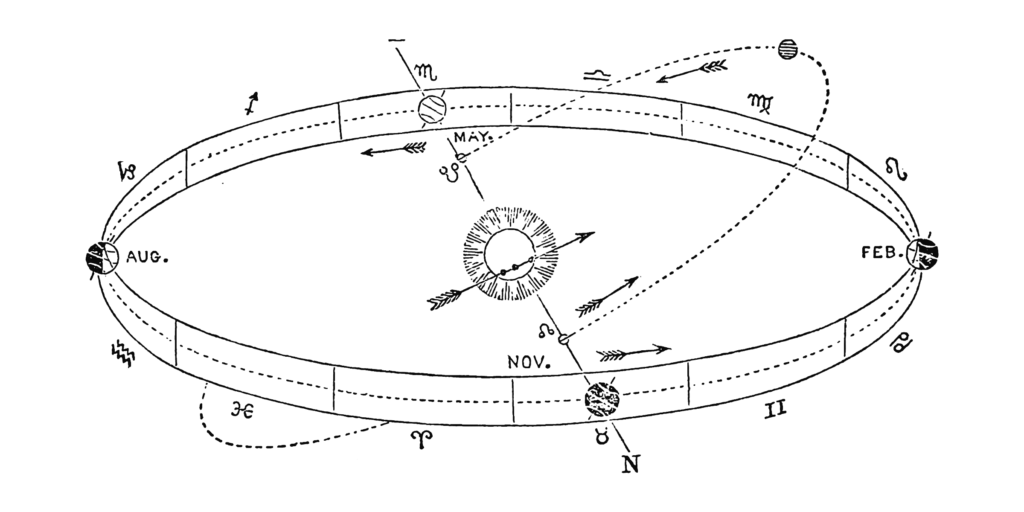
The South Node is directly connected to the mechanism of eclipses. Only when the Moon is near one of the nodes does it align with the Sun and the Earth within the plane of the ecliptic. During a full moon near the South Node, a lunar eclipse may occur, as the Moon enters the Earth’s shadow. During a new moon near the South Node, a solar eclipse may occur, as the Moon passes between the Sun and the Earth and casts its shadow onto the Earth’s surface.
If the Moon passes above or below the plane of the ecliptic, the geometric conditions for an eclipse are not met, and no eclipse occurs.