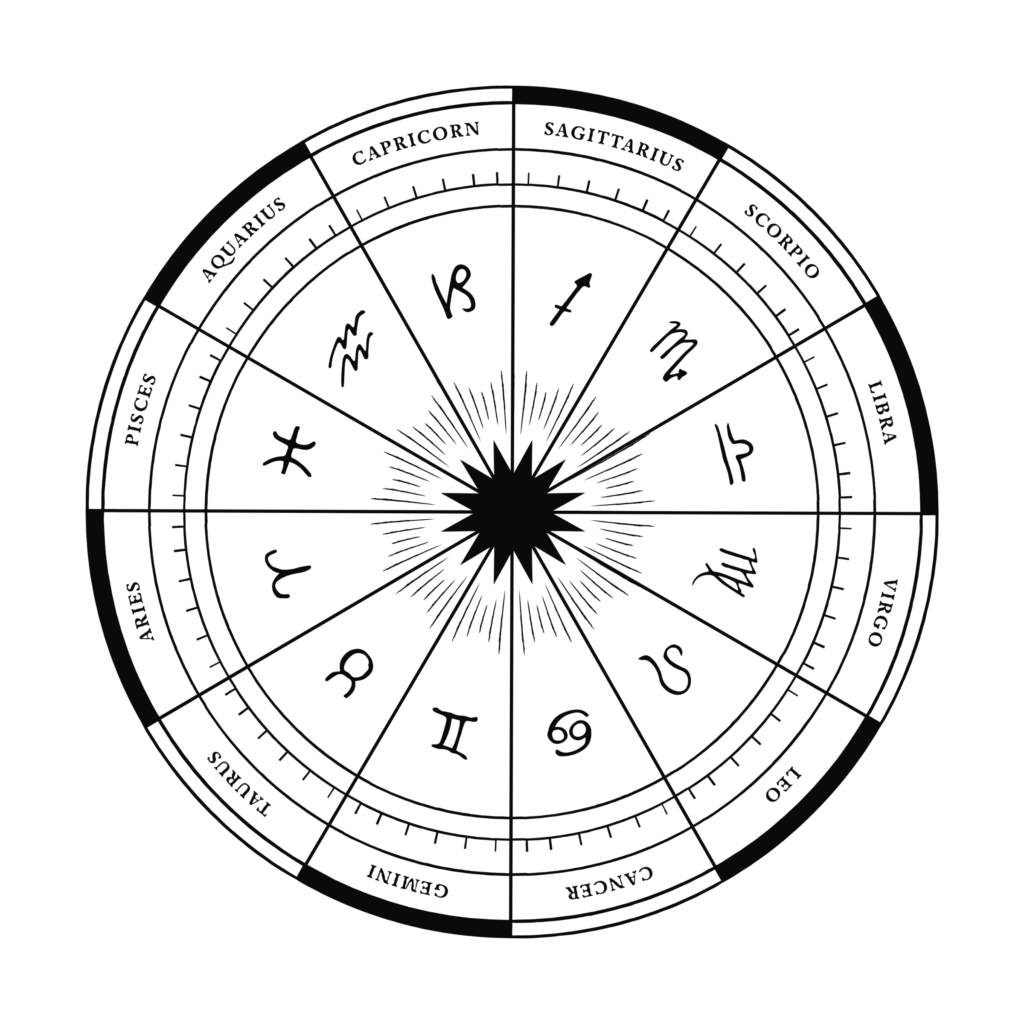
In traditional astrology and geomancy, the zodiac signs are understood very differently from their treatment in modern popular astrology. They function solely as adjectives that qualify the planet associated with them. The energies of the planets, represented by the figures, are the nouns—the actors; the perfections are the verbs—the actions; while the signs provide only the quality or manner, in which the energy of the planets manifests in the chart.
In most geomantic questions, the quality of the sign plays a secondary role. For example, when asking whether a debt will be repaid, the fertility of the sign representing the debtor is irrelevant. Conversely, in other questions the same quality becomes highly significant. For instance, in the question “Will we have a child?” if all the relevant figures are ruled by planets in the so-called barren signs (Albus, Fortuna Major, Fortuna Minor, Conjunctio), the likelihood of a positive outcome decreases sharply—even when strong perfections exist between the figures.
The zodiac signs have numerous divisions that can be useful in interpreting geomantic figures in specific questions. Here we shall describe in detail only those that are genuinely traditional and frequently applied in practice.
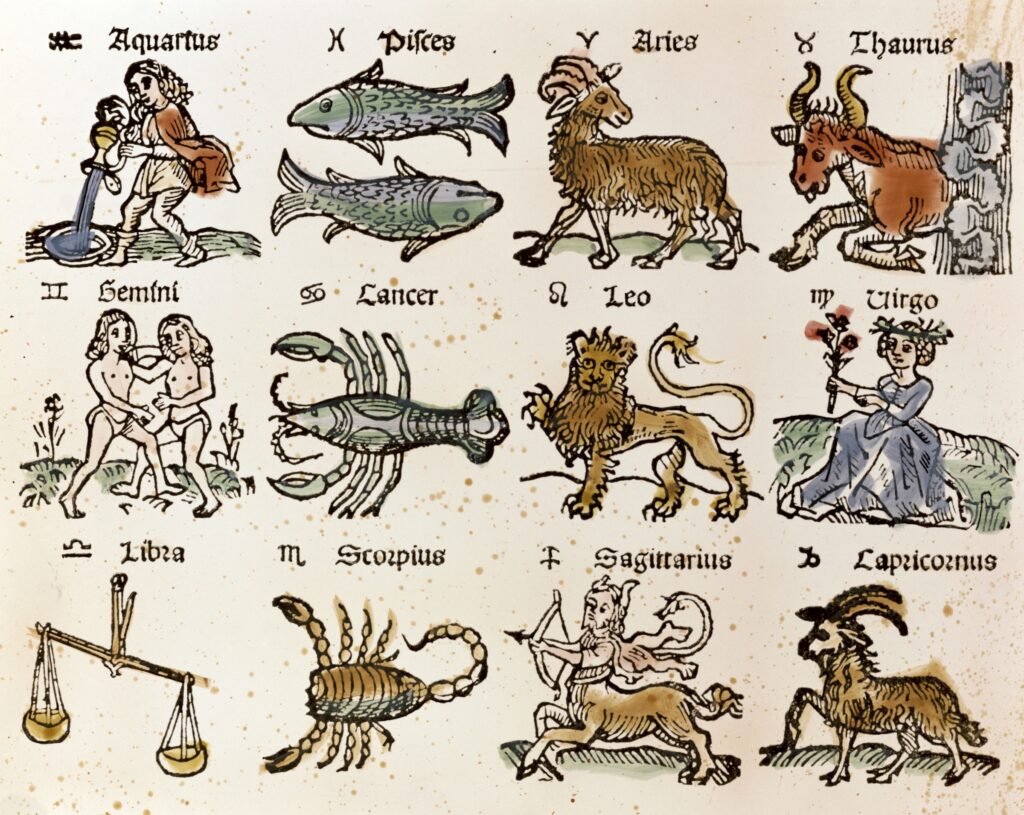
Gender
All diurnal signs (a Aries, c Gemini, e Leo, g Libra, i Sagittarius, k Aquarius ) are masculine, while all nocturnal signs (b Taurus, d Cancer, f Virgo, h Scorpio, j Capricorn, l Pisces ) are feminine.
This classification is primarily used in horary astrology for determining the gender of unborn children and identifying thieves. In geomancy, the figures are also divided into male and female according to their associated zodiac signs, with certain exceptions:
- Although Puella (literally “Girl”) is linked to the male sign of g Libra, it is by default considered a significator of women. This is a case where the fundamental meaning of the figure overrides the gender implication of the sign. However, if the question does not involve determining gender, Puella can also represent men.
- Although Amissio is associated with the female sign of b Taurus, in questions concerning the gender of a future child it indicates a boy.
- In some charts, additional significators appear, and certain figures traditionally point to individuals of a specific gender in relevant questions: Rubeus may signify a husband, despite being linked to the female sign of h Scorpio, while Tristitia may signify a grandmother, even though it is associated with the male sign of k Aquarius.
Quadruplicities (Modes)
Quadruplicities are a classification of the twelve signs into three groups of four signs each, reflecting the quality and dynamic of how a sign’s energy is expressed. In modern astrology, these groups are commonly called modes or modalities. This property of the signs is associated with the speed at which processes unfold and is applicable to phenomena that extend over time.
In ancient astrology, different terms were used:
- Cardinal signs (a Aries, d Cancer, g Libra, j Capricorn) were called movable, convertible, or turning. They are associated with a rapid initiation of action which, however, does not last long.
- Fixed signs (b Taurus, e Leo, h Scorpio, k Aquarius) were referred to as firm or solid. They are characterized by slow, steady, and stable processes.
- Mutable signs (c Gemini, f Virgo, i Sagittarius, l Pisces) were called common or double-bodied. They indicate phenomena that appear and disappear intermittently and have a medium duration. Mutable signs are generally considered less reliable and less inclined toward honesty.
Ptolemy (2nd century CE) explained this through the seasons: the first month of a season (cardinal) represents a sharp transition from the previous one; the second month (fixed) signifies the strengthening and stabilization of the current season; the third month (mutable) reflects fluctuations between the current season and the coming one.
Traditional astrologers used quadruplicities to assess the general quality of energy: a predominance of cardinal signs indicated a greater number of changes; fixed signs pointed to stability; mutable signs suggested fluctuation and inconsistency.
If a planet were in a fixed sign, it denotes everything fixed [and] stable. And if it were in a movable one, it will be transformed. And if it were in a common one, it signifies a stable thing, partly [stable] and partly changeable.
If planets were in fixed signs, they signify fixity—that is, firmness and the stability of matters concerning which the question comes to be. And if they were in common signs, they signify the loosenings of matters and repetitions, and other things will be attached to that matter (or some such other thing). And if they were in movable signs, they signify the speed of the conversions or changes of matters into good or evil.
Examples of Application
- A question about relationships. The significator of the lover in the question “How long will N hate me?” is in a movable sign. The answer: the resentment will fade soon; the anger will not last long.
- A question about litigation, a sporting contest, or military action. The significator of the opponent or adversary is in a fixed sign. Regardless of the outcome, the opposing party will stand firm and has no intention of giving up.
- A question concerning the nature of an illness. The significator of the disease is in a mutable sign. The illness will become chronic, with alternating periods of exacerbation and remission.
Double-Bodied Signs
Firm (mutable) signs are also known as double-bodied. These signs indicate that the object of the question is not singular, but at least more than one.
The double-bodied signs are exclusively c Gemini, f Virgo, i Sagittarius, l Pisces, which correspond to all the figures ruled by B Mercury and K Jupiter: Albus, Conjunctio, Acquisitio, Lætitia.
Examples of Application
- If one of the above figures represents business or work, then it indicates two or more directions of activity, multiple sources of income, or combining a main job with side work (“working on two fronts”).
- In questions about quantity (how many children, thieves, etc.) → more than one.
- When the question concerns “we” (a couple or group) and the figure in the first house corresponds to a double-bodied sign, this is strong testimony that the first house refers to the couple or group rather than to a single individual.
Triplicities (Elements)
Triplicities are a classification of the twelve signs into four groups of three signs each, which were known as trigons or triangles, indicating their association with the four elements: fire, earth, air, and water.
- The fire element includes a Aries, e Leo, and i Sagittarius.
- The earth element includes b Taurus, f Virgo, and j Capricorn.
- The air element includes c Gemini, g Libra, and k Aquarius.
- The water element includes d Cancer, h Scorpio, and l Pisces.
Each element is characterized by a specific combination of qualities. Fire signs—hot and dry; earth signs are considered cold and dry; air signs—hot and moist; water signs—cold and moist. These qualities are used to describe natural conditions and material circumstances.
The element of a sign is applied when determining weather characteristics, the location of people or objects, as well as when considering questions related to life direction and destiny.
Examples of Application
- Suppose it is winter. I ask: “What will the weather be like in my area in ten days?” We see the figure Fortuna Major, which is associated with the fire sign of e Leo. This means the weather will be warm and dry, as far as that is possible for winter.
- A figure indicating a lost object forms a company with another figure. This accompanying figure is associated with an earth sign, suggesting that the search should be conducted on the ground or close to it.
- In the question “Is it destined for me to become a pilot?” we see the figure Amissio, which corresponds to the earth sign of b Taurus. Earth is opposite to air. Answer: no, it is not destined.
Temperament
Humane and Bestial Signs
The air signs (c Gemini, g Libra, k Aquarius) and f Virgo are humane (courteous) signs, while a Aries, b Taurus, e Leo, i Sagittarius, and j Capricorn—are bestial signs (sometimes called quadrupedal or four-footed signs). Among these, e Leo is always feral, while i Sagittarius can sometimes exhibit feral behaviour.
On the “Regal” Misconception of e Leo
Some modern and ancient sources describe the sign of e Leo as “regal”. This is a common and persistent error, in which astrologers or geomancers confuse the inherent qualities of the sign with those of its ruling planet.
The sign of e Leo is unequivocally bestial and feral. Regality belong to the A Sun and to the fixed star Regulus, not to the sign itself.
It is impossible for a sign to be simultaneously feral and regal.
Example of Application
In a question like “How will my boss react if I refuse extra unpaid work?”:
- Humane sign: reasonable, courteous, civilised response.
- Bestial sign: brutish, uncivilised, animal-like reaction.
- Feral sign: wild, aggressive, uncontrolled outburst—like a savage beast.
Commanding and Obeying Signs
The signs are divided into northern and southern according to the position of the ecliptic relative to the celestial equator.
From the vernal equinox (0° a) through to the autumnal equinox (0° g), the ecliptic lies north of the celestial equator; the six signs occupying this portion (a Aries, b Taurus, c Gemini, d Cancer, e Leo, f Virgo) are therefore called northern signs and traditionally described as commanding.
From the autumnal equinox through to the next vernal equinox, the ecliptic lies south of the celestial equator; the six signs in this portion (g Libra, h Scorpio, i Sagittarius, j Capricorn, k Aquarius, l Pisces) are called southern signs and traditionally described as obeying.
This division is used in questions involving subordination or hierarchy and sometimes in questions concerning relationships.
Examples of Application
- In the question “Will my son obey his stepfather?”, the child is represented by the figure Amissio, corresponding to the commanding sign b Taurus. The answer: he will not be obedient.
- If a married couple is signified by figures that correspond to commanding signs, this may indicate problems in the relationship, because each partner will tend to seize the initiative and try to pull the blanket to their own side.
Violent Signs
a Aries and h Scorpio are traditionally regarded as violent signs, inclined toward manifestations of violence in its various forms—physical, emotional, and sexual.
Mutilation
a Aries, b Taurus, e Leo, and l Pisces are considered maimed signs. This classification is based on the descriptions of the drawings of the corresponding constellations in stellar atlases and catalogs:
- The limbs of a Aries in the sign’s image are cut off close to the hooves.
- The body of b Taurus in the sign’s image is depicted only halfway—that is, it represents merely half a bull, severed along the midline.
- The limbs of e Leo in the sign’s image are cut off close to the paws with claws.
- l Pisces are classed among the maimed signs due to their complete lack of limbs.
This quality is useful in physical descriptions of anything to which the concept of “limbs” can be applied—not only people and animals.
Example of Application
- A figure representing a kitchen table in one of the maimed signs? Look for problems with its legs.
Vocality
Water signs (d Cancer, h Scorpio, l Pisces) are considered mute. c Gemini, f Virgo, and g Libra are loud-voiced signs, with c Gemini additionally regarded as an eloquent sign or, as it was traditionally described, the sign of natural orators. a Aries, b Taurus, e Leo, and i Sagittarius are half-voiced signs. j Capricorn and k Aquarius are weak-voiced signs.
This division is useful in questions where the quality or presence of voice is significant.
Examples of Application
- “Am I destined to become a singer?”
- “How will my public speech or presentation go?”
- “Will she reveal my secret?”
- “Will my child start speaking this year?”
Fertility
Water signs (d Cancer, h Scorpio, l Pisces) are considered fertile, whereas c Gemini, e Leo, and f Virgo are barren. The remaining six signs are classified as neutral.
This classification primarily finds application in questions concerning pregnancy and the fertility of the land. However, the same principle of growth or barrenness may be analogically applied to financial matters, indicating whether investments are inclined to increase in value or, conversely, to decline and stagnate.
Ascension
From astronomical observation, the signs from j Capricorn to c Gemini (inclusive) rise at a steeper (more acute) angle to the horizon than the signs from d Cancer to i Sagittarius (inclusive). Consequently:
The first group (j Capricorn, k Aquarius, l Pisces, a Aries, b Taurus, c Gemini) are termed signs of oblique ascension and, because a steep angle allows less time for the Earth’s rotation to bring the full sequence of signs above the horizon, they rise more quickly. Hence they are also called signs of short ascension.
The second group (d Cancer, e Leo, f Virgo, g Libra, h Scorpio, i Sagittarius) rise at a flatter angle to the horizon, taking longer for each sign to fully ascend. They are therefore called signs of long ascension (also known as signs of direct ascension).
Signs of short or long ascension indicate that the significator rises quickly or slowly, where this property is applicable within the context of the question.
Examples of Application
- “How will our ascent of the mountain proceed?” If the figure signifying the undertaking is in a sign of short ascension, the answer is: swiftly.
- “How will my career unfold?” If the figure signifying the career is in a sign of long ascension, the answer is: slowly, with delays.